

- 100% accuracy of data
- 24/7 scientific support
- 0% tolerance in quality of product
Mutagenicity assessment (ICH M7)
Potentially mutagenic impurity (ICH M7 Class 1–3).
N-nitroso compound: ICH M7 cohort of concern.Stock Locations
- New Jersey, USA
- Czech Republic, EU
* Stock subject to availability.
Documentation
Includes: HPLC, MASS/LC-MS, 1H NMR, FT-IR, Potency, Structure Elucidation Report (SER), and additional analytical data depending on the product.
Acalabrutinib Nitroso Impurity 1
● In Stock
| Catalogue No.: | VE0026048 |
|---|---|
| CAS No.: | N/A |
| Mol. Formula: | C22H20N8O2 |
| Mol. Weight: | 428.45 g/mol |
For laboratory use only: analytical, development and regulatory purposes. Supplied in mg quantities. Not for human or veterinary use.
Request a quote for a set
- Request quote for this set
All nitrosamine impurities of Acalabrutinib
6 productsSee the 6 products
- Acalabrutinib Nitroso Impurity 1 VE0026048
- Acalabrutinib Nitroso Impurity 2 VE0023820
- Acalabrutinib Nitroso Impurity 3 VE0026046
- Acalabrutinib Nitroso Impurity 4 VE0026047
- Acalabrutinib Nitroso Impurity 5 VE0026049
- 4-(8-amino-3-(1-nitrosopyrrolidin-2-yl)imidazo[1,5-a]pyrazin-1-yl)-N-phenylbenzamide VE0028292


Additional information on Acalabrutinib Nitroso Impurity 1
| Parent drug | Acalabrutinib |
|---|---|
| Product type | Impurity standards, Nitroso impurities |
| IUPAC name | (S)-4-(8-Amino-3-(1-nitrosopyrrolidin-2-yl)imidazo[1,5-a]pyrazin-1-yl)-N-(pyridin-2-yl)benzamide |
| SMILES | O=C(NC1=NC=CC=C1)C2=CC=C(C3=C4C(N)=NC=CN4C([C@@H]5N(N=O)CCC5)=N3)C=C2 |
| InChI | InChI=1S/C22H20N8O2/c23-20-19-18(27-21(29(19)13-11-25-20)16-4-3-12-30(16)28-32)14-6-8-15(9-7-14)22(31)26-17-5-1-2-10-24-17/h1-2,5-11,13,16H,3-4,12H2,(H2,23,25)(H,24,26,31)/t16-/m1/s1 |
| InChIKey | VKRMETRPBXBPIB-MRXNPFEDSA-N |
| CHNS Ratio (%) (calculated) | C 61.67 · H 4.71 · N 26.15 · S 0.00 |
| Description | Acalabrutinib Nitroso Impurity 1 is a structurally defined nitrosamine related to acalabrutinib, with molecular formula C22H20N8O2 and molecular weight 428.45 g/mol. The nitrogenous nitroso functionality places this impurity within a class of compounds evaluated for mutagenic and potentially carcinogenic risk under ICH M7 frameworks. Its occurrence is typically associated with nitrosating conditions during synthesis, purification, or storage, especially where secondary amine precursors and nitrite sources coexist. Determination generally requires orthogonal high-sensitivity methods such as LC-MS/MS and high-resolution LC-MS, often supported by GC-MS when volatility and stability permit. |
Request a Quote
"*" indicates required fields
Other products related to Acalabrutinib and Nitroso impurities
| Impurity structure | Name of Impurity | Catalogue No. |
|---|---|---|
| 2-methyl-4-oxo Acalabrutinib Impurity | VE0023231 | |
| 4-(8-amino-3-(1-nitrosopyrrolidin-2-yl)imidazo[1,5-a]pyrazin-1-yl)-N-phenylbenzamide | VE0028292 | |
| 4-(8-amino-3-(3,4-dihydro-2H-pyrrol-5-yl)imidazo[1,5-a]pyrazin-1-yl)-N-(pyridin-2-yl)benzamide | VE0023232 | |
| Acalabrutinib Impurity 1 | VL5060003 | |
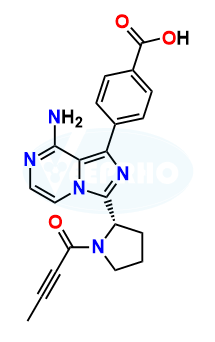 | Acalabrutinib Impurity 2 | VE0011635 |
 | Acalabrutinib Impurity 3 | VE0011636 |
 | Acalabrutinib Impurity 4 | VE0011637 |
 | Acalabrutinib Impurity 5 | VE0011638 |
 | Acalabrutinib Impurity 6 | VE0011641 |
 | Acalabrutinib Impurity 7 | VE0011643 |
 | Acalabrutinib Impurity 8 | VE0011652 |
 | Acalabrutinib Impurity 9 | VE0011653 |
Show all related products N-Nitroso Acalabrutinib impurities (5)