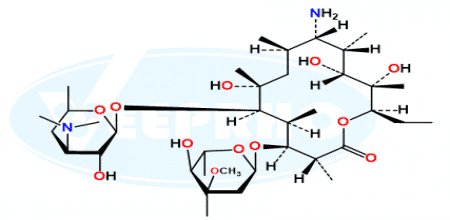
Dirithromycin is a macrolide glycopeptide antibiotic. Dirithromycin is a more lipid-soluble prodrug derivative of 9S-erythromycyclamine prepared by condensation of the latter with 2-acetaldehyde. The API is synthesized as a low melting, white to off-white crystalline powder with enhanced lipophilicity relative to the parent erythromycin derivatives, which promotes improved membrane permeability and tissue distribution in preclinical studies. Chemically the molecule is designed to undergo in vivo hydrolysis to the active 9S-erythromycyclamine species; the active metabolite exerts antibacterial activity by reversible binding to the 50S ribosomal subunit and inhibiting protein synthesis. For development and quality control, common characterization methods include HPLC with UV detection for assay and related substances, LC-MS for impurity profiling and identity confirmation, DSC and XRPD for polymorph screening, and Karl Fischer titration for water content. The substance is practically insoluble in water and soluble in common organic solvents such as methanol and acetonitrile; typical storage conditions for the API are cool, dry and protected from light to minimize degradation.
Parent: Dirithromycin

Parent: Dirithromycin

Parent: Dirithromycin

Parent: Dirithromycin
Typical related compounds and potential impurities observed during synthesis and storage include unreacted 9S-erythromycyclamine, acetaldehyde adduct variants, erythromycin-like ring-opened or epimerized products, N-oxide species, desmethyl analogs and process-related residual solvents and reagents. A representative quality control specification applied by manufacturers frequently sets limits such as individual specified impurities not greater than 0.5 to 1.0 percent by area or weight depending on the impurity structural risk, any unspecified impurity not greater than 0.10 percent, and total impurities not to exceed approximately 2.0 percent. Water content is typically controlled to under 0.5 percent by KF and residual solvents are restricted in accordance with ICH Q3C classification and limits. Stability-monitoring includes periodic profiling by validated HPLC and LC-MS methods to ensure impurity profiles remain within acceptance criteria through the proposed shelf life.
Dirithromycin is developed as an oral macrolide antibiotic prodrug intended to deliver the active erythromycyclamine species systemically; its intended use is to treat bacterial infections susceptible to macrolide-class agents by inhibiting bacterial protein synthesis via the 50S ribosomal subunit.
Dirithromycin is a lipid-soluble prodrug that is converted in vivo by hydrolysis to the active 9S-erythromycyclamine metabolite; the released metabolite binds to the 50S bacterial ribosome and blocks protein elongation.
Assay and related substances are commonly measured by reversed-phase HPLC with UV detection for routine QC; LC-MS is employed for identification and structural confirmation of impurities; additional techniques such as NMR, DSC and XRPD support identity, purity and polymorph characterization.
Typical quality limits used in manufacturing specifications include individual specified impurity limits in the range of 0.5 to 1.0 percent depending on impurity risk, unspecified impurities limited to about 0.10 percent, and total impurities generally capped near 2.0 percent; water and residual solvents are controlled per KF and ICH Q3C respectively.
Store dirithromycin API in a cool, dry environment protected from light and moisture, in airtight containers; follow validated storage conditions from stability studies with humidity and temperature control to limit impurity formation.


