Imidazole is an organic compound with the formula (CH)₃N. It is a white or colourless solid that is soluble in water, producing a mildly alkaline solution. It can be classified as a heterocycle, specifically as a diazole. Many natural products, especially the amino acid histidine and its decarboxylation product histamine, contain imidazole rings. Additional technical information: imidazole has the empirical formula C3H4N2 and a molecular weight of 68.08 g mol and a conjugate acid pKa near 7.0, it exhibits tautomerism between the two nitrogen sites, participates as a common ligand in coordination chemistry, acts as a nucleophilic catalytic base in organic synthesis, and is widely used as a buffer component in biochemical assays and as a precursor or structural motif in pharmaceutical and agrochemical agents.

Parent: Imidazole Working Standard (Secondary Reference Standard)

Parent: Imidazole / Metronidazole
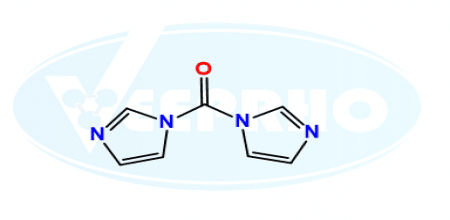
Parent: Rivaroxaban/ Imidazole
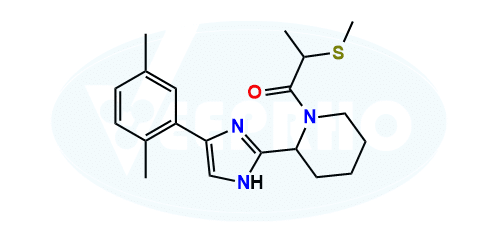
Parent: Imidazole

Parent: Imidazole

Parent: Imidazole
![1-[(4S)-2-(4-fluoro-3,5-dimethylphenyl)-4-methyl-4,5,6,7-tetrahydropyrazolo[4,3-c]pyridin-3-yl]-3-(4-fluoro-1-methylindazol-5-yl)imidazol-2-one](https://veeprho.com/wp-content/uploads/2026/10/1-4S-2-4-fluoro-35-dimethylphenyl-4-methyl-4567-tetrahydropyrazolo43-cpyridin-3-yl-3-4-fluoro-1-methylindazol-5-ylimidazol-2-one-2212022-56-3-VZA000069.png "1-[(4S)-2-(4-fluoro-3,5-dimethylphenyl)-4-methyl-4,5,6,7-tetrahydropyrazolo[4,3-c]pyridin-3-yl]-3-(4-fluoro-1-methylindazol-5-yl)imidazol-2-one")
Parent: Imidazole

Parent: Imidazole

Parent: Imidazole
Commercial and pharmaceutical grades of imidazole are typically supplied with analytical specifications to control related substances and inorganic residues; a common specification is assay greater than or equal to 99.0 percent by GC or titration, individual related organic impurities such as 2 methylimidazole, 4(5) methylimidazole or 2 ethylimidazole controlled to not more than 0.5 percent each, total related substances not to exceed 1.0 percent, residual solvents below 0.1 percent w w where applicable, water content commonly limited to 0.5 percent by Karl Fischer, heavy metals typically specified below 10 ppm, and inorganic anions and ash specified at low levels (for example chloride or sulfate below about 50 ppm); tighter limits may be applied for pharmaceutical use depending on the monograph or customer requirement.
Imidazole itself is primarily a chemical building block and reagent rather than a marketed single drug product; however the imidazole ring is a core structural element in many therapeutic agents, notably several antifungal drugs and enzyme inhibitors, and is used in buffers, protein purification (as an imidazole eluent for histidine tagged proteins), coordination chemistry and synthetic chemistry.
Imidazole refers to a heterocyclic chemical scaffold rather than a single pharmacological class; in clinical contexts the term imidazoles often denotes imidazole derived azole antifungals and other drug families that incorporate the imidazole ring such as certain histamine H2 receptor antagonists and enzyme inhibitors.
Imidazole is not a single type of drug; it is a chemical motif present in diverse drug types including antifungals, receptor antagonists, enzyme modulators and small molecule ligands; the pharmacology depends on the substitution pattern on the imidazole core.
Yes, imidazole is aromatic; the ring system is planar and contains six pi electrons distributed over the five atom ring in accordance with Hückel aromaticity, with one nitrogen lone pair contributing to the aromatic sextet and the other nitrogen acting as a protonatable site.


