
Naratriptan Impurities
Request a quote for a set
- Request quote for this set
All USP impurities of Naratriptan
5 productsSee the 5 products
- Bisaryl Naratriptan VE009124
CAS 1346604-16-7 - Naratriptan Inhouse Impurity B VE008860
CAS 121679-20-7 - Naratriptan Pyridinium Salt VE0028446
CAS 1638617-36-3 - Naratriptan Related compound A (HCl Salt) VE0021674
CAS 1956385-76-4 - Naratriptan Related Compound B (Oxalate Salt) VE0021694
CAS 121679-21-8
- Bisaryl Naratriptan VE009124
- Request quote for this set
All nitrosamine impurities of Naratriptan
7 productsSee the 7 products
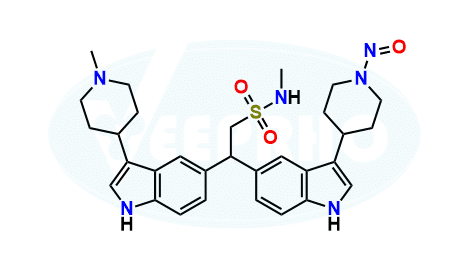
- N-methyl-2-(3-(1-methylpiperidin-4-yl)-1H-indol-5-yl)-2-(3-(1-nitrosopiperidin-4-yl)-1H-indol-5-yl)ethanesulfonamide VE0018724
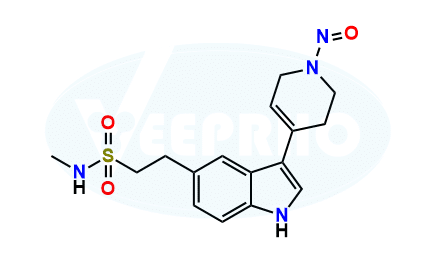
- N-methyl-2-(3-(1-nitroso-1,2,3,6-tetrahydropyridin-4-yl)-1H-indol-5-yl)ethanesulfonamide VE0018722
- N-Nitroso Naratriptan VE0021679
CAS 1216880-64-6 - N-Nitroso Naratriptan (Chloride Salt) VE0018721
- 2,2′-(3-(1-nitrosopiperidin-4-yl)-1H-indole-1,5-diyl)bis(N-methylethanesulfonamide) VE0018728
- 4-(1,5-bis(2-(N-methylsulfamoyl)ethyl)-1H-indol-3-yl)-1-nitrosopyridin-1-ium VE0018730
- 4-(5-(2-(N-methylsulfamoyl)ethyl)-1H-indol-3-yl)-1-nitrosopyridin-1-ium VE0018729




1–33 of 33 results33 in stock


Naratriptan Related Compound
Impurities in naratriptan arise primarily from its multi-step chemical synthesis and degradation under environmental conditions. All impurities must meet ICH Q3A/B regulatory standards and pharmacopeial requirements (e.g., EP, USP) to ensure product safety and efficacy.
Types of Impurities in Naratriptan
Process-Related Impurities
- Unreacted starting materials such as substituted indoles or amines
- By-products from amide formation or sulfonamide coupling
- Residual solvents like methanol, isopropanol, or dichloromethane
Degradation Impurities
- Hydrolyzed amide or sulfonamide derivatives
- Oxidative degradation products (especially under light or heat exposure)
- Impurities due to pH instability in formulations
Elemental Impurities
- Trace metals from catalysts (e.g., palladium or platinum-based)
- Must comply with ICH Q3D limits
Analytical Techniques for Impurity Detection
- High-Performance Liquid Chromatography (HPLC) – main method for related substances
- Liquid Chromatography–Mass Spectrometry (LC-MS) – for identifying unknown or low-level impurities
- Gas Chromatography (GC) – for quantifying residual solvents
- ICP-MS – for elemental impurities
FAQ
What is Naratriptan used for?
Naratriptan is used to treat migraine attacks in adults. It is not intended for migraine prevention or for treating other types of headaches.
How does Naratriptan work?
It stimulates 5-HT₁B/1D receptors, causing vasoconstriction of dilated cranial blood vessels and blocking the release of neuropeptides involved in migraine pathophysiology.
What are the common side effects of Naratriptan?
Dizziness or fatigue Nausea Sensation of pressure or tightness (usually chest or throat) Rare: Serotonin syndrome when combined with other serotonergic drugs
Can Naratriptan be used during pregnancy?
It should only be used if clearly needed and prescribed by a healthcare provider. Safety data in pregnancy is limited.
How is Naratriptan different from Sumatriptan?
Naratriptan has a slower onset but a longer duration of action, making it suitable for migraines with prolonged symptoms or recurrence.