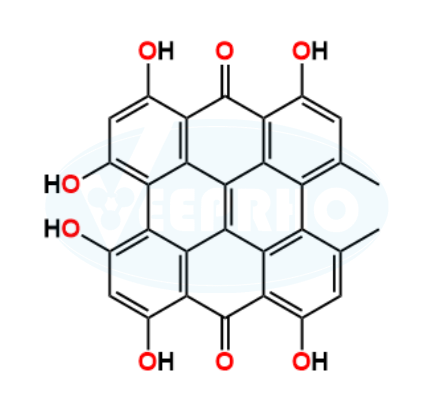
Hypericin is a carbopolycyclic compound derived from bisanthene with antidepressant properties, found in various Hypericum species, and is being studied for treating cutaneous T-cell lymphoma. Opinions differ on the extent to which hypericin exhibits antiviral, antitumor and photosensitizing activities; mechanistic data show it is a highly conjugated polycyclic anthrone-based pigment (empirical formula C30H16O8, MW 504.45 g mol-1) with strong absorption in the visible region and potent photosensitizer behavior under light exposure. It is lipophilic and sparingly soluble in water, more soluble in polar organic solvents such as dimethyl sulfoxide and dimethylformamide, and it readily forms noncovalent complexes with lipids and proteins. In vitro and preclinical studies report generation of singlet oxygen and other reactive oxygen species upon illumination, modulation of certain kinase pathways, and interactions with nucleic acids and membranes; however, cellular effects are context dependent and influenced by formulation, light dose, and coexisting Hypericum constituents such as pseudohypericin and hyperforin.
Typical chromatographic profiles from Hypericum extracts and isolated hypericin standards show related bisanthrone congeners and photo precursors as the main related compounds and impurities. Pseudohypericin commonly appears at levels ranging from trace amounts up to about 0.5 to 5 percent relative to hypericin depending on extraction and cultivar, protohypericin is often detected at trace to approximately 1 percent where samples have been protected from or exposed to light, and other minor bisanthrones and oxidative degradation products together can account for 0.1 to 3 percent. For research and reference materials, isolated hypericin batches typically report HPLC assay purities in the range of 90 to 98 percent; individual unspecified impurities are commonly controlled below 0.5 percent and total impurities below 5 percent for nonclinical materials, with pharmaceutical grade specifications set tighter depending on regulatory requirements. Stability is sensitive to light and oxygen, so observed impurity profiles vary with storage, solvent, and processing conditions.
Hypericin is used primarily as a research compound and analytical reference for studying Hypericum extracts, photodynamic effects, and potential bioactivities. Clinically, Hypericum perforatum extracts that contain hypericin have been used as herbal antidepressants, and hypericin itself is under investigation for photodynamic therapy applications and as an experimental agent in studies of cutaneous T cell lymphoma and antiviral activity; therapeutic use of isolated hypericin requires controlled formulation and clinical validation.
Hypericin and hyperforin are distinct bioactive constituents found in Hypericum species. Hypericin is a polycyclic bisanthrone pigment with photosensitizing and lipophilic properties, whereas hyperforin is a phloroglucinol derivative with a different chemical scaffold, markedly higher lipophilicity, and activity linked to modulation of neurotransmitter uptake and ion channels. They differ in solubility, chromatographic behavior, and biological targets, and each contributes differently to the pharmacology and analytical profile of St John’s wort preparations.