
- 100 % Datengenauigkeit
- Wissenschaftlicher Support rund um die Uhr
- 0 % Toleranz bei der Produktqualität
Lagerstandorte
- New Jersey, USA
- Tschechien, EU
* Bestand vorbehaltlich Verfügbarkeit.
Dokumentation
Enthält: HPLC, MASS/LC-MS, 1H-NMR, FT-IR, Gehalt, Structure Elucidation Report (SER) sowie zusätzliche analytische Daten je nach Produkt.
152302-45-9
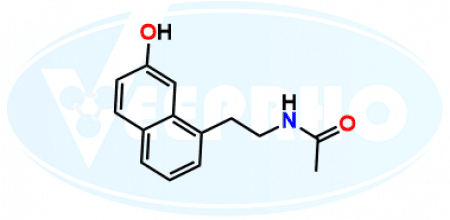
Agomelatine Desmethyl Impurity
● Under Development
| Katalog-Nr.: | VL1840009 |
|---|---|
| CAS-Nr.: | 152302-45-9 |
| Summenformel: | C14H15NO2 |
| Molare Masse: | 229.28 |
For laboratory use only: analytical, development and regulatory purposes. Supplied in mg quantities. Not for human or veterinary use.
Zusätzliche Informationen zu CAS 152302-45-9
| Wirkstoff | Agomelatine |
|---|---|
| Produkttyp | Verunreinigungsstandards |
| IUPAC-Name | N-[2-(7-Hydroxy-1-naphthalenyl)ethyl]acetamide |
| SMILES | CC(=O)NCCc1cccc2ccc(O)cc12 |
| InChIKey | UNTZQBYXDYYXIY-UHFFFAOYSA-N |
| CHNS-Verhältnis (%) (berechnet) | C 73.34 · H 6.59 · N 6.11 · S 0.00 |
| Referenzen | Liu | Yaxuan | et al. “Quantification and Structural Elucidation of Potential Impurities in Agomelatine Active Pharmaceutical Ingredient.â€Â Journal of Pharmaceutical and Biomedical Analysis | vol. 81-82 | July 2013 | pp. 193–201 |  https://doi.org/10.1016/j.jpba.2013.04.016. Somana | Siva | et al. “QBD BASED ANALYTICAL METHOD DEVELOPMENT and VALIDATION for the SEPARATION and QUANTIFICATION of AGOMELATINE and ITS IMPURITIES in SOLID ORAL DOSAGE FORMS USING HPLC.†Rasayan J. Chem | vol. 14 | no. 3 | 2183 | p. 2 |
| Beschreibung | Agomelatine Desmethyl Impurity, CAS 152302-45-9, ist das N-demethylierte Analogon von Agomelatin und eine strukturverwandte prozessbedingte Verunreinigung, die aus unvollständiger Methylierungssteuerung oder metabolischer N-Dealkylierung hervorgehen kann. Mit der Summenformel C14H15NO2 und einer Molekülmasse von 229,28 behält sie das aminomethylierte Arylacetamid-Grundgerüst der Muttersubstanz bei, jedoch ohne einen Methylsubstituenten am Amidstickstoff. Für die Charakterisierung sind meist orthogonale chromatographische und spektrometrische Verfahren erforderlich, einschließlich LC-MS/MS zur Spurenidentifizierung sowie LC-UV oder HPLC mit Referenzvergleich zur Quantifizierung. In der regulatorischen Impuritätsbewertung wird ihr Ursprung und Gehalt innerhalb substanzspezifischer Kontrollstrategien beurteilt. |
Angebot anfordern
"*" kennzeichnet Pflichtfelder
Weitere Produkte zu Agomelatine Verunreinigungen
| Struktur der Verunreinigung | Name der Verunreinigung | Katalog-Nr. |
|---|---|---|
| 7-Methoxy-1-naphthylacetonitrile | VE0022473 | |
| Agomelatine 3 Hydroxy Impurity | VL1840005 | |
| Agomelatine Amide Impurity | VL1840011 | |
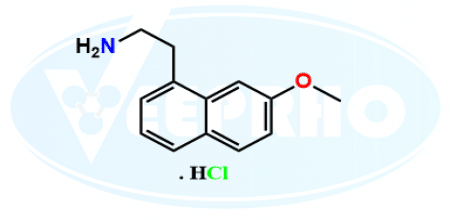 | Agomelatine Desacetyl Impurity | VL1840012 |
| Agomelatine Desmethyl 3 Hydroxy Impurity | VL1840010 | |
| Agomelatine Diacetyl Impurity | VL1840003 | |
| Agomelatine Dimer Acetamide | VL1840007 | |
| Agomelatine Dimer Urea | VL1840008 | |
| Agomelatine Impurity 1 | VL1840004 | |
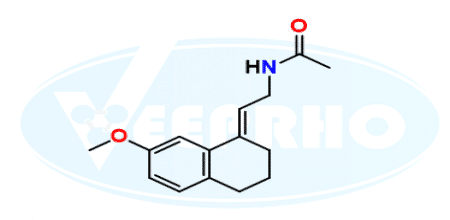 | Agomelatine Impurity 2 | VL1840001 |
| Agomelatine Impurity 6 | VE0012033 | |
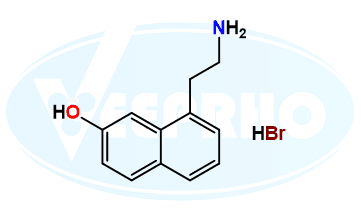 | Agomelatine Impurity 7 HBr | VE0012035 |
Alle verwandten Produkte zeigen N-Nitroso-Agomelatine-Verunreinigungen (2)