
- 100 % Datengenauigkeit
- Wissenschaftlicher Support rund um die Uhr
- 0 % Toleranz bei der Produktqualität
Lagerstandorte
- New Jersey, USA
- Tschechien, EUAuf Lager
* Bestand vorbehaltlich Verfügbarkeit.
Dokumentation
Enthält: HPLC, MASS/LC-MS, 1H-NMR, FT-IR, Gehalt, Structure Elucidation Report (SER) sowie zusätzliche analytische Daten je nach Produkt.
58-55-9
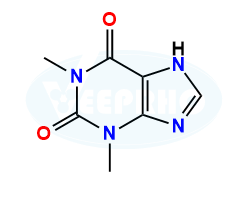
Caffeine EP Impurity A
● Auf Lager
| Katalog-Nr.: | VL3710003 |
|---|---|
| CAS-Nr.: | 58-55-9 |
| Summenformel: | C7H8N4O2 |
| Molare Masse: | 180.16 g/mol |
For laboratory use only: analytical, development and regulatory purposes. Supplied in mg quantities. Not for human or veterinary use.
Zusätzliche Informationen zu CAS 58-55-9
| Wirkstoff | Caffiene / Pentoxifylline / Diprophylline / Dimenhydrinate |
|---|---|
| Produkttyp | Verunreinigungsstandards |
| IUPAC-Name | 1,3-Dimethyl-3,7-dihydro-1H-purine-2,6-dione |
| Name im EP | Caffeine EP Impurity A / Pentoxifylline EP Impurity C/ Dimenhydrinate EP Impurity A/ Diprophylline EP Impurity B |
| Name in der USP | Theophylline |
| Arzneibuch-Synonyme | Pentoxifylline EP Impurity C; Dimenhydrinate EP Impurity A; Diprophylline EP Impurity B; Theophylline |
| Weitere Synonyme | 1,3-Dimethylxanthine; 1,3-dimethyl-7H-purine-2,6-dione |
| SMILES | O=C(N1C)N(C)C2=C(NC=N2)C1=O |
| InChI | InChI=1S/C7H8N4O2/c1-10-5-4(8-3-9-5)6(12)11(2)7(10)13/h3H,1-2H3,(H,8,9) |
| InChIKey | ZFXYFBGIUFBOJW-UHFFFAOYSA-N |
| CHNS-Verhältnis (%) (berechnet) | C 46.67 · H 4.48 · N 31.10 · S 0.00 |
| Versandbedingung | Ambient Temperature |
| Referenzen | Barnes | Peter J. “Theophylline.†American Journal of Respiratory and Critical Care Medicine | vol. 167 | no. 6 | Mar. 2003 | pp. 813–18 | https://doi.org/10.1164/rccm.200210-1142pp. ? |
| Beschreibung | Die als Caffeine EP Impurity A, außerdem als Pentoxifylline EP Impurity C, Dimenhydrinate EP Impurity A, Diprophylline EP Impurity B, Theophyllin und Doxofylline impurity C bezeichnete Substanz ist 1,3-Dimethylxanthin (CAS 58-55-9) mit der Summenformel C7H8N4O2 und einer Molekülmasse von 180,16 g/mol. Sie gehört zur chemischen Klasse der Methylxanthine und kann als prozessbezogene Verunreinigung, Synthesezwischenprodukt oder Abbauprodukt in Purinalkaloiden und Xanthinderivaten auftreten. Die Identifizierung erfolgt typischerweise über stabilitätsindizierende HPLC, LC-MS/MS oder HRMS; zur Strukturabsicherung wird häufig NMR herangezogen. Es handelt sich nicht um ein Nitrosamin, jedoch um eine substanzspezifische, regulatorisch relevante Nebenkomponente. |
Angebot anfordern
"*" kennzeichnet Pflichtfelder