

- 100 % Datengenauigkeit
- Wissenschaftlicher Support rund um die Uhr
- 0 % Toleranz bei der Produktqualität
Lagerstandorte
- New Jersey, USA
- Tschechien, EU
* Bestand vorbehaltlich Verfügbarkeit.
Dokumentation
Enthält: HPLC, MASS/LC-MS, 1H-NMR, FT-IR, Gehalt, Structure Elucidation Report (SER) sowie zusätzliche analytische Daten je nach Produkt.
93106-58-2
Ciprofloxacin Chloro Analog Impurity
● In Stock
| Katalog-Nr.: | VL204008 |
|---|---|
| CAS-Nr.: | 93106-58-2 |
| Summenformel: | C17H18ClN3O3 |
| Molare Masse: | 347.80 g/mol |
For laboratory use only: analytical, development and regulatory purposes. Supplied in mg quantities. Not for human or veterinary use.
Zusätzliche Informationen zu CAS 93106-58-2
| Wirkstoff | Ciprofloxacin |
|---|---|
| Produkttyp | Verunreinigungsstandards |
| IUPAC-Name | 6-Chloro-1-cyclopropyl-1,4-dihydro-4-oxo-7-(1-piperazinyl)-3-quinolinecarboxylic Acid |
| SMILES | O=C(O)c1cn(C2CC2)c2cc(N3CCNCC3)c(Cl)cc2c1=O |
| InChIKey | OSHQUWATYOBFNE-UHFFFAOYSA-N |
| CHNS-Verhältnis (%) (berechnet) | C 58.71 · H 5.22 · N 12.08 · S 0.00 |
| Referenzen | Aksoy, B., et al. “Development and Validation of a Stability-Indicating HPLC Method for Determination of Ciprofloxacin Hydrochloride and Its Related Compounds in Film-Coated Tablets.†Chromatographia, vol. 66, no. S1, June 2007, pp. 57–63, https://doi.org/10.1365/s10337-007-0287-6 ‌Vance-Bryan, Kyle, et al. “Clinical Pharmacokinetics of Ciprofloxacin.†Clinical Pharmacokinetics, vol. 19, no. 6, Dec. 1990, pp. 434–61, https://doi.org/10.2165/00003088-199019060-00003 |
| Beschreibung | Der Ciprofloxacin-Chloroanalog-Verunreinigungsstandard, auch als Ciprofloxacin-6-Chloroanalog oder 6-Desfluoro-6-Chloro-Ciprofloxacin bezeichnet, ist eine halogenierte Fluorchinolon-Prozessverunreinigung mit CAS 93106-58-2. Die Summenformel lautet C17H18ClN3O3 bei einer Molekülmasse von 347,80 g/mol. Strukturell entspricht sie dem Ersatz des 6-Fluor-Substituenten durch Chlor und ist damit ein synthetisch bedingtes Analogon, das aus unvollständiger Fluorierung oder Halogenaustausch während der Herstellung entstehen kann. Für die Identifizierung und Gehaltsbestimmung werden typischerweise LC-MS/MS, HRMS und orthogonale HPLC-Verfahren eingesetzt, ergänzt durch NMR zur Strukturabsicherung. |
Angebot anfordern
"*" kennzeichnet Pflichtfelder
Weitere Produkte zu Ciprofloxacin Verunreinigungen
| Struktur der Verunreinigung | Name der Verunreinigung | Katalog-Nr. |
|---|---|---|
| Ciprofloxacin EP Impurity A | VL204004 | |
| Ciprofloxacin EP Impurity B (HCl Salt) | VL204005 | |
 | Ciprofloxacin EP Impurity B (Hydrochloride Monohydrate Salt) | VE0021151 |
| Ciprofloxacin EP Impurity C (Free Base) | VE007082 | |
| Ciprofloxacin EP Impurity C (HCl Salt) | VL204002 | |
| Ciprofloxacin EP Impurity D | VL204006 | |
| Ciprofloxacin EP Impurity D (Free Base) | VE007083 | |
| Ciprofloxacin EP Impurity E | VL204003 | |
 | Ciprofloxacin EP Impurity E (HCl Salt) | VE0010231 |
| Ciprofloxacin EP Impurity F | VL204001 | |
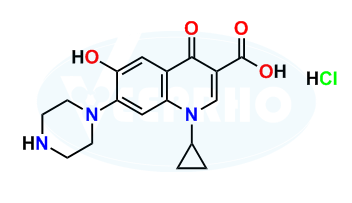 | Ciprofloxacin EP Impurity F (HCl Salt) | VE0021150 |
| N-Nitroso Ciprofloxacin EP Impurity C | VE0024383 |
Alle verwandten Produkte zeigen N-Nitroso-Ciprofloxacin-Verunreinigungen (3)