

- 100 % Datengenauigkeit
- Wissenschaftlicher Support rund um die Uhr
- 0 % Toleranz bei der Produktqualität
Lagerstandorte
- New Jersey, USA
- Tschechien, EU
* Bestand vorbehaltlich Verfügbarkeit.
Dokumentation
Enthält: HPLC, MASS/LC-MS, 1H-NMR, FT-IR, Gehalt, Structure Elucidation Report (SER) sowie zusätzliche analytische Daten je nach Produkt.
105176-70-3
Doxylamine Di-N-Oxide
● In Stock
| Katalog-Nr.: | VL38006 |
|---|---|
| CAS-Nr.: | 105176-70-3 |
| Summenformel: | C17H22N2O3 |
| Molare Masse: | 302.37g/mol |
For laboratory use only: analytical, development and regulatory purposes. Supplied in mg quantities. Not for human or veterinary use.
Zusätzliche Informationen zu CAS 105176-70-3
| Wirkstoff | Doxylamine |
|---|---|
| Produkttyp | Verunreinigungsstandards |
| IUPAC-Name | N,N-Dimethyl-2-[1-phenyl-1-(2-pyridinyl)ethoxy]-ethanamine N,N’-dioxide |
| SMILES | CC(OCC[N+](C)(C)[O-])(c1ccccc1)c1cccc[n+]1[O-] |
| InChIKey | QJKBZZLLRVCOFS-UHFFFAOYSA-N |
| CHNS-Verhältnis (%) (berechnet) | C 67.53 · H 7.33 · N 9.26 · S 0.00 |
| Referenzen | Friedman | H. | et al. “Clearance of the Antihistamine Doxylamine.†Clinical Pharmacokinetics | vol. 16 | no. 5 | May 1989 | pp. 312–16 | https://doi.org/10.2165/00003088-198916050-00003. ?Koren | Gideon | et al. “Effectiveness of Delayed-Release Doxylamine and Pyridoxine for Nausea and Vomiting of Pregnancy: A Randomized Placebo Controlled Trial.†American Journal of Obstetrics and Gynecology | vol. 203 | no. 6 | Dec. 2010 | pp. 571.e1–7 | https://doi.org/10.1016/j.ajog.2010.07.030 |
| Beschreibung | Doxylamin-Di-N-oxid, CAS 105176-70-3, ist die tertiäre Amin-N-oxid-Verunreinigung, die aus der oxidativen Umwandlung des dimethylamino Substituenten von Doxylamin hervorgeht. Mit der Molekülformel C17H22N2O3 und einer Molmasse von 302,37 g/mol entspricht es einer oxidativen Metaboliten- oder Abbau-Spezies und nicht einer Nitrosamin-Verbindung. Die Bildung kann bei Lagerung unter peroxidischen oder photochemischen Bedingungen sowie während oxidativer Syntheseschritte erfolgen. Aufgrund der polaren N-oxid-Funktion sind Retention und Ionisation verändert, weshalb die Charakterisierung typischerweise LC-MS/MS, hochauflösende MS und orthogonale HPLC erfordert. |
Angebot anfordern
"*" kennzeichnet Pflichtfelder
Weitere Produkte zu Doxylamine Verunreinigungen
| Struktur der Verunreinigung | Name der Verunreinigung | Katalog-Nr. |
|---|---|---|
| Doxylamine EP Impurity A | VL38001 | |
| Doxylamine EP Impurity B | VL38002 | |
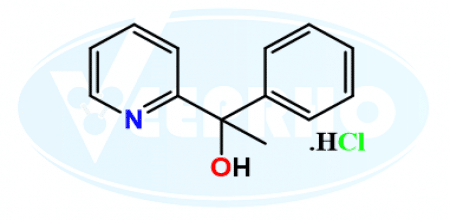 | Doxylamine EP Impurity B (HCl Salt) | VE007036 |
| Doxylamine EP Impurity C (Free Base) | VL38003 | |
| Doxylamine EP Impurity D | VL38004 | |
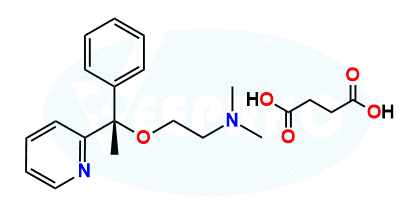 | (S)-Doxylamine Succinate | VE0014668 |
| Doxylamine Impurity 1 | VE0014569 | |
| Doxylamine N-Oxide | VL38005 | |
| Doxylamine Phenyl(pyridin-2-yl)methanol | VL38007 | |
| Doxylamine Pyridinyl N- oxide | VL38008 | |
| N-Desmethyldoxylamine (Succinate Salt) | VE0022470 | |
| N-Methyl-N-(2-(phenyl(pyridin-2-yl)methoxy)ethyl)nitrous amide | VE0025329 |
Alle verwandten Produkte zeigen N-Nitroso-Doxylamine-Verunreinigungen (2)