
Febuxostat-Verunreinigungen
1–40 von 40 Ergebnissen40 auf Lager
| Struktur | Produktname |
|---|---|
| Ethyl 2-(3-formyl-4-hydroxyphenyl)-4-methylthiazole-5-carboxylateCAS-Nr. 161798-01-2 · VE008787 · Auf Lager | |
| Febuxostat 3-Formyl AnalogCAS-Nr. 144060-62-8 · VE008757 · Auf Lager | |
| Febuxostat Amide ImpurityCAS-Nr. 1239233-86-3 · VL730006 · Auf Lager | |
| Febuxostat Bromo ImpurityCAS-Nr. 144060-40-2 · VE008817 · Auf Lager | |
| Febuxostat Diacid ImpurityCAS-Nr. 1239233-87-4 · VL730009 · Auf Lager | |
| Febuxostat Diformyl ImpurityCAS-Nr. 2073891-59-3 · VE0018870 · Auf Lager | |
| Febuxostat Dithiazole Acid ImpurityCAS-Nr. 1330632-48-8 · VE0015997 · Auf Lager | |
| Febuxostat Ethyl EsterCAS-Nr. 160844-75-7 · VE007274 · Auf Lager | |
| Febuxostat Impurity 1VL730004 · Auf Lager | |
| Febuxostat Impurity 2VL730005 · Auf Lager | |
| Febuxostat Impurity 5CAS-Nr. 161798-02-3 · VE0015917 · Auf Lager | |
| Febuxostat Impurity 6CAS-Nr. 1271738-74-9 · VE0015918 · Auf Lager | |
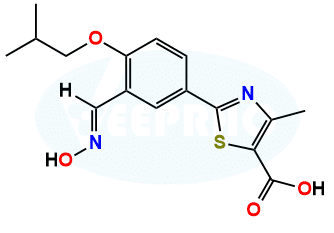 | Febuxostat Impurity 7VE0015919 · Auf Lager |
| Febuxostat Impurity 9CAS-Nr. 407582-48-3 · VE0015920 · Auf Lager | |
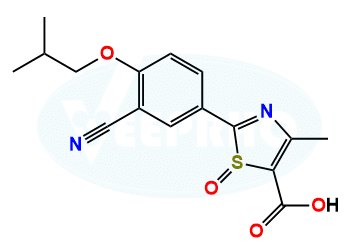 | Febuxostat Impurity 10VE0015921 · Auf Lager |
| Febuxostat Impurity 11VL730008 · Auf Lager | |
| Febuxostat Impurity 19CAS-Nr. 118485-48-6 · VE0015940 · Auf Lager | |
| Febuxostat Impurity 23CAS-Nr. 2476465-06-0 · VE0010677 · Auf Lager | |
| Febuxostat Impurity 25CAS-Nr. 2095166-41-7 · VE0015949 · Auf Lager | |
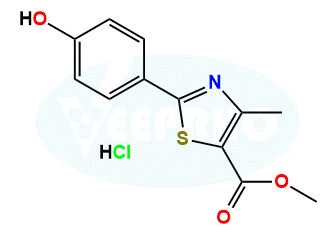 | Febuxostat Impurity 32 (HCl)VE0015950 · Auf Lager |
| Febuxostat Impurity 33CAS-Nr. 144060-97-9 · VE0015951 · Auf Lager | |
| Febuxostat Impurity 34CAS-Nr. 1206550-99-3 · VE0015969 · Auf Lager | |
| Febuxostat Impurity 35CAS-Nr. 1312815-35-2 · VE0015971 · Auf Lager | |
| Febuxostat Impurity 42CAS-Nr. 100118-38-5 · VE0015973 · Auf Lager | |
| Febuxostat Impurity 46CAS-Nr. 528607-60-5 · VE0015976 · Auf Lager | |
| Febuxostat Impurity 47CAS-Nr. 161718-85-0 · VE0015978 · Auf Lager | |
| Febuxostat Impurity 61CAS-Nr. 609-15-4 · VE0017865 · Auf Lager | |
| Febuxostat Impurity 64CAS-Nr. 1330632-46-6 · VE0015975 · Auf Lager | |
| Febuxostat Impurity 67CAS-Nr. 1330632-47-7 · VE0015993 · Auf Lager | |
| Febuxostat Impurity 78CAS-Nr. 1643131-93-4 · VE0015999 · Auf Lager | |
| Febuxostat Impurity 80CAS-Nr. 2375033-26-2 · VE0016000 · Auf Lager | |
 | Febuxostat Impurity VVE005958 · Auf Lager |
| Febuxostat Isopropyl EsterCAS-Nr. 1346238-10-5 · VE008811 · Auf Lager | |
| Febuxostat Isopropyl Ether AnalogCAS-Nr. 144060-52-6 · VE008773 · Auf Lager | |
| Febuxostat Methyl EsterCAS-Nr. 923942-34-1 · VE008815 · Auf Lager | |
| Febuxostat n-Butyl IsomerCAS-Nr. 1657014-33-9 · VE008765 · Auf Lager | |
| Febuxostat sec-Butoxy AcidCAS-Nr. 1335202-59-9 · VE008766 · Auf Lager | |
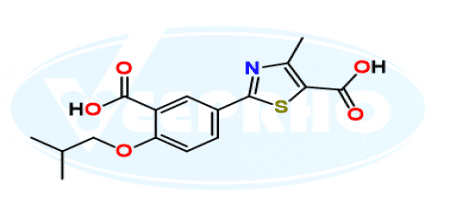 | Febuxostate Impurity CVL730002 · Auf Lager |
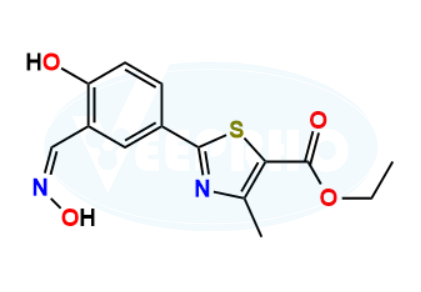 | (Z)-ethyl 2-(4-hydroxy-3-((hydroxyimino)methyl)phenyl)-4-methylthiazole-5-carboxylateVE0021235 · Auf Lager |
| 2-(3-((hydroxyimino)methyl)-4-isobutoxyphenyl)-4-methylthiazole-5-carboxylic acidCAS-Nr. 1350352-70-3 · VE0021236 · Auf Lager |
Febuxostat Related Compound
Impurities in Febuxostat arise due to synthesis, degradation, or storage conditions. These impurities must be within ICH Q3A/Q3B limits to ensure drug purity and safety.
Types of Impurities in Febuxostat
- Process-Related Impurities
- Unreacted intermediates from synthesis
- Residual solvents (e.g., methanol, acetone, ethyl acetate)
- Catalyst residues
- Degradation Impurities
- Oxidative degradation (due to oxygen exposure)
- Hydrolytic degradation (moisture-induced breakdown)
- Photodegradation (light-sensitive changes)
- Elemental Impurities
- Heavy metals (e.g., lead, arsenic, mercury)
- Residual catalysts
Analytical Techniques for Impurity Detection
- High-Performance Liquid Chromatography (HPLC)
- Gas Chromatography (GC)
- Fourier-Transform Infrared Spectroscopy (FT-IR)
Mass Spectrometry (MS)
Häufige Fragen
What is febuxostat used to treat?
Febuxostat is used to treat gout by reducing uric acid levels in the blood. It is prescribed for chronic gout management but not for acute attacks.
Is febuxostat 40 mg safe for kidneys?
Febuxostat can be used in patients with mild-to-moderate kidney disease. However, dose adjustments may be needed in severe renal impairment. It is generally considered safer than allopurinol for patients with kidney problems.
What is the most common side effect of febuxostat?
The most common side effects include joint pain, nausea, liver function abnormalities, and skin rash . It may also increase the risk of cardiovascular events in some patients .
Which is better, allopurinol or febuxostat?
Febuxostat is preferred in patients with kidney disease or allopurinol intolerance , while allopurinol is often the first-line treatment due to its longer safety history and cost-effectiveness. The choice depends on patient-specific factors.