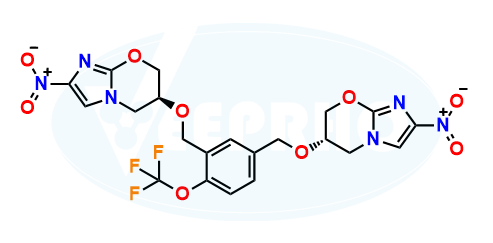
Pretomanid ist ein Antibiotikum zur Behandlung multiresistenter Lungentuberkulose. Es wird im Allgemeinen zusammen mit Bedaquilin und Linezolid angewendet und oral eingenommen. Pretomanid gehört zur chemischen Klasse der Nitroimidazooxazine und ist ein Prodrug, das in Mycobacterium tuberculosis durch die deazaflavinabhängige Nitroreduktase Ddn unter Beteiligung des Cofaktors F420 bioaktiviert wird; dabei entstehen reaktive Stickstoffspezies, die die Mykolsäuresynthese beeinträchtigen und den Atmungsstoffwechsel sowohl unter aeroben als auch unter anaeroben Bedingungen schwächen. Das zugelassene orale Schema im BPaL-Protokoll sieht Pretomanid 200 mg einmal täglich mit Nahrung für den vorgesehenen Behandlungszeitraum vor. Wichtige Entwicklungs- und Anwendungsaspekte umfassen die Gabe zusammen mit Nahrung zur Verbesserung der Exposition, den primären Metabolismus unter Beteiligung von CYP-Enzymen mit Potenzial für Arzneimittelwechselwirkungen, insbesondere mit starken CYP3A-Induktoren, eine terminale Halbwertszeit, die eine einmal tägliche Dosierung unterstützt, sowie die Überwachung auf hepatische Effekte, eine QT-Intervall-Verlängerung bei Kombination mit anderen QT-verlängernden Wirkstoffen und additive Toxizitäten wie periphere Neuropathie bei Anwendung mit Linezolid.
Typical quality specifications for pretomanid drug substance and tablets align with ICH-related-substance and impurity control principles: assay by validated HPLC 98.0 to 102.0 percent; total related substances not more than 1.0 percent by area; any single unspecified impurity not more than 0.2 percent by area; specified known related compounds and degradants set at tighter limits depending on toxicologic qualification for each impurity, for example a primary process-related impurity limited to 0.5 percent, a key oxidative or reduced degradant limited to 0.2 percent, and genotoxic or structurally related nitro-reduction products limited to 0.1 percent or below where warranted by qualification data. Residual solvents are controlled per ICH Q3C with Class 2 solvents below established ppm limits, elemental impurities are controlled per ICH Q3D, and total impurities in finished product are verified by stability studies to remain within specification across shelf life.
Häufige Fragen
What is a pretomanid?
Pretomanid is an oral nitroimidazooxazine-class antibiotic used as part of a combination regimen to treat pulmonary multi-drug-resistant and extensively drug-resistant tuberculosis; it is a prodrug that requires activation by mycobacterial enzymes to exert bactericidal effects against M. tuberculosis.
Is pretomanid a new drug?
Pretomanid received regulatory approval in recent years and is a relatively new treatment option for drug-resistant pulmonary tuberculosis, introduced after clinical trials established efficacy and safety as part of the BPaL regimen with bedaquiline and linezolid.
Is pretomanid available in India?
Availability varies by country and over time; access in India may be limited to national tuberculosis program channels, partner-supported programs, or special access schemes rather than broad retail distribution, so check current Indian regulatory listings and national TB program resources for up-to-date availability and access pathways.
What is the mechanism of action of delamanid and pretomanid?
Both delamanid and pretomanid are nitroimidazole-class prodrugs that require enzymatic reduction within M. tuberculosis; activation produces reactive species that inhibit mycolic acid synthesis and disrupt respiratory functions, with pretomanid activation dependent on the deazaflavin-dependent nitroreductase Ddn and cofactor F420, and both drugs can generate reactive nitrogen intermediates that contribute to bactericidal activity.