
Impurezas de Imatinib
Solicitar cotización de un conjunto
- Solicitar cotización de este conjunto
Todas las impurezas EP de Imatinib
12 productosVer los 12 productos
- Imatinib EP Impurity A VL272007
CAS 55314-16-4 - Imatinib EP Impurity B VL272003
CAS 581076-65-5 - Imatinib EP Impurity B(HCl Salt) VE008330
CAS 581076-67-7 - Imatinib EP impurity C VL272004
CAS 404844-02-6 - Imatinib EP Impurity C (HCl Salt) VE008632
CAS 1820893-54-6 - Imatinib EP Impurity C (Mesylate Salt) VE0021203
CAS 404844-03-7 - Imatinib EP Impurity D VL272002
CAS 1821122-73-9 - Imatinib EP Impurity D (Free Base) VE0023463
- Imatinib EP Impurity F VL272008
CAS 152460-10-1 - Imatinib EP Impurity G (Diydrochloride Salt) VE0021202
CAS 34352-59-5 - Imatinib EP Impurity H VL272005
CAS 350-03-8 - Imatinib Impurity J VL272009
CAS 571186-91-9
- Imatinib EP Impurity A VL272007
- Solicitar cotización de este conjunto
Todas las impurezas de nitrosaminas de Imatinib
3 productosVer los 3 productos
- N-Nitroso Benzamide VE0024093
- N-Nitroso Imatinib VE0013972
- N-Nitroso Imatinib EP Impurity C VE0015092
CAS 2816369-80-7
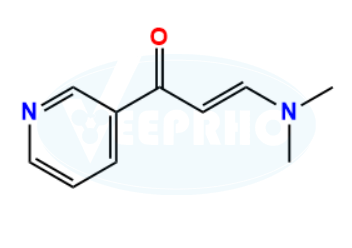
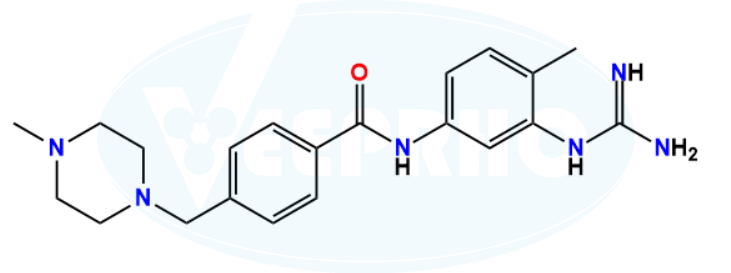
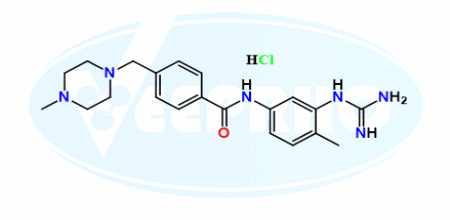
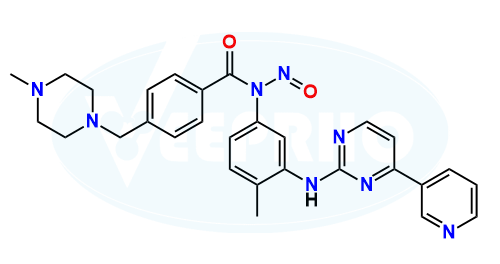


1–37 de 37 resultados36 en stock
| Estructura | Nombre del producto |
|---|---|
| Des(methylpiperazinyl-N-methyl) Imatinib Dimer ImpurityN.º CAS 1365802-18-1 · VE0015073 · En stock | |
| Imatinib (Piperidine)-N4-OxideN.º CAS 938082-57-6 · VE0015093 · En stock | |
| Imatinib Carboxylic ImpurityN.º CAS 106261-49-8 · VE009042 · En stock | |
| Imatinib EP Impurity AN.º CAS 55314-16-4 · VL272007 · En stock | |
| Imatinib EP Impurity BN.º CAS 581076-65-5 · VL272003 · En stock | |
| Imatinib EP Impurity B(HCl Salt)N.º CAS 581076-67-7 · VE008330 · En stock | |
| Imatinib EP impurity CN.º CAS 404844-02-6 · VL272004 · En stock | |
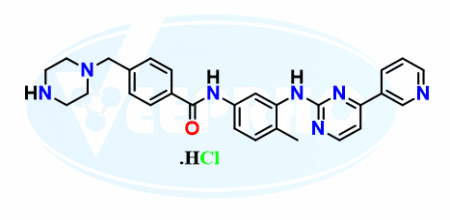 | Imatinib EP Impurity C (HCl Salt)N.º CAS 1820893-54-6 · VE008632 · En stock |
| Imatinib EP Impurity C (Mesylate Salt)N.º CAS 404844-03-7 · VE0021203 · En stock | |
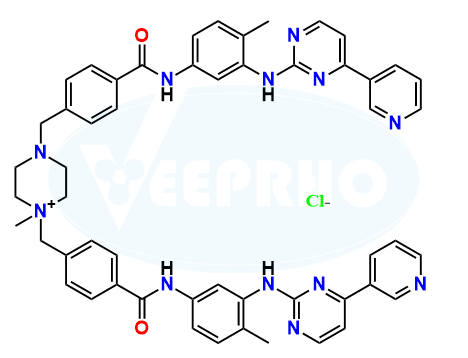 | Imatinib EP Impurity DN.º CAS 1821122-73-9 · VL272002 · En stock |
| Imatinib EP Impurity D (Free Base)VE0023463 · En stock | |
| Imatinib EP Impurity FN.º CAS 152460-10-1 · VL272008 · En stock | |
| Imatinib EP Impurity G (Diydrochloride Salt)N.º CAS 34352-59-5 · VE0021202 · En stock | |
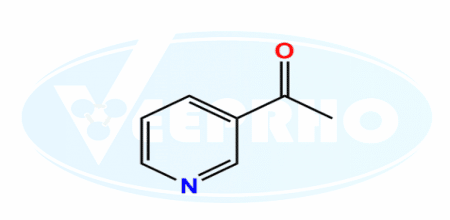 | Imatinib EP Impurity HN.º CAS 350-03-8 · VL272005 · En stock |
| Imatinib Impurity 3N.º CAS 152459-96-6 · VL272006 · En stock | |
| Imatinib Impurity 4N.º CAS 942514-62-7 · VE0015078 · En stock | |
| Imatinib Impurity 5N.º CAS 1032314-73-0 · VE0015080 · En stock | |
| Imatinib Impurity 6N.º CAS 112696-91-0 · VE0015081 · En stock | |
| Imatinib Impurity 8N.º CAS 1356565-46-2 · VE0015086 · En stock | |
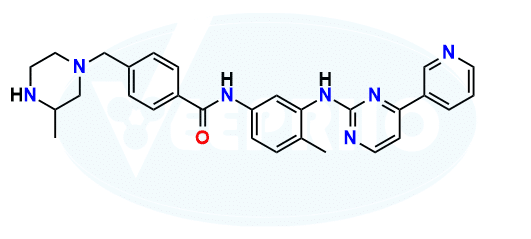 | Imatinib Impurity 12VE0015088 · En stock |
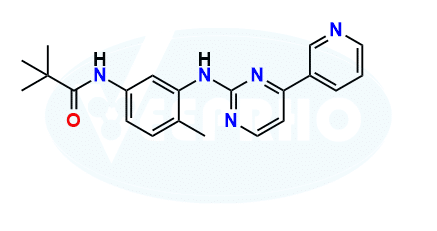 | Imatinib Impurity 14VE0015090 · En stock |
| Imatinib Impurity 22N.º CAS 404844-11-7 · VE0015075 · En stock | |
 | Imatinib Impurity 28VE0015076 · En stock |
 | Imatinib Impurity 31VE0015091 · En stock |
| Imatinib Impurity JN.º CAS 571186-91-9 · VL272009 · En stock | |
| Imatinib meta-Methyl-Piperazine ImpurityN.º CAS 1246819-59-9 · VE0015074 · En stock | |
| Imatinib N-Acetyl ImpurityN.º CAS 1321600-78-5 · VE009742 · En stock | |
| Imatinib para-DiaminomethylbenzeneN.º CAS 1026753-54-7 · VE0015077 · En stock | |
| Imatinib Piperazine-N,N-DiOxideN.º CAS 571186-93-1 · VE006650 · En stock | |
| Imatinib pyridine N oxide ImpurityN.º CAS 571186-92-0 · VL272010 · En stock | |
| Methyl 4-[(4-Methylpiperazin-1-yl)methyl]benzoateN.º CAS 314268-40-1 · VE0022856 · En stock | |
| N-Nitroso BenzamideVE0024093 · En stock | |
| N-Nitroso ImatinibVE0013972 | |
| N-Nitroso Imatinib EP Impurity CN.º CAS 2816369-80-7 · VE0015092 · En stock | |
| p-Toluic AcidN.º CAS 99-94-5 · VE0020082 · En stock | |
| 1,3-Bis(4-methyl-3-(4-(pyridin-3-yl)pyrimidin-2-ylamino)phenyl)ureaVE0021982 · En stock | |
| 2-Methyl-5-nitro-N-[4-(pyridin-3-yl)pyrimidin-2-yl]benzenamineN.º CAS 152460-09-8 · VE0022663 · En stock |
Imatinib Related Compound
Impurities in imatinib result from its multi-step chemical synthesis, including aryl-substituted piperazine and pyrimidine derivatives, and from degradation under acidic, basic, or oxidative conditions. Due to its chronic use in oncology, impurity control is highly stringent and regulated under ICH Q3A/B, USP, EP, and FDA oncology product guidelines.
Types of Impurities in Imatinib
Process-Related Impurities
- Unreacted starting materials like N-methylpiperazine, anilines, or substituted pyrimidines
- By-products from N-alkylation, acylation, or condensation reactions
- Residual solvents such as dimethylformamide (DMF), methanol, or acetonitrile
Degradation Impurities
- N-oxide derivatives and other oxidized forms
- Amide hydrolysis products under acidic or basic conditions
- Isomeric or rearranged structures formed under heat or light
- Photodegradation products affecting the aromatic rings
Elemental Impurities
- Trace metals like palladium, copper, or iron from cross-coupling catalysts or manufacturing equipment
- Controlled under ICH Q3D for chronic oral anticancer use
Analytical Techniques for Impurity Detection
- High-Performance Liquid Chromatography (HPLC) – for assay and related substance quantification
- LC-MS/MS (Liquid Chromatography–Tandem Mass Spectrometry) – for identifying unknown impurities
- Chiral HPLC – for enantiomeric purity (where applicable)
- Gas Chromatography (GC) – for residual solvent determination
- ICP-MS – for elemental impurity analysis
- Photostability and forced degradation studies – to assess stability profile
Preguntas frecuentes
What is Imatinib used for?
Imatinib is used to treat cancers like CML , GIST , Ph+ ALL , and other rare tyrosine kinase–driven tumors by blocking the abnormal signaling that promotes cancer cell growth.
How does Imatinib work?
It inhibits BCR-ABL , c-KIT , and PDGFR tyrosine kinases , which are responsible for uncontrolled cell proliferation in certain cancers.
What are common side effects of Imatinib?
Nausea and vomiting Edema (especially around the eyes) Muscle cramps Diarrhea Fatigue Myelosuppression (low blood counts)
Can Imatinib be taken long-term?
Yes. Imatinib is often taken for years , especially in CML, where it may achieve major molecular response (MMR) and complete cytogenetic response (CCyR) .
Is Imatinib chemically stable?
Imatinib is sensitive to moisture, heat, and light . It should be stored in tight containers at controlled room temperature , protected from humidity and direct sunlight .