
Impurezas de Octenidine Dihydrochloride
Solicitar cotización de un conjunto
- Solicitar cotización de este conjunto
Todas las impurezas de nitrosaminas de Octenidine Dihydrochloride
2 productosVer los 2 productos

1–3 de 3 resultados
| Estructura | Nombre del producto |
|---|---|
| Octenidine Dihydrochloride Impurity 1VE0021825 | |
| 1-(10-(4-Iminopyridin-1(4H)-yl)decyl)-N-octylpyridin-4(1H)-imineVE0021824 | |
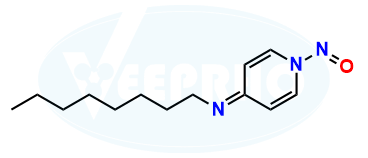
| 1-Nitroso-N-octylpyridin-4(1H)-imineVE0021823 |
Octenidine Dihydrochloride and Related Compound
Typical quality specifications for antiseptic or technical grades focus on assay, related substances and residual process impurities determined by validated HPLC, GC and elemental methods. A representative supplier specification would state assay by HPLC 98.0 percent minimum on a dry basis, water content not greater than 0.5 percent, heavy metals not greater than 20 ppm and residual solvents controlled to ICH Q3C class limits. Related compounds encountered in manufacture and storage include desalkylated and partially alkylated pyridinium congeners, N-oxide species, residual mono- and di-chloride counterion variants and trace oligomeric by-products; typical limits are individual unspecified related impurities not greater than 0.5 percent and total related impurities not greater than 1.5 percent. Analytical control strategies include identity by IR and mass spectrometry, purity and related substances by gradient HPLC with appropriate reference standards, and routine microbial and endotoxin testing for products intended for topical use.
Preguntas frecuentes
What is octenidine dihydrochloride used for?
It is used as a topical antiseptic and disinfectant in preoperative skin preparation, wound cleansing, mucosal antisepsis and in some oral care products; it is formulated in aqueous or alcohol-based solutions and applied where fast-acting, broad-spectrum bactericidal activity is required.
Is octenidine better than chlorhexidine?
Both agents are membrane-active antiseptics with broad spectra; octenidine often shows comparable or faster in vitro bactericidal kinetics and good activity against certain resistant strains, while chlorhexidine has a longer-established clinical history in some regions. Choice depends on formulation requirements, compatibility with other ingredients, local clinical data and regulatory approvals rather than a universal superiority claim.
Is octenidine an antibiotic?
No. Octenidine is an antiseptic and disinfectant that acts topically by disrupting microbial cell membranes; it is not a systemic antibiotic and is not used to treat systemic infections.
Is octenidine safe to use?
When used at recommended concentrations and contact times for topical antisepsis it has a favorable safety profile with low systemic absorption; local irritation or hypersensitivity reactions can occur in a minority of users and it should not be used in the middle ear or on large, deep wounds without appropriate clinical guidance. Follow product-specific instructions, concentration limits and contraindications provided by manufacturers and regulatory authorities.