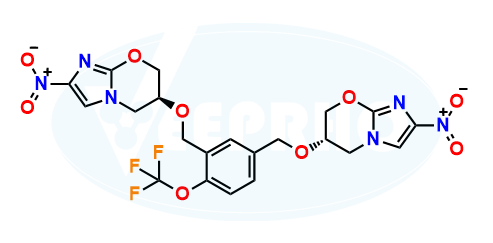
La pretomanida es un antibiótico utilizado para el tratamiento de la tuberculosis pulmonar multirresistente. Generalmente se utiliza junto con bedaquilina y linezolid. Se administra por vía oral. La pretomanida pertenece a la clase química de las nitroimidazooxazinas y es un profármaco que se bioactiva dentro de Mycobacterium tuberculosis por la nitrorreductasa Ddn dependiente de deazaflavina, con el cofactor F420, produciendo especies reactivas de nitrógeno que alteran la síntesis de ácidos micólicos y comprometen el metabolismo respiratorio tanto en condiciones aerobias como anaerobias. El régimen oral aprobado en el protocolo BPaL utiliza pretomanida 200 mg una vez al día con alimentos durante el período de tratamiento establecido. Entre las consideraciones clave de desarrollo y uso figuran la administración con alimentos para mejorar la exposición, un metabolismo primario en el que intervienen enzimas CYP, con posibilidad de interacciones medicamentosas, especialmente con inductores potentes de CYP3A; una semivida terminal compatible con la administración diaria, y la vigilancia de la seguridad por efectos hepáticos, prolongación del intervalo QT cuando se combina con otros agentes que prolongan el QT y toxicidades aditivas, como la neuropatía periférica cuando se utiliza con linezolid.
Typical quality specifications for pretomanid drug substance and tablets align with ICH-related-substance and impurity control principles: assay by validated HPLC 98.0 to 102.0 percent; total related substances not more than 1.0 percent by area; any single unspecified impurity not more than 0.2 percent by area; specified known related compounds and degradants set at tighter limits depending on toxicologic qualification for each impurity, for example a primary process-related impurity limited to 0.5 percent, a key oxidative or reduced degradant limited to 0.2 percent, and genotoxic or structurally related nitro-reduction products limited to 0.1 percent or below where warranted by qualification data. Residual solvents are controlled per ICH Q3C with Class 2 solvents below established ppm limits, elemental impurities are controlled per ICH Q3D, and total impurities in finished product are verified by stability studies to remain within specification across shelf life.
Preguntas frecuentes
What is a pretomanid?
Pretomanid is an oral nitroimidazooxazine-class antibiotic used as part of a combination regimen to treat pulmonary multi-drug-resistant and extensively drug-resistant tuberculosis; it is a prodrug that requires activation by mycobacterial enzymes to exert bactericidal effects against M. tuberculosis.
Is pretomanid a new drug?
Pretomanid received regulatory approval in recent years and is a relatively new treatment option for drug-resistant pulmonary tuberculosis, introduced after clinical trials established efficacy and safety as part of the BPaL regimen with bedaquiline and linezolid.
Is pretomanid available in India?
Availability varies by country and over time; access in India may be limited to national tuberculosis program channels, partner-supported programs, or special access schemes rather than broad retail distribution, so check current Indian regulatory listings and national TB program resources for up-to-date availability and access pathways.
What is the mechanism of action of delamanid and pretomanid?
Both delamanid and pretomanid are nitroimidazole-class prodrugs that require enzymatic reduction within M. tuberculosis; activation produces reactive species that inhibit mycolic acid synthesis and disrupt respiratory functions, with pretomanid activation dependent on the deazaflavin-dependent nitroreductase Ddn and cofactor F420, and both drugs can generate reactive nitrogen intermediates that contribute to bactericidal activity.