100% accuracy
of data
of data
24/7 scientific
support
support
0% tolerance in
quality of product
quality of product
Stock Locations
- New Jersey, USA
- Czech Republic, EU
- Mumbai, India
* Stock subject to availability.
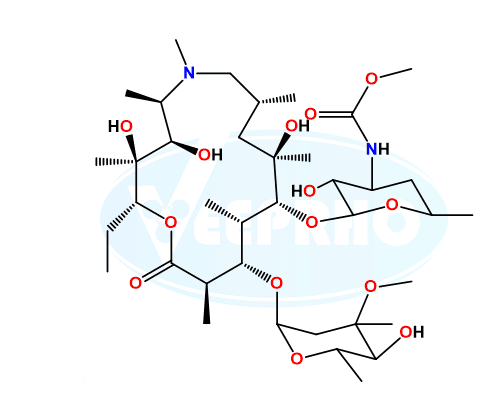
N-Nitroso Azithromycin
● Under Development
| Catalogue No.: | VE0010108 |
|---|---|
| CAS No.: | N/A |
| Mol. Formula: | C37H69N3O13 |
| Mol. Weight: | 764 g/mol |
Additional information on N-Nitroso Azithromycin
Parent drug
AzithromycinIUPAC Name
(2R,3S,4R,5R,8R,10R,11R,12S,13S,14R)-11-(((2S,3R,4S,6R)-4-(dimethylamino)-3-hydroxy-6-methyltetrahydro-2H-pyran-2-yl)oxy)-2-ethyl-3,4,10-trihydroxy-13-(((2R,4R,5S,6S)-5-hydroxy-4-methoxy-4,6-dimethyltetrahydro-2H-pyran-2-yl)oxy)-3,5,8,10,12,14-hexamethyl-6-nitroso-1-oxa-6-azacyclopentadecan-15-onePharmacopeial Synonyms
N/ASynonyms
N-Nitroso Azithromycin EP impurity ASmiles
O=C1[C@H](C)[C@@H](O[C@H]2C[C@@](C)(OC)[C@@H](O)[C@H](C)O2)[C@H](C)[C@@H](O[C@H]3[C@H](O)[C@@H](N(C)C)C[C@@H](C)O3)[C@](C)(O)C[C@@H](C)CN(N=O)[C@H](C)[C@@H](O)[C@](C)(O)[C@@H](CC)O1InChI
InChI=1S/C37H69N3O13/c1-14-26-37(10,46)30(42)23(6)40(38-47)18-19(2)16-35(8,45)32(53-34-28(41)25(39(11)12)15-20(3)49-34)21(4)29(22(5)33(44)51-26)52-27-17-36(9,48-13)31(43)24(7)50-27/h19-32,34,41-43,45-46H,14-18H2,1-13H3/t19-,20-,21+,22-,23-,24+,25+,26-,27+,28-,29+,30-,31+,32-,34+,35-,36-,37-/m1/s1Characterization Data (Included)
HPLC, MASS/LC-MS, 1H NMR, FT-IR, Potency, and Structure Elucidation Report (SER).Additional Characterization Data
QNMR, D2O Exchange, 13C NMR, 13C APT, COSY NMR, NOESY NMR, 15N NMR, HSQC NMR, HMQC NMR, and HMBC NMR. These are available upon request and may be free or subject to additional charges.Description
N-Nitroso Azithromycin, also designated N-Nitroso Azithromycin EP Impurity A, is a nitrosamine-related azithromycin impurity with molecular formula C37H69N3O13 and molecular weight 764 g/mol. It arises plausibly through nitrosation of the tertiary amine functionality during manufacturing or from interaction with nitrosating agents under acidic or oxidative conditions. As a structural nitrosamine analog, it is relevant to genotoxic impurity assessment under ICH M7 and current nitrosamine control expectations. Trace determination generally requires LC-MS/MS with selective reaction monitoring, often supported by high-resolution mass spectrometry and orthogonal chromatographic resolution to distinguish it from closely related macrolide degradants.Request a Quote
« * » indique les champs nécessaires
Other products related to Azithromycin and Nitroso impurities
Impurity structure
Parent Drug Name
CAS No.
Name of Impurity
Catalog No.