
Impuretés de Cilnidipine
Demander un devis pour un ensemble
- Demander un devis pour ce lot
Cilnidipine : toutes les impuretés nitrosamines
3 produitsVoir les 3 produits
- N-Nitroso Cilnidipine VE008671
- N-Nitroso Cilnidipine: Synthesis Attempts and Failure Report (NAP Test) VE0023186
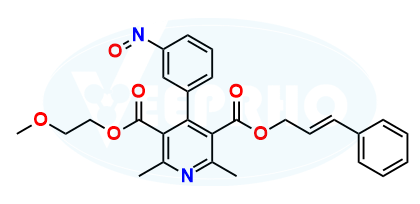
- 3-Cinnamyl 5-(2-methoxyethyl) 2,6-dimethyl-4-(3-nitrosophenyl)pyridine-3,5-dicarboxylate VE0024984
CAS 1974323-07-3


1–10 sur 10 résultats9 en stock
| Structure | Nom du produit |
|---|---|
 | Cilnidipine Impurity 2VE0013647 · En stock |
| Cilnidipine Impurity 3N° CAS 123853-41-8 · VE0013649 · En stock | |
| Cilnidipine Impurity 4N° CAS 74936-76-8 · VE0013651 · En stock | |
| Cilnidipine Impurity 5N° CAS 5349-99-5 · VE0013652 · En stock | |
| Cilnidipine Impurity 7N° CAS 68077-28-1 · VE0013653 · En stock | |
| N-Nitroso CilnidipineVE008671 | |
| (E)-Dehydro CilnidipineN° CAS 146845-34-3 · VE009691 · En stock | |
| (Z)-Dehydro CilnidipineN° CAS 146845-35-4 · VE0013646 · En stock | |
| 3-Cinnamyl 5-(2-methoxyethyl) 2,6-dimethyl-4-(3-nitrosophenyl)pyridine-3,5-dicarboxylateN° CAS 1974323-07-3 · VE0024984 · En stock | |
| 3-Nitro Benzaldehyde Cilnidipine ImpurityN° CAS 99-61-6 · VL3910001 · En stock |
Cilnidipine Related Compound
Impurities in cilnidipine arise from its synthetic process, which includes the esterification of 3-nitrophenyl derivatives and dihydropyridine ring formation. It is sensitive to light and oxidative conditions, making stability and impurity control critical. Regulatory limits are guided by ICH Q3A/B and pharmacopoeial standards (e.g., JP, IP).
Types of Impurities in Cilnidipine
Process-Related Impurities • Unreacted starting materials like 2-methoxyethyl acetoacetate or 3-nitrobenzaldehyde • Side products from incomplete cyclization or nitration • Residual solvents like methanol, ethyl acetate, or dichloromethane • By-products from over-esterification or ester cleavage Degradation Impurities • Oxidation of the dihydropyridine ring to inactive pyridine derivatives • Photodegradation under light exposure leading to ring-opened compounds • Hydrolysis of ester groups in humid or aqueous environments Elemental Impurities • Trace levels of iron, palladium, or tin from equipment or catalysts • Controlled as per ICH Q3D for oral dosage forms Analytical Techniques for Impurity Detection
- HPLC – main technique for related substances and assay • LC-MS – for characterization of unknown or trace-level impurities • GC – for residual solvent analysis • Photostability testing (ICH Q1B) – due to known light sensitivity • ICP-MS – for elemental impurity profiling • Chiral HPLC – if enantiomeric purity needs to be monitored
Questions fréquentes
What is Cilnidipine used for?
Cilnidipine is used to manage high blood pressure and reduce cardiovascular risks. It is especially effective in patients with diabetes or chronic kidney disease due to its N-type calcium channel blocking effect.
How does Cilnidipine work?
It blocks L-type calcium channels (vascular smooth muscle) and N-type channels (sympathetic nerves), lowering blood pressure without triggering a strong reflex heart rate increase.
What are the common side effects of Cilnidipine?
Dizziness • Peripheral edema • Flushing • Headache • Rare: hypotension or bradycardia
Is Cilnidipine better than amlodipine?
Cilnidipine may offer advantages like lower incidence of pedal edema and reduced sympathetic activation, but the choice depends on patient-specific factors.
How should Cilnidipine be stored?
Store in a cool, dry place below 25°C, protected from light and moisture. Keep in original packaging to prevent photodegradation.