
Impuretés de Dasatinib
Demander un devis pour un ensemble
- Demander un devis pour ce lot
Dasatinib : toutes les impuretés USP
2 produitsVoir les 2 produits
- Dasatinib Dehydroxy Ethyl Impurity VE009762
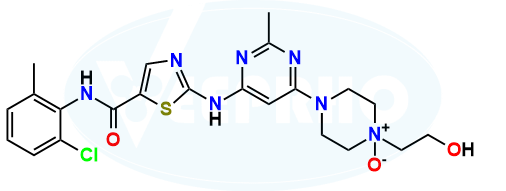
CAS 910297-51-7 - Dasatinib N-Oxide VL4870001
CAS 910297-52-8
- Dasatinib Dehydroxy Ethyl Impurity VE009762
- Demander un devis pour ce lot
Dasatinib : toutes les impuretés nitrosamines
2 produitsVoir les 2 produits
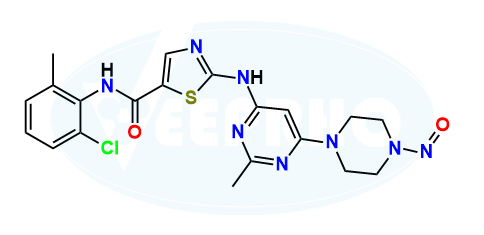
- Dasatinib Nitroso Impurity VE0011523
- N-Nitroso N-Deshydroxyethyl Dasatinib VE0023829
CAS 2135905-86-9


1–20 sur 20 résultats19 en stock
| Structure | Nom du produit |
|---|---|
| Dasatinib Carboxylic AcidN° CAS 910297-53-9 · VE0014221 · En stock | |
| Dasatinib Dehydroxy Ethyl ImpurityN° CAS 910297-51-7 · VE009762 · En stock | |
| Dasatinib Dimer ImpurityN° CAS 910297-61-9 · VE0014217 · En stock | |
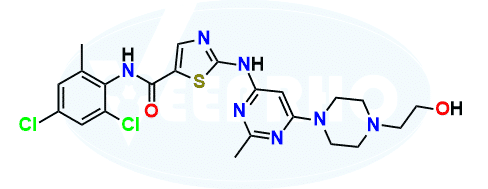 | Dasatinib Impurity 1VE0014226 · En stock |
| Dasatinib Impurity 2N° CAS 302964-24-5 · VE0014227 · En stock | |
| Dasatinib Impurity 3N° CAS 302964-08-5 · VE0014229 · En stock | |
| Dasatinib Impurity 5N° CAS 1245157-85-0 · VE0014207 · En stock | |
| Dasatinib Impurity 6N° CAS 2468737-75-7 · VE0014209 · En stock | |
| Dasatinib Impurity 7N° CAS 2468737-76-8 · VE0014210 · En stock | |
| Dasatinib Impurity 13N° CAS 910297-71-1 · VE0014219 · En stock | |
| Dasatinib Impurity 14N° CAS 863127-76-8 · VE0014225 · En stock | |
| Dasatinib N-Deshydroxyethyl Impurity (HCl Salt)N° CAS 1852573-26-2 · VE0023995 · En stock | |
| Dasatinib N-OxideN° CAS 910297-52-8 · VL4870001 · En stock | |
| Dasatinib Nitroso ImpurityVE0011523 | |
| Deschloro DasatinibN° CAS 1184919-23-0 · VE0014230 · En stock | |
| Hydroxymethyl DasatinibN° CAS 910297-58-4 · VE0014220 · En stock | |
| N-Boc-N-deshydroxyethyl DasatinibN° CAS 1159977-13-5 · VE0020714 · En stock | |
| N-Nitroso N-Deshydroxyethyl DasatinibN° CAS 2135905-86-9 · VE0023829 · En stock | |
| 2-[4-(6-Chloro-2-methylpyrimidin-4-yl)piperazin-1-yl]ethanolN° CAS 127116-19-2 · VE0022857 · En stock | |
| 2-Deschloro-2-Hydroxy DasatinibN° CAS 1159977-25-9 · VE0014218 · En stock |
Dasatinib Related Compound
Due to its complex structure and synthetic pathway, impurities in dasatinib must be tightly controlled to meet ICH Q3A/B and regulatory pharmacopeial standards.
Types of Impurities in Dasatinib
Process-Related Impurities
- Unreacted starting materials and intermediates (e.g., substituted thiazoles or aminopyrimidines)
- By-products from amidation, chlorination, or cyclization steps
- Residual solvents like dimethylformamide (DMF), methanol, or dichloromethane
Degradation Impurities
- Hydrolysis products under moisture or acidic conditions
- Oxidative degradation when exposed to light or air
- N-oxide or sulfone derivatives affecting activity or stability
Elemental Impurities
- Trace metal catalysts (e.g., palladium, platinum, copper) used in key steps of synthesis
Analytical Techniques for Impurity Detection
- High-Performance Liquid Chromatography (HPLC)
- Liquid Chromatography–Mass Spectrometry (LC-MS)
- Fourier-Transform Infrared Spectroscopy (FT-IR)
- Nuclear Magnetic Resonance (NMR)
- Inductively Coupled Plasma Mass Spectrometry (ICP-MS) for metal detection
Questions fréquentes
What is dasatinib used for?
Dasatinib is used to treat: Newly diagnosed or resistant CML (chronic, accelerated, or blast phase) Philadelphia chromosome-positive ALL Patients who fail treatment with other TKIs like imatinib
How does dasatinib work?
Dasatinib works by: Inhibiting BCR-ABL tyrosine kinase , which is responsible for uncontrolled cancer cell proliferation Also blocks other kinases ( SRC, c-KIT, PDGFR ), enhancing its anti-leukemic action
What are common side effects of dasatinib?
Myelosuppression (low blood cell counts) Fluid retention (pleural effusion, peripheral edema) Headache, fatigue, rash Nausea, diarrhea QT prolongation (rare – requires ECG monitoring)
Is dasatinib taken with or without food?
Dasatinib can be taken with or without food , but it should be taken at the same time each day Avoid antacids or PPIs close to dosing, as they may reduce absorption
Can dasatinib cause drug resistance?
Yes, resistance can develop over time due to: BCR-ABL mutations , including the T315I mutation Alternative signaling pathway activation In such cases, other TKIs or combination therapies may be needed.