
Impuretés de Isoproterenol
Demander un devis pour un ensemble
- Demander un devis pour ce lot
Isoproterenol : toutes les impuretés nitrosamines
2 produitsVoir les 2 produits

1–9 sur 9 résultats9 en stock
| Structure | Nom du produit |
|---|---|
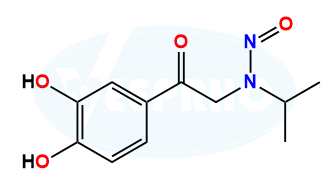
| N-(2-(3,4-dihydroxyphenyl)-2-oxoethyl)-N-isopropylnitrous amideVE0024728 · En stock | |
| N-Isopropyldopamine HydrochlorideN° CAS 5178-52-9 · VE008568 · En stock | |
| N-Nitroso IsoproterenolVE007833 · En stock | |
| Norepinephrine Impurity 1N° CAS 60912-82-5 · VE0019799 · En stock | |
| 2-(2-((2-(3,4-dihydroxyphenyl)-2-hydroxyethyl)(isopropyl)amino)-2-oxoethyl)-2-hydroxysuccinic acidVE0023278 · En stock | |
| 2-(2-(1-(3,4-dihydroxyphenyl)-2-(isopropylamino)ethoxy)-2-oxoethyl)-2-hydroxysuccinic acidVE0023280 · En stock | |
| 3-((1-(3,4-dihydroxyphenyl)-2-(isopropylamino)ethoxy)carbonyl)-3-hydroxypentanedioic acidVE0023281 · En stock | |
| 3-((2-(3,4-dihydroxyphenyl)-2-hydroxyethyl)(isopropyl)carbamoyl)-3-hydroxypentanedioic acidVE0023279 · En stock | |
| 6,7-Dihydroxy-1-isopropylindolin-3-oneN° CAS 2512214-03-6 · VE0011666 · En stock |
Isoproterenol Related Compound
As with all pharmaceutical products, impurities may develop in isoproterenol during manufacturing, storage, or handling. Regulatory agencies like the U.S. FDA and EMA enforce strict guidelines to monitor and control impurities to ensure the medication’s safety, efficacy, and quality.
Types of Impurities in Isoproterenol
Related Substances These are chemically similar compounds or byproducts formed during the synthesis of isoproterenol. Monitoring these related substances ensures the drug’s purity and therapeutic effectiveness. Degradation Products Isoproterenol is prone to degradation when exposed to light, heat, or oxygen, leading to the formation of byproducts that may compromise its stability. Proper storage conditions are essential to minimize degradation. Residual Solvents Trace amounts of solvents used during manufacturing may remain in the final product. Regulatory standards ensure these solvents are within permissible limits to minimize potential risks to patients. Analytical Techniques for Monitoring Impurities Techniques like High-Performance Liquid Chromatography (HPLC) and Mass Spectrometry (LC-MS) are commonly used to detect and quantify impurities, ensuring isoproterenol meets stringent safety and quality standards.
Questions fréquentes
What are the contraindications for isoproterenol?
Isoproterenol is contraindicated in patients with tachyarrhythmias (abnormally fast heart rates), ventricular fibrillation, or those with known hypersensitivity to the drug. It should also be avoided in conditions where increased heart rate could worsen symptoms, such as severe myocardial ischemia.
Why is isoproterenol not used?
Isoproterenol is less commonly used today due to the availability of safer and more specific medications for treating cardiac conditions and asthma. Its non-selective beta-adrenergic action can lead to side effects like tachycardia and hypotension, which limit its use in non-emergency situations.
What are the adverse effects of isoproterenol?
Adverse effects of isoproterenol include tachycardia, palpitations, hypotension, flushing, headaches, nausea, and dizziness. In some cases, it can exacerbate myocardial ischemia or lead to arrhythmias. Close monitoring is essential during administration.
What is the time to onset of isoproterenol?
The onset of action for isoproterenol is rapid, typically occurring within 1 to 5 minutes when administered intravenously. Its effects are short-lived, lasting for about 10 to 15 minutes, depending on the dosage and route of administration.