
Impuretés de Lapatinib
Demander un devis pour un ensemble
- Demander un devis pour ce lot
Lapatinib : toutes les impuretés nitrosamines
2 produitsVoir les 2 produits
- DiNitroso Lapatinib VE0015665
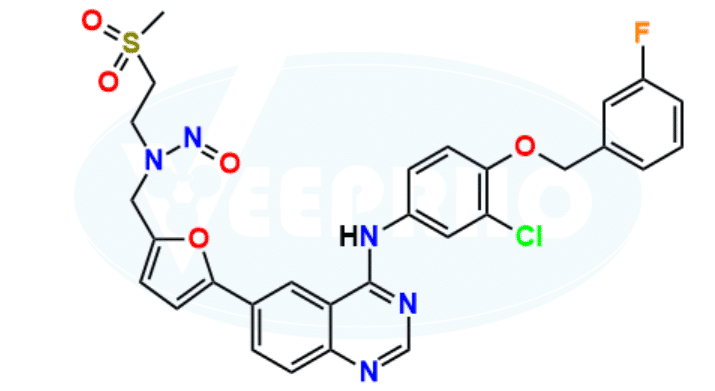
- N-Nitroso Lapatinib VE0013436

1–19 sur 19 résultats19 en stock
| Structure | Nom du produit |
|---|---|
| Deschloro LapatinibN° CAS 633370-23-7 · VE0021750 · En stock | |
| DiNitroso LapatinibVE0015665 · En stock | |
| Lapatinib 2-Fluoro ImpurityN° CAS 1393112-45-2 · VE0015754 · En stock | |
| Lapatinib 4-Fluoro ImpurityN° CAS 1026818-86-9 · VE0015753 · En stock | |
| Lapatinib Carboxylic Acid ImpurityN° CAS 1152131-73-1 · VE0015752 · En stock | |
| Lapatinib Desmesylethyl ImpurityN° CAS 697299-82-4 · VE0015763 · En stock | |
| Lapatinib Desmesylethylamino Hydroxy ImpurityN° CAS 320337-48-2 · VE0015764 · En stock | |
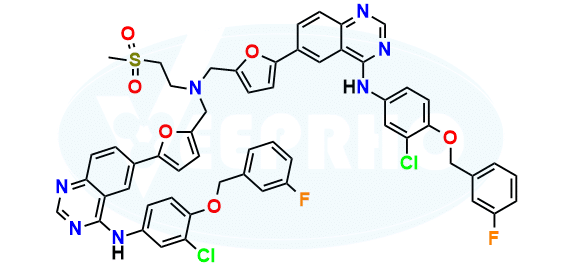 | Lapatinib Dimer ImpurityVE0015757 · En stock |
| Lapatinib HydroxylamineN° CAS 1360431-86-2 · VE0015755 · En stock | |
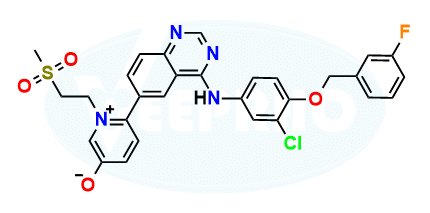 | Lapatinib Impurity 2N° CAS 1807733-95-4 · VE0015762 · En stock |
| Lapatinib Impurity 9N° CAS 231278-84-5 · VE0015751 · En stock | |
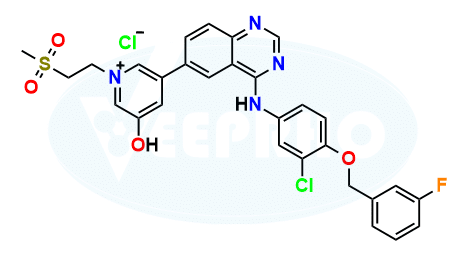 | Lapatinib Impurity 13VE0015759 · En stock |
| Lapatinib Impurity 15N° CAS 231278-20-9 · VE0021753 · En stock | |
| Lapatinib Impurity 18N° CAS 202197-26-0 · VE0015760 · En stock | |
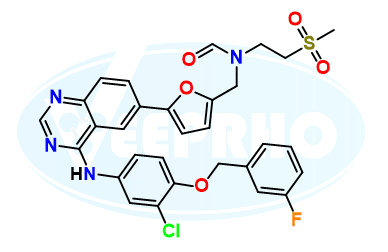 | Lapatinib Impurity 21VE0010931 · En stock |
| N-Nitroso LapatinibVE0013436 · En stock | |
| O-De(3-fluorobenzyl) LapatinibN° CAS 1268997-70-1 · VE0021748 · En stock | |
 | O-De(3-fluorobenzyl) Lapatinib (Ditosylate Salt)VE0015761 · En stock |
| SelatinibN° CAS 1275595-86-2 · VE0010965 · En stock |
Lapatinib Impurities and Related Compound
Typical quality control specifications for lapatinib active pharmaceutical ingredient target high assay purity and low levels of related substances. Typical assay acceptance is greater than or equal to 98.0 percent of the labeled compound on a dry basis. Known related compounds and degradants include N-desmethyl-lapatinib, lapatinib N-oxide, hydroxylated metabolites, dehalogenated species and tosylate-related counterion residues when the salt form is present. Typical target amounts used in analytical specifications are individual known impurities in the range of 0.01 to 0.5 percent depending on the impurity identity and risk, with common examples being N-desmethyl-lapatinib 0.05 to 0.30 percent and N-oxide 0.02 to 0.20 percent, unspecified individual impurities commonly limited to 0.10 percent or less, and total impurities typically limited to 0.5 to 1.0 percent. Genotoxic impurity thresholds are controlled to very low levels consistent with regulatory guidance, commonly below 0.05 percent or at qualified limits. Analytical control is performed by stability-indicating HPLC with UV and mass spectrometric confirmation, with limits of detection and quantitation set to enable reliable measurement of impurities at or below the specification thresholds.
Questions fréquentes
What is lapatinib used for?
Lapatinib is used to treat certain advanced solid tumours, most commonly HER2 positive metastatic breast cancer, where it is given orally to inhibit HER2 and EGFR signalling; it is often used in combination with other agents such as capecitabine in patients who have progressed on prior therapies.
What is the difference between trastuzumab and lapatinib?
Trastuzumab is a monoclonal antibody that binds the extracellular domain of HER2 and mediates immune and receptor blockade effects, while lapatinib is a small molecule that inhibits the intracellular tyrosine kinase activity of HER2 and EGFR; their mechanisms, routes of administration, tissue distribution and resistance profiles differ, which is why they can be complementary in some treatment settings.
Is lapatinib a targeted therapy?
Yes, lapatinib is a targeted therapy because it selectively inhibits specific receptor tyrosine kinases, principally HER2 and EGFR, rather than acting as a nonspecific cytotoxic agent.
Is lapatinib an EGFR inhibitor?
Yes, lapatinib inhibits EGFR kinase activity in addition to HER2, so it functions as a dual EGFR and HER2 tyrosine kinase inhibitor.