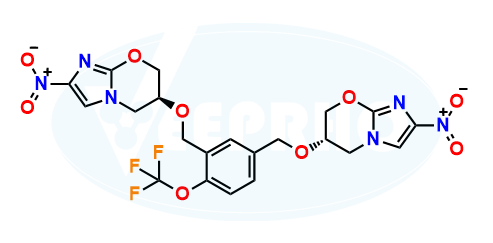
Le prétomanid est un antibiotique utilisé pour le traitement de la tuberculose multirésistante aux médicaments touchant les poumons. Il est généralement utilisé en association avec la bédaquiline et le linézolide. Il se prend par voie orale. Le prétomanid appartient à la classe chimique des nitroimidazooxazines et est un promédicament bioactivé à l’intérieur de Mycobacterium tuberculosis par la nitroréductase Ddn dépendante de la déazaflavine, avec le cofacteur F420, produisant des espèces azotées réactives qui altèrent la synthèse de l’acide mycolique et compromettent le métabolisme respiratoire, en conditions aérobies comme anaérobies. Le schéma oral approuvé dans le protocole BPaL utilise le prétomanid à 200 mg une fois par jour, avec un repas, pendant la durée de traitement désignée. Les principales considérations de développement et d’usage comprennent l’administration du médicament avec un repas pour améliorer l’exposition, un métabolisme principal impliquant les enzymes CYP avec un potentiel d’interactions médicamenteuses, notamment avec les inducteurs puissants du CYP3A, une demi-vie terminale compatible avec une posologie quotidienne unique, et une surveillance de la sécurité portant sur les effets hépatiques, l’allongement de l’intervalle QT lorsqu’il est associé à d’autres agents allongeant le QT, et les toxicités additives telles que la neuropathie périphérique lorsqu’il est utilisé avec le linézolide.
Typical quality specifications for pretomanid drug substance and tablets align with ICH-related-substance and impurity control principles: assay by validated HPLC 98.0 to 102.0 percent; total related substances not more than 1.0 percent by area; any single unspecified impurity not more than 0.2 percent by area; specified known related compounds and degradants set at tighter limits depending on toxicologic qualification for each impurity, for example a primary process-related impurity limited to 0.5 percent, a key oxidative or reduced degradant limited to 0.2 percent, and genotoxic or structurally related nitro-reduction products limited to 0.1 percent or below where warranted by qualification data. Residual solvents are controlled per ICH Q3C with Class 2 solvents below established ppm limits, elemental impurities are controlled per ICH Q3D, and total impurities in finished product are verified by stability studies to remain within specification across shelf life.
Questions fréquentes
What is a pretomanid?
Pretomanid is an oral nitroimidazooxazine-class antibiotic used as part of a combination regimen to treat pulmonary multi-drug-resistant and extensively drug-resistant tuberculosis; it is a prodrug that requires activation by mycobacterial enzymes to exert bactericidal effects against M. tuberculosis.
Is pretomanid a new drug?
Pretomanid received regulatory approval in recent years and is a relatively new treatment option for drug-resistant pulmonary tuberculosis, introduced after clinical trials established efficacy and safety as part of the BPaL regimen with bedaquiline and linezolid.
Is pretomanid available in India?
Availability varies by country and over time; access in India may be limited to national tuberculosis program channels, partner-supported programs, or special access schemes rather than broad retail distribution, so check current Indian regulatory listings and national TB program resources for up-to-date availability and access pathways.
What is the mechanism of action of delamanid and pretomanid?
Both delamanid and pretomanid are nitroimidazole-class prodrugs that require enzymatic reduction within M. tuberculosis; activation produces reactive species that inhibit mycolic acid synthesis and disrupt respiratory functions, with pretomanid activation dependent on the deazaflavin-dependent nitroreductase Ddn and cofactor F420, and both drugs can generate reactive nitrogen intermediates that contribute to bactericidal activity.