Le rimégépant, commercialisé sous le nom de marque Nurtec ODT entre autres, est un médicament utilisé pour le traitement aigu de la migraine avec ou sans aura chez l’adulte et pour le traitement prophylactique/préventif de la migraine épisodique chez l’adulte. Il se prend par voie orale et se dissout sur la langue sous forme de comprimé orodispersible. Le rimégépant est un antagoniste à petite molécule du récepteur du peptide lié au gène de la calcitonine, de la classe des gépants, qui se lie sélectivement au récepteur du CGRP pour bloquer la vasodilatation médiée par le CGRP et l’inflammation neurogène impliquées dans la physiopathologie de la migraine. Les caractéristiques pharmacocinétiques cliniquement pertinentes comprennent une absorption orale rapide avec des concentrations plasmatiques maximales généralement atteintes en 1 à 2 heures environ, une demi-vie d’élimination de l’ordre de 11 heures et un métabolisme principalement par le CYP3A4 avec une implication mineure du CYP2C9 ; les voies rénale et biliaire sont responsables de l’excrétion du composé parent et des métabolites. Le médicament a une activité vasoconstrictrice minimale par rapport aux agonistes 5-HT1B/1D et est formulé sous forme de comprimé orodispersible pour permettre l’administration sans eau en cas de besoin.
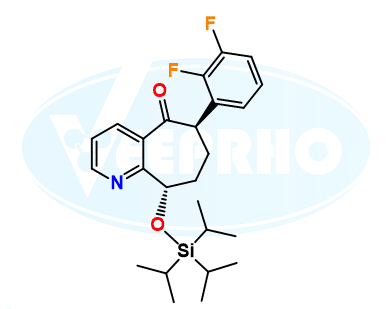
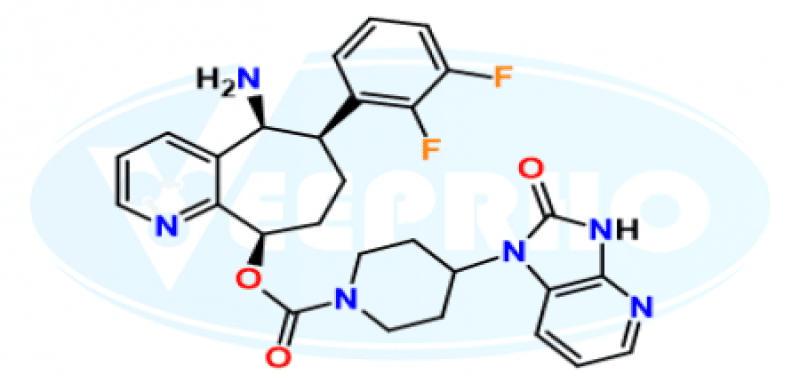
Impurity control for rimegepant covers process-related impurities, degradation products from stress conditions, residual solvents and elemental impurities, and specified related compounds arising from synthesis and purification. Typical quality specifications follow global regulatory guidance and limit individual known related compounds to low parts per thousand or parts per ten thousand ranges, often controlled to about 0.05 to 0.20 percent by weight for specified impurities and with total impurities maintained below approximately 1.0 percent by weight depending on the manufacturer specification; unspecified impurities are typically controlled at tighter reporting and identification thresholds. Residual solvents are limited according to ICH Q3C classifications and elemental impurities are controlled per ICH Q3D. Analytical methods commonly used for profiling include HPLC with UV or MS detection, LC-MS for identification of unknowns, and forced-degradation studies to define degradants for shelf life and stability programs.
Questions fréquentes
What kind of drug is rimegepant?
Rimegepant is a small-molecule CGRP receptor antagonist in the gepant class indicated for acute treatment of migraine attacks and for preventive treatment of episodic migraine in adults; it is an orally disintegrating tablet formulation.
What is the mechanism of action of rimegepant?
Rimegepant binds selectively to the calcitonin gene-related peptide receptor and blocks CGRP signaling, reducing CGRP-driven vasodilation and neurogenic inflammation that contribute to migraine pain and associated symptoms.
What are the side effects of rimegepant?
Common adverse events reported in clinical studies include nausea, somnolence and dry mouth; most events are mild to moderate. Rimegepant has not been associated with the vasoconstrictive effects seen with triptans, but hepatic and hypersensitivity reactions are monitored in postmarketing surveillance. Clinically relevant drug interactions can occur with strong CYP3A4 inhibitors or inducers.
Is rimegepant the same as sumatriptan?
No, Sumatriptan is a triptan that acts as a 5-HT1B/1D receptor agonist and exerts migraine relief in part through cranial vasoconstriction. Rimegepant is a CGRP receptor antagonist and does not cause the same vasoconstrictive action, so their mechanisms, safety profiles and some clinical considerations differ.