
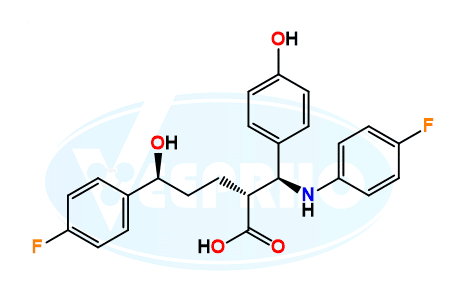
- 100% accuracy of data
- 24/7 scientific support
- 0% tolerance in quality of product
Mutagenicity assessment (ICH M7)
Treated as a potentially non-mutagenic impurity (ICH M7 Class 4–5).
Computational (in silico) assessmentStock Locations
- New Jersey, USA
- Czech Republic, EU
* Stock subject to availability.
Documentation
Includes: HPLC, MASS/LC-MS, 1H NMR, FT-IR, Potency, Structure Elucidation Report (SER), and additional analytical data depending on the product.
1391053-63-6
Ezetimibe Azetidinone Ring-Opened Impurity
● In Stock
| Catalogue No.: | VE0010974 |
|---|---|
| CAS No.: | 1391053-63-6 |
| Mol. Formula: | C24H23F2NO4 |
| Mol. Weight: | 427.44 g/mol |
For laboratory use only: analytical, development and regulatory purposes. Supplied in mg quantities. Not for human or veterinary use.
Additional information on CAS 1391053-63-6
| Parent drug | Ezetimibe |
|---|---|
| Product type | Impurity standards |
| IUPAC name | (2R,5S)-5-(4-Fluorophenyl)-2-((S)-(4-fluorophenylamino)(4-hydroxyphenyl)methyl)-5-hydroxypentanoic Acid |
| SMILES | O=C(O)[C@H](CC[C@H](O)c1ccc(F)cc1)[C@H](Nc1ccc(F)cc1)c1ccc(O)cc1 |
| InChIKey | XGNDFEVQHMNNOJ-XPWALMASSA-N |
| CHNS Ratio (%) (calculated) | C 67.44 · H 5.42 · N 3.28 · S 0.00 |
| References | - |
| Description | Ezetimibe azetidinone ring-opened impurity, also described as ezetimibe open-ring acid, is a degradant derived from cleavage of the β-lactam-like azetidinone moiety of ezetimibe. The structure, CAS 1391053-63-6, corresponds to C24H23F2NO4 with a molecular weight of 427.44 g/mol. Ring opening alters conformational rigidity and polarity, producing a carboxylic acid analog that may arise during hydrolytic stress, process-related exposure, or prolonged storage under adverse pH. Characterization commonly requires LC-MS/MS, high-resolution MS, and orthogonal LC-UV methods, with NMR confirmation for structural assignment. Although not a classic genotoxic alerting species, it is relevant to impurity profiling and stability assessment. |
Request a Quote
"*" indicates required fields
Other products related to Ezetimibe impurities
| Impurity structure | Name of Impurity | Catalogue No. |
|---|---|---|
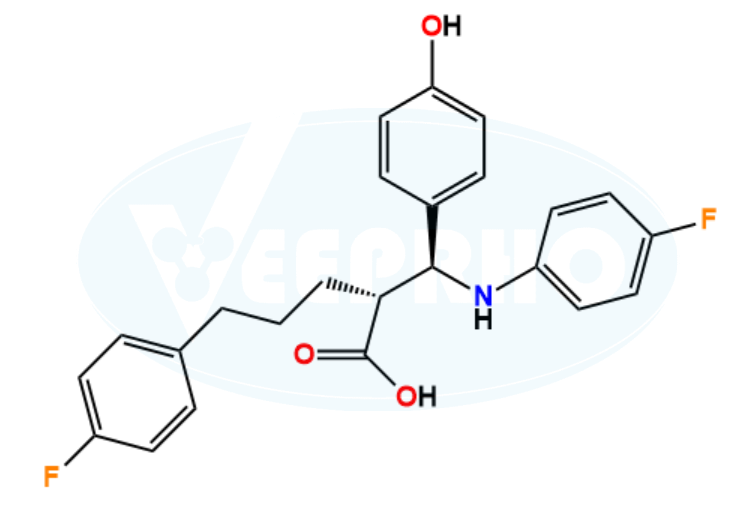 | (R)-5-(4-fluorophenyl)-2-((S)-((4-fluorophenyl)amino)(4-hydroxyphenyl)methyl)pentanoic acid | VE0011660 |
 | (S)-1-(3-Fluorophenyl)-5-(2-oxo-4-phenyloxazolidin-3-yl)pentane-1,5-dione | VE008807 |
| 3-O-Acetyl Ezetimibe | VE0015616 | |
 | 3’-Anhydro-Z-Ezetimibe | VE008805 |
| 4-((2R,3S,6S)-6-(4-Fluorophenyl)-3-(hydroxymethyl)tetrahydro-2H-pyran-2-yl)phenol | VE009235 | |
| 4-(4-Fluorobenzoyl)butyric Acid | VE0011659 | |
| 4-Fluoroaniline | VE0020130 | |
| 5-(2-Fluorophenyl)-5-oxovaleric Acid | VE008756 | |
| Desilylated EZM-II | VE0010975 | |
| Ent-Ezetimibe Ketone | VE009622 | |
| Ezetimibe (RSR) Isomer | VL203012 | |
| Ezetimibe (RSS)-Isomer | VE007989 |
Show all related products N-Nitroso Ezetimibe impurities (11)