

- 100% accuracy of data
- 24/7 scientific support
- 0% tolerance in quality of product
Stock Locations
- New Jersey, USA
- Czech Republic, EU
* Stock subject to availability.
Documentation
Includes: HPLC, MASS/LC-MS, 1H NMR, FT-IR, Potency, Structure Elucidation Report (SER), and additional analytical data depending on the product.
414858-02-9
1,8-Bis(4-((1,4,8,11-Tetraazacyclotetradecan-1-yl)methyl)benzyl)-1,4,8,11-tetraazacyclo tetradecane
● In Stock
| Catalogue No.: | VE009431 |
|---|---|
| CAS No.: | 414858-02-9 |
| Mol. Formula: | C46H84N12 |
| Mol. Weight: | 805.24 g/mol |
For laboratory use only: analytical, development and regulatory purposes. Supplied in mg quantities. Not for human or veterinary use.
Additional information on CAS 414858-02-9
| Parent drug | Plerixafor |
|---|---|
| Product type | Impurity standards |
| IUPAC name | 1,8-bis(4-((1,4,8,11-tetraazacyclotetradecan-1-yl)methyl)benzyl)-1,4,8,11-tetraazacyclotetradecane |
| SMILES | c1cc(CN2CCCNCCN(Cc3ccc(CN4CCCNCCNCCCNCC4)cc3)CCCNCC2)ccc1CN1CCCNCCNCCCNCC1 |
| InChIKey | JFXKZZUXCPLCJW-UHFFFAOYSA-N |
| CHNS Ratio (%) (calculated) | C 68.61 · H 10.51 · N 20.87 · S 0.00 |
| References | Fricker, Simon P. Physiology and Pharmacology of Plerixafor.†Transfusion Medicine and Hemotherapy, vol. 40, no. 4, 2013, pp. 237–45, https://doi.org/10.1159/000354132. |
| Description | 1,8-Bis(4-((1,4,8,11-tetraazacyclotetradecan-1-yl)methyl)benzyl)-1,4,8,11-tetraazacyclotetradecane, CAS 414858-02-9, is a high-molecular-weight macrocyclic diamine derivative with formula C46H84N12 and molecular weight 805.24 g/mol. The structure comprises two cyclam motifs linked through p-xylyl methylene bridges, consistent with a synthetic intermediate or coupling byproduct arising during alkylation of tetraazamacrocycles. Because the scaffold is strongly chelating and nonvolatile, characterization typically relies on LC-MS/MS, high-resolution MS, and, where needed, HPLC with charged aerosol or UV detection. The impurity is primarily relevant in the context of process-related impurity control and structural elucidation of macrocyclic amine synthesis streams. |
Request a Quote
"*" indicates required fields
Other products related to Plerixafor impurities
| Impurity structure | Name of Impurity | Catalogue No. |
|---|---|---|
| (1,4,8,11-tetraazacyclotetradecan-1-yl)(p-tolyl)methanone | VE0029136 | |
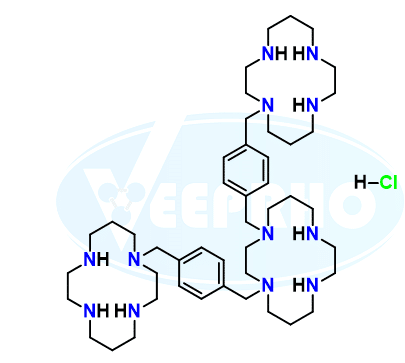 | 1,4-bis(4-((1,4,8,11-Tetraazacyclotetradecan-1-yl)methyl)benzyl)-1,4,8,11-tetraazacyclotetradecane Hydrochloride | VE0011745 |
| Cyclam impurity Plerixafor | VL4740001 | |
| Cyclam Impurity-Plerixafor (HCl Salt) | VE0022558 | |
| N-Nitroso Plerixafor Impurity 3 | VE0014189 | |
 | Plerixafor Impurity 1 (4HCl Salt) | VE0019462 |
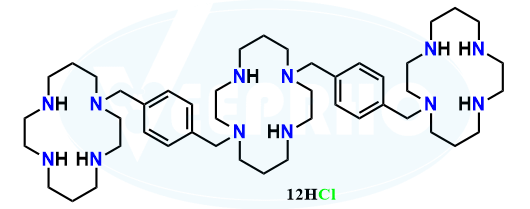 | Plerixafor Impurity 2 (12HCl Salt) | VE0019469 |
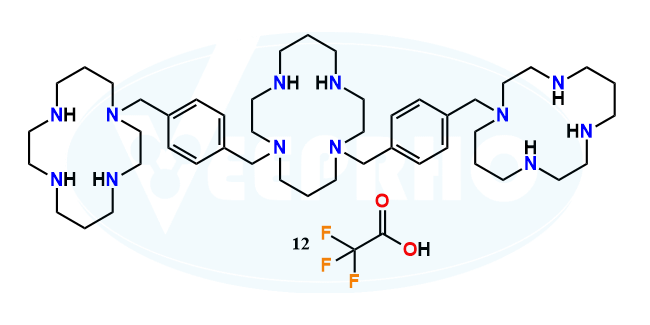 | Plerixafor Impurity 3 (12TFA Salt) | VE0019466 |
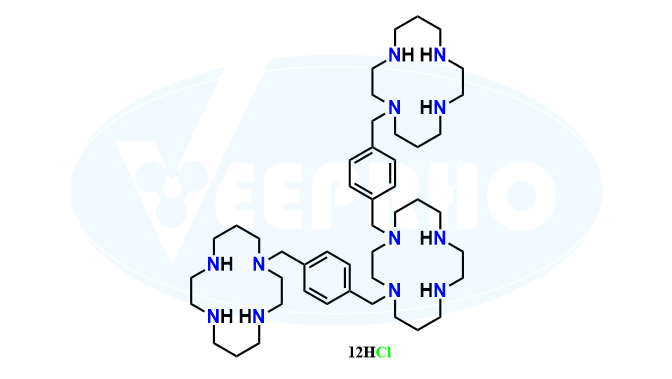 | Plerixafor Impurity 4 (12HCl Salt) | VE0019470 |
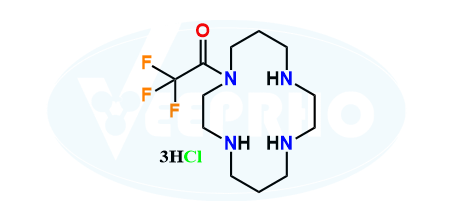 | Plerixafor Impurity 5 (3HCl Salt) | VE0019473 |
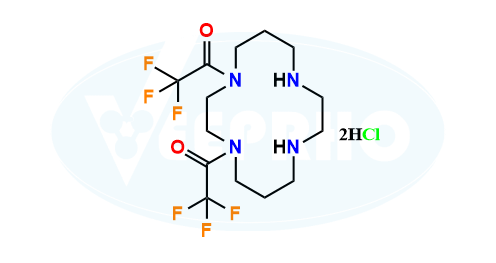 | Plerixafor Impurity 7 (2HCl Salt) | VE0019252 |
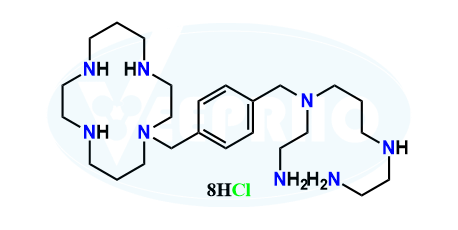 | Plerixafor Impurity 27 (8HCl Salt) | VE0019475 |
Show all related products N-Nitroso Plerixafor impurities (4)