

- 100% accuracy of data
- 24/7 scientific support
- 0% tolerance in quality of product
Stock Locations
- New Jersey, USA
- Czech Republic, EU
* Stock subject to availability.
Documentation
Includes: HPLC, MASS/LC-MS, 1H NMR, FT-IR, Potency, Structure Elucidation Report (SER), and additional analytical data depending on the product.
1187594-13-3
(2-(1-(ethylsulfonyl)-3-(4-(7-((2-(trimethylsilyl)ethoxy)methyl)-7H-pyrrolo[2,3-d]pyrimidin-4-yl)-1H-pyrazol-1-yl)azetidin-3-yl)acetonitrile)
● In Stock
| Catalogue No.: | VE0019681 |
|---|---|
| CAS No.: | 1187594-13-3 |
| Mol. Formula: | C22H31N7O3SSi |
| Mol. Weight: | 501.68 g/mol |
For laboratory use only: analytical, development and regulatory purposes. Supplied in mg quantities. Not for human or veterinary use.
Additional information on CAS 1187594-13-3
| Parent drug | Baricitinib |
|---|---|
| Product type | Impurity standards |
| IUPAC name | (2-(1-(ethylsulfonyl)-3-(4-(7-((2-(trimethylsilyl)ethoxy)methyl)-7H-pyrrolo[2,3-d]pyrimidin-4-yl)-1H-pyrazol-1-yl)azetidin-3-yl)acetonitrile) |
| SMILES | CCS(=O)(=O)N1CC(CC#N)(n2cc(-c3ncnc4c3ccn4COCC[Si](C)(C)C)cn2)C1 |
| InChIKey | WUWJJJDMZWZKQS-UHFFFAOYSA-N |
| CHNS Ratio (%) (calculated) | C 52.67 · H 6.23 · N 19.54 · S 6.39 |
| Description | Baricitinib Sulfonyl Impurity, CAS 1187594-13-3, is a process-related sulfonylated derivative of the JAK inhibitor scaffold, formally 2-(1-(ethylsulfonyl)-3-(4-(7-((2-(trimethylsilyl)ethoxy)methyl)-7H-pyrrolo[2,3-d]pyrimidin-4-yl)-1H-pyrazol-1-yl)azetidin-3-yl)acetonitrile. Its molecular formula, C22H31N7O3SSi, and molecular weight, 501.68 g/mol, indicate a lipophilic, heteroatom-rich impurity that may arise during sulfonylation steps or from side reactions involving ethylsulfonyl introduction and late-stage functionalization. As a structurally defined related substance, it is typically monitored by LC-MS/MS with orthogonal LC-UV or high-resolution MS confirmation, and may require impurity profiling under ICH Q3A/Q3B expectations, with genotoxic risk assessed case-by-case if synthetic origin suggests potential reactive intermediates. |
Request a Quote
"*" indicates required fields
Other products related to Baricitinib impurities
| Impurity structure | Name of Impurity | Catalogue No. |
|---|---|---|
| (N-((3-(4-(7H-pyrrolo[2,3-d]pyrimidin-4-yl)-1H-pyrazol-1-yl)-5-oxotetrahydrofuran-3-yl)methyl)ethanesulfonamide) | VE0019680 | |
| Baricitinib Desethylsulfonyl N-Nitroso Impurity | VE0024263 | |
| Baricitinib Impurity 1 | VL3190001 | |
| Baricitinib Impurity 2 | VL3190002 | |
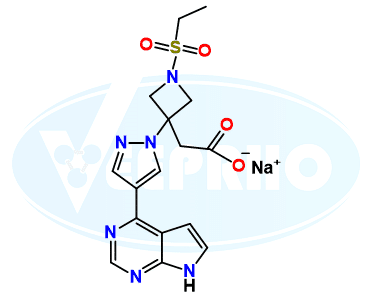 | Baricitinib Impurity 2 (Na Salt) | VE0012573 |
| Baricitinib Impurity 3 | VL3190003 | |
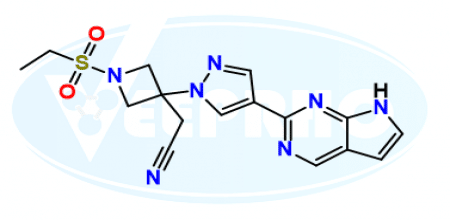 | Baricitinib Impurity 4 | VL3190004 |
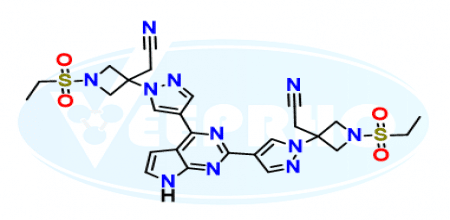 | Baricitinib Impurity 5 | VL3190005 |
| Baricitinib Impurity 11 | VE0029124 | |
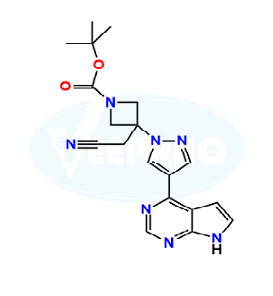 | Baricitinib Impurity 12 | VE0020536 |
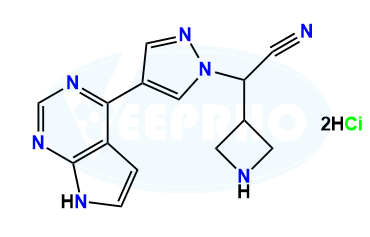 | Baricitinib Impurity 16 (2HCl Salt) | VE0020537 |
| Baricitinib Impurity 20 | VE0012574 |