

- 100% accuracy of data
- 24/7 scientific support
- 0% tolerance in quality of product
Stock Locations
- New Jersey, USA
- Czech Republic, EU
* Stock subject to availability.
Documentation
Includes: HPLC, MASS/LC-MS, 1H NMR, FT-IR, Potency, Structure Elucidation Report (SER), and additional analytical data depending on the product.
2-(2-(ethyl(1-(3-(trifluoromethyl)phenyl)propan-2-yl)amino)-2-oxoethyl)-2-hydroxysuccinic acid
● In Stock
| Catalogue No.: | VE0027776 |
|---|---|
| CAS No.: | N/A |
| Mol. Formula: | C18H22F3NO6 |
| Mol. Weight: | 405.37 g/mol |
For laboratory use only: analytical, development and regulatory purposes. Supplied in mg quantities. Not for human or veterinary use.
Additional information on 2-(2-(ethyl(1-(3-(trifluoromethyl)phenyl)propan-2-yl)amino)-2-oxoethyl)-2-hydroxysuccinic acid
| Parent drug | Fenfluramine |
|---|---|
| Product type | Impurity standards |
| IUPAC name | 2-(2-(ethyl(1-(3-(trifluoromethyl)phenyl)propan-2-yl)amino)-2-oxoethyl)-2-hydroxysuccinic acid |
| SMILES | O=C(O)C(O)(CC(N(CC)C(C)CC1=CC=CC(C(F)(F)F)=C1)=O)CC(O)=O |
| InChI | InChI=1S/C18H22F3NO6/c1-3-22(14(23)9-17(28,16(26)27)10-15(24)25)11(2)7-12-5-4-6-13(8-12)18(19,20)21/h4-6,8,11,28H,3,7,9-10H2,1-2H3,(H,24,25)(H,26,27) |
| InChIKey | BGNZLTAAURBPEU-UHFFFAOYSA-N |
| CHNS Ratio (%) (calculated) | C 53.33 · H 5.47 · N 3.46 · S 0.00 |
| Description | 2-(2-(ethyl(1-(3-(trifluoromethyl)phenyl)propan-2-yl)amino)-2-oxoethyl)-2-hydroxysuccinic acid is a polar, multifunctional impurity characterized by a trifluoromethyl-substituted aryl moiety, a tertiary N-alkyl center, a ketoethyl linker and a hydroxysuccinic diacid motif. Its combination of acidic and basic sites increases aqueous solubility and promotes ionizable behavior across formulation pH ranges, complicating reversed-phase retention and requiring LC-MS or HILIC methods for reliable detection and quantification. The impurity may originate from incomplete coupling, hydrolytic cleavage or over-alkylation during synthesis and can affect assay accuracy and stability profiles. Control strategies include orthogonal chromatographic methods, pKa informed buffer selection and stability-indicating forced-degradation studies. |
Request a Quote
"*" indicates required fields
Other products related to Fenfluramine impurities
| Impurity structure | Name of Impurity | Catalogue No. |
|---|---|---|
| 2-(ethylamino)-1-(3-(trifluoromethyl)phenyl)propan-1-ol | VE0027778 | |
| 2-(ethylamino)-1-(3-(trifluoromethyl)phenyl)propan-1-one | VE0027777 | |
| Fenfluramine Alcohol Impurity | VE009516 | |
| Fenfluramine Impurity 1 | VE0016003 | |
| Fenfluramine Keto Impurity | VE009517 | |
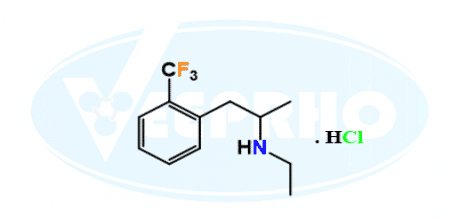 | Fenfluramine Ortho Impurity (HCl Salt) | VE009514 |
| Fenfluramine Para Impurity (HCl Salt) | VE009515 | |
| N-ethyl-4-hydroxy-N-(1-(3-(trifluoromethyl) phenyl)propan-2-yl)benzamide | VE0027774 | |
| Norfenfluramine (HCl Salt) | VE0022722 |