
- 100% accuracy of data
- 24/7 scientific support
- 0% tolerance in quality of product
Mutagenicity assessment (ICH M7)
Potentially mutagenic impurity (ICH M7 Class 1–3).
N-nitroso compound: ICH M7 cohort of concern.Stock Locations
- New Jersey, USA
- Czech Republic, EU
* Stock subject to availability.
Documentation
Includes: HPLC, MASS/LC-MS, 1H NMR, FT-IR, Potency, Structure Elucidation Report (SER), and additional analytical data depending on the product.
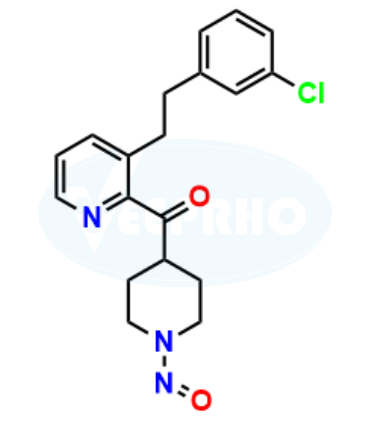
(3-(3-chlorophenethyl)pyridin-2-yl)(1-nitrosopiperidin-4-yl)methanone
● In Stock
| Catalogue No.: | VE0025668 |
|---|---|
| CAS No.: | N/A |
| Mol. Formula: | C19H20ClN3O2 |
| Mol. Weight: | 357.83 g/mol |
For laboratory use only: analytical, development and regulatory purposes. Supplied in mg quantities. Not for human or veterinary use.
Additional information on (3-(3-chlorophenethyl)pyridin-2-yl)(1-nitrosopiperidin-4-yl)methanone
| Parent drug | Loratadine |
|---|---|
| Product type | Impurity standards, Nitroso impurities |
| SMILES | ClC1=CC(CCC2=CC=CN=C2C(C3CCN(N=O)CC3)=O)=CC=C1 |
| InChI | InChI=1S/C19H20ClN3O2/c20-17-5-1-3-14(13-17)6-7-15-4-2-10-21-18(15)19(24)16-8-11-23(22-25)12-9-16/h1-5,10,13,16H,6-9,11-12H2 |
| InChIKey | VZAXYACIAIJPNH-UHFFFAOYSA-N |
| CHNS Ratio (%) (calculated) | C 63.77 · H 5.63 · N 11.74 · S 0.00 |
| Description | (3-(3-chlorophenethyl)pyridin-2-yl)(1-nitrosopiperidin-4-yl)methanone is a synthetic impurity characterized by a nitroso-substituted piperidinyl ketone linked to a chlorophenethyl-pyridinyl fragment. The nitroso functionality imparts distinctive mass spectral and IR signatures and can form during nitrosation or oxidative pathways, making it a critical analyte in impurity profiling. Analytical characterization relies on LC-MS for sensitive quantification, HPLC-UV for routine monitoring, and NMR for structural confirmation. Attention to stability under acidic and oxidative conditions, validated quantitation methods, and defined control limits are recommended to mitigate downstream impact on overall product purity and regulatory compliance. |
Request a Quote
"*" indicates required fields
Other products related to Loratadine and Nitroso impurities
| Impurity structure | Name of Impurity | Catalogue No. |
|---|---|---|
| Loratadine EP Impurity A | VL810004 | |
| Loratadine EP Impurity C | VL810009 | |
| Loratadine EP Impurity D | VL810005 | |
| Loratadine EP Impurity E | VL810011 | |
| Loratadine EP Impurity F | VL810010 | |
| Loratadine EP Impurity G | VL810006 | |
| Loratadine Related Compound D | VL810003 | |
| Loratadine Related Compound E | VL810012 | |
 | Loratadine Related Compound H | VE008810 |
| Loratadine Related Compound I | VL810002 | |
| 2-Cyano Loratadine | VE008816 | |
| 2-Methoxycarbonyl Loratadine | VE008812 |