

- 100% accuracy of data
- 24/7 scientific support
- 0% tolerance in quality of product
Stock Locations
- New Jersey, USA
- Czech Republic, EU
* Stock subject to availability.
Documentation
Includes: HPLC, MASS/LC-MS, 1H NMR, FT-IR, Potency, Structure Elucidation Report (SER), and additional analytical data depending on the product.
92759-37-0
4-(Chloromethyl)-2-((dimethylamino)methyl)-4,5-dihydrothiazol-4-ol
● In Stock
| Catalogue No.: | VE008887 |
|---|---|
| CAS No.: | 92759-37-0 |
| Mol. Formula: | C7H13ClN2OS |
| Mol. Weight: | 208.7 g/mol |
For laboratory use only: analytical, development and regulatory purposes. Supplied in mg quantities. Not for human or veterinary use.
Additional information on CAS 92759-37-0
| Parent drug | Nizatidine |
|---|---|
| Product type | Impurity standards |
| IUPAC name | 4-(Chloromethyl)-2-((dimethylamino)methyl)-4,5-dihydrothiazol-4-ol |
| SMILES | CN(C)CC1=NC(O)(CCl)CS1 |
| InChIKey | QNEVCTUHZWPHJE-UHFFFAOYSA-N |
| CHNS Ratio (%) (calculated) | C 40.29 · H 6.28 · N 13.42 · S 15.36 |
| References | El-Shaheny, Rania, et al. “Estimation of Nizatidine Gastric Nitrosatability and Product Toxicity via an Integrated Approach Combining HILIC, in Silico Toxicology, and Molecular Docking.†Journal of Food and Drug Analysis, vol. 27, no. 4, Oct. 2019, pp. 915–25, https://doi.org/10.1016/j.jfda.2019.08.001. ‌ |
| Description | 4-(Chloromethyl)-2-((dimethylamino)methyl)-4,5-dihydrothiazol-4-ol, also known as 4-Thiazolol, 4-(chloromethyl)-2-[(dimethylamino)methyl]-4,5-dihydro-; 4-(CHLOROMETHYL)-2-[(DIMETHYLAMINO)METHYL]-5H-1,3-THIAZOL-4-OL; 4-(chloromethyl)-2-[(dimethylamino)methyl]-4,5-dihydro-1,3-thiazol-4-ol, is a highly characterized reference material. It fully complies with stringent regulatory standards, including those set by USP, EMA, JP, and BP. This product is essential for use in Abbreviated New Drug Applications (ANDA), New Drug Applications (NDA), and the commercial production of Nizatidine. Moreover, it comes with a detailed Structure Elucidation Report (SER), ensuring its accuracy and reliability for a wide range of analytical applications. It is an H2 receptor antagonist used to treat various types of ulcers and GERD. Nizatidine inhibits histamine in a competitive, reversible manner at histamine H2-receptors, notably those found in the gastric parietal cells. Nizatidine lowers stomach acid production by preventing histamine from acting on stomach cells. There was no observable antiandrogenic effect of nizatidine. The maximum duration of full-dose therapy for nizatidine-treated conditions is 8 weeks. It has been proven that nizatidine medication at a lower dose works well as maintenance therapy once active duodenal ulcers have healed. |
Request a Quote
"*" indicates required fields
Other products related to Nizatidine impurities
| Impurity structure | Name of Impurity | Catalogue No. |
|---|---|---|
| Nizatidine EP Impurity A | VL2910001 | |
 | Nizatidine EP Impurity B | VE006308 |
 | Nizatidine EP Impurity C | VL2910004 |
| Nizatidine EP Impurity D | VL2910005 | |
| Nizatidine EP Impurity E | VE008884 | |
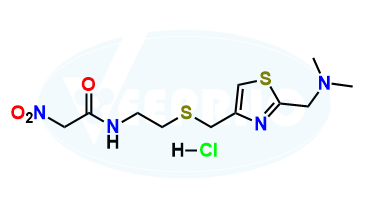 | Nizatidine EP Impurity E | VE0019798 |
 | Nizatidine EP Impurity E ( Sodium Salt) | VE0022653 |
 | Nizatidine EP Impurity F | VE006309 |
| Nizatidine EP Impurity G | VL2910002 | |
| Nizatidine EP Impurity H | VL2910006 | |
| Nizatidine EP Impurity H (HCl Salt) | VE0010213 | |
| Nizatidine EP Impurity J | VE008888 |
Show all related products N-Nitroso Nizatidine impurities (3)