
- 100% accuracy of data
- 24/7 scientific support
- 0% tolerance in quality of product
Stock Locations
- New Jersey, USA
- Czech Republic, EU
* Stock subject to availability.
Documentation
Includes: HPLC, MASS/LC-MS, 1H NMR, FT-IR, Potency, Structure Elucidation Report (SER), and additional analytical data depending on the product.
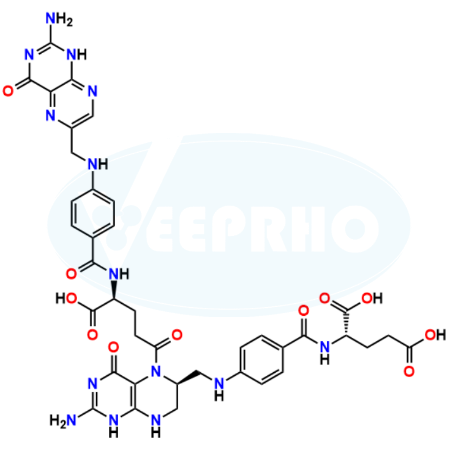
5-(gamma-folinoyl)tetrahydrofolate
● Under Development
| Catalogue No.: | VE0028021 |
|---|---|
| CAS No.: | N/A |
| Mol. Formula: | C38H40N14O11 |
| Mol. Weight: | 868.81 g/mol |
For laboratory use only: analytical, development and regulatory purposes. Supplied in mg quantities. Not for human or veterinary use.
Additional information on 5-(gamma-folinoyl)tetrahydrofolate
| Parent drug | Folic Acid |
|---|---|
| Product type | Impurity standards |
| IUPAC name | {4-[({(S)-2-amino-5-[(S)-4-(4-{[(2-amino-4-oxo-1,4-dihydropteridin-6-yl)methyl]amino}benzamido)-4-carboxybutanoyl]-4-oxo-1,4,5,6,7,8-hexahydropteridin-6-yl}methyl)amino]benzoyl}-L-glutamic acid |
| SMILES | O=C(O)CC[C@@H](C(O)=O)NC(C1=CC=C(NC[C@@H]2N(C(CC[C@H](NC(C3=CC=C(NCC4=CN=C5NC(N)=NC(C5=N4)=O)C=C3)=O)C(O)=O)=O)C6=C(NC(N)=NC6=O)NC2)C=C1)=O |
| InChI | InChI=1S/C38H40N14O11/c39-37-48-29-27(33(58)50-37)45-21(14-43-29)13-41-19-5-1-17(2-6-19)31(56)46-23(35(60)61)9-11-25(53)52-22(16-44-30-28(52)34(59)51-38(40)49-30)15-42-20-7-3-18(4-8-20)32(57)47-24(36(62)63)10-12-26(54)55/h1-8,14,22-24,41-42H,9-13,15-16H2,(H,46,56)(H,47,57)(H,54,55)(H,60,61)(H,62,63)(H3,39,43,48,50,58)(H4,40,44,49,51,59)/t22-,23-,24-/m0/s1 |
| InChIKey | LZUGNSQGTDZZOK-HJOGWXRNSA-N |
| CHNS Ratio (%) (calculated) | C 52.53 · H 4.64 · N 22.57 · S 0.00 |
| Description | 5-(gamma-folinoyl)tetrahydrofolate is an oxidative or conjugation-derived impurity observed in folate synthesis and storage, characterized by a mass shift consistent with gamma linkage and distinct chromatographic retention. Analytical methods such as HPLC with UV detection and LC-MS/MS provide robust quantitation and structural confirmation, while NMR can confirm regiochemistry. This impurity may arise from partial hydrolysis, improper coupling conditions, or folate reoxidation, and shows variable stability under acidic or aerobic conditions. Control strategies include optimized synthetic coupling, oxygen-free handling, stabilized formulations, and specification limits established through impurity profiling to ensure consistent product quality. |
Request a Quote
"*" indicates required fields
Other products related to Folic Acid impurities
| Impurity structure | Name of Impurity | Catalogue No. |
|---|---|---|
| Folic Acid EP Impurity B (Free Base) | VE006816 | |
| Folic Acid EP Impurity B (Sulfate Salt) | VL3520002 | |
| Folic Acid EP Impurity C | VL3520003 | |
| Folic Acid EP Impurity D | VL3520004 | |
| Folic Acid EP Impurity E | VL3520005 | |
| Folic Acid EP Impurity F | VL3520006 | |
| Folic Acid EP Impurity G | VE0011870 | |
 | Methyltetrahydrofolate Related Compound 4 | VE008300 |
 | Methyltetrahydrofolate Related Compound 6 | VE008301 |
| Oxybuprocaine EP Impurity A (Free Base) | VL3520007 | |
| (6R)-Mefox | VE0027712 | |
| (6S)-Mefox | VE0027711 |
Show all related products N-Nitroso Folic Acid impurities (3)