
- 100% accuracy of data
- 24/7 scientific support
- 0% tolerance in quality of product
Stock Locations
- New Jersey, USA
- Czech Republic, EUIn stock
* Stock subject to availability.
Documentation
Includes: HPLC, MASS/LC-MS, 1H NMR, FT-IR, Potency, Structure Elucidation Report (SER), and additional analytical data depending on the product.
58-55-9
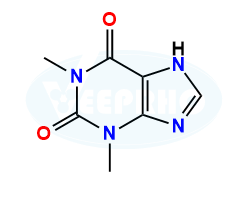
Caffeine EP Impurity A
● In Stock
| Catalogue No.: | VL3710003 |
|---|---|
| CAS No.: | 58-55-9 |
| Mol. Formula: | C7H8N4O2 |
| Mol. Weight: | 180.16 g/mol |
For laboratory use only: analytical, development and regulatory purposes. Supplied in mg quantities. Not for human or veterinary use.
Additional information on CAS 58-55-9
| Parent drug | Caffiene / Pentoxifylline / Diprophylline / Dimenhydrinate |
|---|---|
| Product type | Impurity standards |
| IUPAC name | 1,3-Dimethyl-3,7-dihydro-1H-purine-2,6-dione |
| EP name | Caffeine EP Impurity A / Pentoxifylline EP Impurity C/ Dimenhydrinate EP Impurity A/ Diprophylline EP Impurity B |
| USP name | Theophylline |
| Pharmacopeial synonyms | Pentoxifylline EP Impurity C; Dimenhydrinate EP Impurity A; Diprophylline EP Impurity B; Theophylline |
| Other Synonyms | 1,3-Dimethylxanthine; 1,3-dimethyl-7H-purine-2,6-dione |
| SMILES | O=C(N1C)N(C)C2=C(NC=N2)C1=O |
| InChI | InChI=1S/C7H8N4O2/c1-10-5-4(8-3-9-5)6(12)11(2)7(10)13/h3H,1-2H3,(H,8,9) |
| InChIKey | ZFXYFBGIUFBOJW-UHFFFAOYSA-N |
| CHNS Ratio (%) (calculated) | C 46.67 · H 4.48 · N 31.10 · S 0.00 |
| Shipping condition | Ambient Temperature |
| References | Barnes | Peter J. “Theophylline.†American Journal of Respiratory and Critical Care Medicine | vol. 167 | no. 6 | Mar. 2003 | pp. 813–18 | https://doi.org/10.1164/rccm.200210-1142pp. ? |
| Description | The substance identified as Caffeine EP Impurity A, also listed as Pentoxifylline EP Impurity C, Dimenhydrinate EP Impurity A, Diprophylline EP Impurity B, Theophylline, and Doxofylline impurity C, is 1,3-dimethylxanthine (CAS 58-55-9), molecular formula C7H8N4O2, molecular weight 180.16 g/mol. It belongs to the methylxanthine class and is a recognized synthetic intermediate, process-related impurity, or degradation product in purine alkaloid and xanthine derivatives. Its occurrence is typically monitored by stability-indicating HPLC and characterized with LC-MS/MS or HRMS, with NMR used for structural confirmation. The compound is not a nitrosamine, but its presence may reflect route-specific carryover or hydrolytic transformation. |
Request a Quote
"*" indicates required fields