

- 100% accuracy of data
- 24/7 scientific support
- 0% tolerance in quality of product
Stock Locations
- New Jersey, USA
- Czech Republic, EU
* Stock subject to availability.
Documentation
Includes: HPLC, MASS/LC-MS, 1H NMR, FT-IR, Potency, Structure Elucidation Report (SER), and additional analytical data depending on the product.
Caspofungin Acetate Impurity C
● In Stock
| Catalogue No.: | VE0027319 |
|---|---|
| CAS No.: | N/A |
| Mol. Formula: | C52H88N10O16 |
| Mol. Weight: | 1109.31 g/mol |
For laboratory use only: analytical, development and regulatory purposes. Supplied in mg quantities. Not for human or veterinary use.
Additional information on Caspofungin Acetate Impurity C
| Parent drug | Caspofungin |
|---|---|
| Product type | Impurity standards |
| IUPAC name | (R,2R,6S,9S,11R,12R,14aS,15S,20S,23S,25aS)-20-((R)-3-amino-1-hydroxypropyl)-N-(2-aminoethyl)-23-((1S,2S)-1,2-dihydroxy-2-(4-hydroxyphenyl)ethyl)-9-(10,12-dimethyltetradecanamido)-2,11,15-trihydroxy-6-((R)-1-hydroxyethyl)-5,8,14,19,22,25-hexaoxotetracosahydro-1H-dipyrrolo[2,1-c:2',1'-l][1,4,7,10,13,16]hexaazacyclohenicosin-12-amine oxide |
| SMILES | O=C([C@@H]1[C@@H](O)CCN1C([C@@H](N2)[C@H](O)CCN)=O)N[C@@H]([C@H](O)C[C@H](NC(CCCCCCCCC(C)CC(C)CC)=O)C(N[C@H](C(N3C[C@H](O)C[C@H]3C(N[C@@H]([C@H](O)[C@H](C4=CC=C(O)C=C4)O)C2=O)=O)=O)[C@@H](C)O)=O)[N@H+]([O-])CCN |
| InChI | InChI=1S/C52H88N10O16/c1-5-28(2)24-29(3)12-10-8-6-7-9-11-13-39(69)55-34-26-38(68)46(62(78)23-21-54)59-50(75)43-37(67)19-22-60(43)52(77)41(36(66)18-20-53)57-49(74)42(45(71)44(70)31-14-16-32(64)17-15-31)58-48(73)35-25-33(65)27-61(35)51(76)40(30(4)63)56-47(34)72/h14-17,28-30,33-38,40-46,62-68,70-71H,5-13,18-27,53-54H2,1-4H3,(H,55,69)(H,56,72)(H,57,74)(H,58,73)(H,59,75)/t28?,29?,30-,33-,34+,35+,36-,37+,38-,40+,41+,42+,43+,44+,45+,46-/m1/s1 |
| InChIKey | VECQIUJPICGLGL-GNOZHQIZSA-N |
| CHNS Ratio (%) (calculated) | C 56.30 · H 8.00 · N 12.63 · S 0.00 |
| Description | Caspofungin Acetate Impurity C is a defined process-related degradation product detected in the impurity profile of caspofungin acetate batches and stability samples. It is typically observed as a discrete HPLC peak and confirmed by LC-MS with a characteristic mass shift suggesting peptide backbone alteration or side chain modification. Formation pathways include hydrolytic cleavage, transamidation or incomplete protection during peptide coupling. Analytical characterization employs validated HPLC-UV assays, high-resolution mass spectrometry and NMR for structural elucidation. Control strategies focus on optimizing synthetic conditions, enhanced purification and routine monitoring to maintain specification limits and ensure overall drug substance quality. |
Request a Quote
"*" indicates required fields
Other products related to Caspofungin impurities
| Impurity structure | Name of Impurity | Catalogue No. |
|---|---|---|
| Caspofungin Acetate Amine Impurity | VE0021593 | |
| Caspofungin Acetate Des-methyl Impurity | VE0021594 | |
| Caspofungin Acetate Impurity E | VE0027321 | |
| Caspofungin Acetate Isomer Impurity | VE0021595 | |
| Caspofungin C0 Impurity | VE0027324 | |
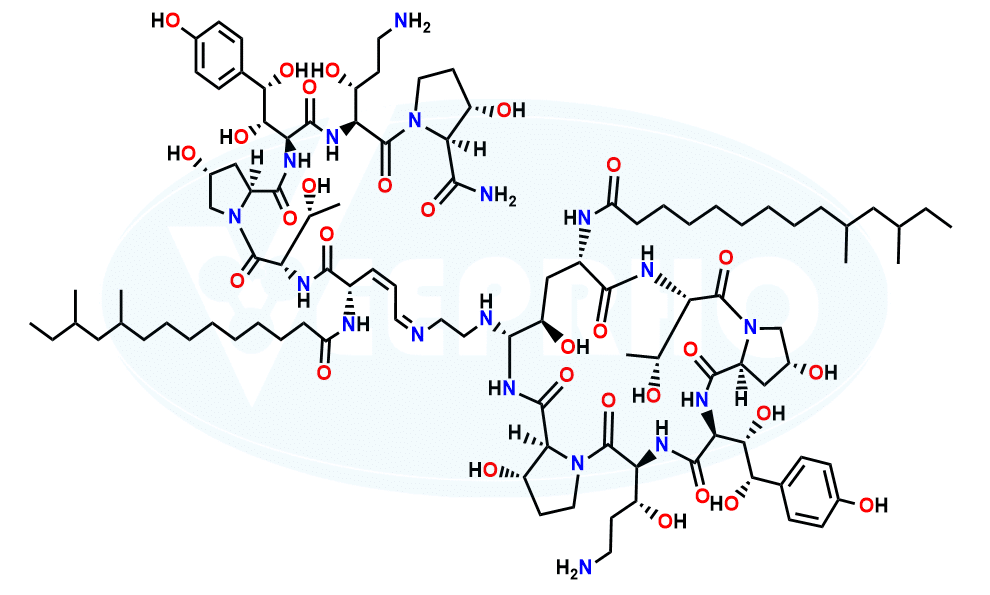 | Caspofungin Dimer II | VE0018386 |
| Caspofungin Dimer-1 | VE0021589 | |
| Caspofungin Dimer-2 | VE0021591 | |
| N-Nitroso Caspofungin | VE0014156 | |
| N-Nitroso Caspofungin (Ditrifluoroacetate Salt) | VE0019181 |
Show all related products N-Nitroso Caspofungin impurities (2)