

- 100% accuracy of data
- 24/7 scientific support
- 0% tolerance in quality of product
Stock Locations
- New Jersey, USA
- Czech Republic, EU
* Stock subject to availability.
Documentation
Includes: HPLC, MASS/LC-MS, 1H NMR, FT-IR, Potency, Structure Elucidation Report (SER), and additional analytical data depending on the product.
93106-58-2
Ciprofloxacin Chloro Analog Impurity
● In Stock
| Catalogue No.: | VL204008 |
|---|---|
| CAS No.: | 93106-58-2 |
| Mol. Formula: | C17H18ClN3O3 |
| Mol. Weight: | 347.80 g/mol |
For laboratory use only: analytical, development and regulatory purposes. Supplied in mg quantities. Not for human or veterinary use.
Additional information on CAS 93106-58-2
| Parent drug | Ciprofloxacin |
|---|---|
| Product type | Impurity standards |
| IUPAC name | 6-Chloro-1-cyclopropyl-1,4-dihydro-4-oxo-7-(1-piperazinyl)-3-quinolinecarboxylic Acid |
| SMILES | O=C(O)c1cn(C2CC2)c2cc(N3CCNCC3)c(Cl)cc2c1=O |
| InChIKey | OSHQUWATYOBFNE-UHFFFAOYSA-N |
| CHNS Ratio (%) (calculated) | C 58.71 · H 5.22 · N 12.08 · S 0.00 |
| References | Aksoy, B., et al. “Development and Validation of a Stability-Indicating HPLC Method for Determination of Ciprofloxacin Hydrochloride and Its Related Compounds in Film-Coated Tablets.†Chromatographia, vol. 66, no. S1, June 2007, pp. 57–63, https://doi.org/10.1365/s10337-007-0287-6 ‌Vance-Bryan, Kyle, et al. “Clinical Pharmacokinetics of Ciprofloxacin.†Clinical Pharmacokinetics, vol. 19, no. 6, Dec. 1990, pp. 434–61, https://doi.org/10.2165/00003088-199019060-00003 |
| Description | Ciprofloxacin Chloro Analog Impurity, also designated Ciprofloxacin 6-Chloro Analog or 6-Desfluoro 6-Chloro Ciprofloxacin, is a halogenated fluoroquinolone process impurity with CAS 93106-58-2. Its molecular formula is C17H18ClN3O3 and molecular weight is 347.80 g/mol. Structurally, it reflects replacement of the 6-fluoro substituent by chlorine, consistent with a synthesis-related analog arising from incomplete fluorination or halogen exchange during manufacture. Because such analogs can affect impurity profiling and related-substance specifications, characterization commonly relies on LC-MS/MS, HRMS, and orthogonal HPLC methods, with NMR used for structural confirmation when needed. |
Request a Quote
"*" indicates required fields
Other products related to Ciprofloxacin impurities
| Impurity structure | Name of Impurity | Catalogue No. |
|---|---|---|
| Ciprofloxacin EP Impurity A | VL204004 | |
| Ciprofloxacin EP Impurity B (HCl Salt) | VL204005 | |
 | Ciprofloxacin EP Impurity B (Hydrochloride Monohydrate Salt) | VE0021151 |
| Ciprofloxacin EP Impurity C (Free Base) | VE007082 | |
| Ciprofloxacin EP Impurity C (HCl Salt) | VL204002 | |
| Ciprofloxacin EP Impurity D | VL204006 | |
| Ciprofloxacin EP Impurity D (Free Base) | VE007083 | |
| Ciprofloxacin EP Impurity E | VL204003 | |
 | Ciprofloxacin EP Impurity E (HCl Salt) | VE0010231 |
| Ciprofloxacin EP Impurity F | VL204001 | |
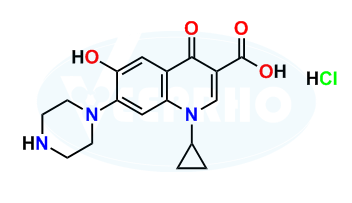 | Ciprofloxacin EP Impurity F (HCl Salt) | VE0021150 |
| N-Nitroso Ciprofloxacin EP Impurity C | VE0024383 |
Show all related products N-Nitroso Ciprofloxacin impurities (3)