

- 100% accuracy of data
- 24/7 scientific support
- 0% tolerance in quality of product
Stock Locations
- New Jersey, USA
- Czech Republic, EU
* Stock subject to availability.
Documentation
Includes: HPLC, MASS/LC-MS, 1H NMR, FT-IR, Potency, Structure Elucidation Report (SER), and additional analytical data depending on the product.
1354727-63-1
Erlotinib Impurity 3
● In Stock
| Catalogue No.: | VL2460003 |
|---|---|
| CAS No.: | 1354727-63-1 |
| Mol. Formula: | C22H25N3O5 |
| Mol. Weight: | 411.45 |
For laboratory use only: analytical, development and regulatory purposes. Supplied in mg quantities. Not for human or veterinary use.
Additional information on CAS 1354727-63-1
| Parent drug | Erlotinib |
|---|---|
| Product type | Impurity standards |
| IUPAC name | 1-(3-((6,7-bis(2-methoxyethoxy)quinazolin-4-yl)amino)phenyl)ethanone |
| SMILES | COCCOc1cc2ncnc(Nc3cccc(C(C)=O)c3)c2cc1OCCOC |
| InChIKey | FMRDQKHUXMVMTP-UHFFFAOYSA-N |
| CHNS Ratio (%) (calculated) | C 64.22 · H 6.12 · N 10.21 · S 0.00 |
| References | Pérez-Soler | Román | et al. "Determinants of tumor response and survival with erlotinib in patients with non—small-cell lung cancer." Journal of clinical oncology 22.16 (2004): 3238-3247. Bareschino | M. A. | et al. “Erlotinib in Cancer Treatment.†Annals of Oncology | vol. 18 | June 2007 | pp. vi35–41 | https://doi.org/10.1093/annonc/mdm222. |
| Description | Erlotinib Impurity 3, also designated Erlotinib Impurity C, is a structurally defined related substance indexed as CAS 1354727-63-1. With molecular formula C22H25N3O5 and molecular weight 411.45, it represents an oxygenated erlotinib analog bearing increased polarity relative to the parent API. Such impurities commonly arise during multi-step quinazoline synthesis, oxidative transformation, or side-chain derivatization. Its identification and quantification typically require orthogonal techniques such as LC-MS/MS, high-resolution LC-MS, and stability-indicating HPLC with UV or photodiode-array detection. In regulatory impurity profiling, it is evaluated as a process-related or degradation-associated constituent within ICH Q3A and Q3B frameworks. |
Request a Quote
"*" indicates required fields
Other products related to Erlotinib impurities
| Impurity structure | Name of Impurity | Catalogue No. |
|---|---|---|
| 3-Ethynylaniline hydrochloride | VE0023238 | |
 | 6,6′,7,7′-Tetrakis(2-methoxyethoxy)-4H-[3,4′-biquinazolin]-4-one | VE008800 |
| 6,7-bis(2-Methoxyethoxy)-4-methoxyquinazoline | VE008353 | |
| Desmethyl Erlotinib Carboxylate Acid | VE0015241 | |
| Erlotinib 3-Bromo Impurity | VE008354 | |
 | Erlotinib Amine impurity (HCl salt) | VL2460006 |
| Erlotinib Chloro Impurity | VL2460005 | |
| Erlotinib Impurity 1 | VL2460001 | |
| Erlotinib Impurity 2 | VL2460002 | |
| Erlotinib Impurity 4 | VL2460004 | |
| Erlotinib Impurity 6 | VL2460010 | |
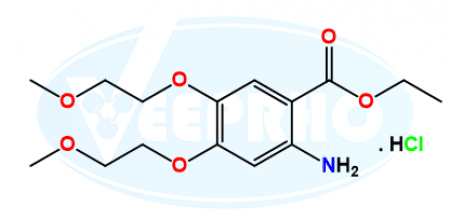 | Erlotinib Impurity 7 | VL2460008 |