- 100% accuracy of data
- 24/7 scientific support
- 0% tolerance in quality of product
Stock Locations
- New Jersey, USA
- Czech Republic, EU
* Stock subject to availability.
Documentation
Includes: HPLC, MASS/LC-MS, 1H NMR, FT-IR, Potency, Structure Elucidation Report (SER), and additional analytical data depending on the product.
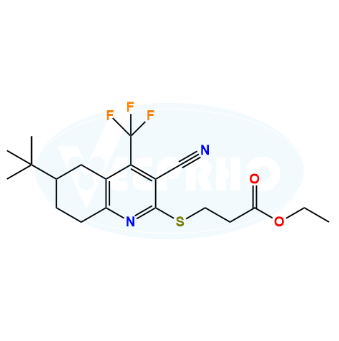
Ethyl 3-{[3-cyano-6-(2-methyl-2-propanyl)-4-(trifluoromethyl)-5,6,7,8-tetrahydro-2-quinolinyl]sulfanyl}propanoate
● Under Development
| Catalogue No.: | VE0026571 |
|---|---|
| CAS No.: | N/A |
| Mol. Formula: | C20H25F3N2O2S |
| Mol. Weight: | 414.48 g/mol |
For laboratory use only: analytical, development and regulatory purposes. Supplied in mg quantities. Not for human or veterinary use.
Additional information on Ethyl 3-{[3-cyano-6-(2-methyl-2-propanyl)-4-(trifluoromethyl)-5,6,7,8-tetrahydro-2-quinolinyl]sulfanyl}propanoate
| Parent drug | Cromolyn |
|---|---|
| IUPAC name | ethyl 3-{[3-cyano-6-(2-methyl-2-propanyl)-4-(trifluoromethyl)-5,6,7,8-tetrahydro-2-quinolinyl]sulfanyl}propanoate |
| SMILES | CCOC(CCSC1=NC2=C(CC(C(C)(C)C)CC2)C(C(F)(F)F)=C1C#N)=O |
| InChI | InChI=1S/C20H25F3N2O2S/c1-5-27-16(26)8-9-28-18-14(11-24)17(20(21,22)23)13-10-12(19(2,3)4)6-7-15(13)25-18/h12H,5-10H2,1-4H3 |
| InChIKey | XMQYOAJCTONYFN-UHFFFAOYSA-N |
| CHNS Ratio (%) (calculated) | C 57.96 · H 6.08 · N 6.76 · S 7.73 |
| Description | Ethyl 3-{[3-cyano-6-(2-methyl-2-propanyl)-4-(trifluoromethyl)-5,6,7,8-tetrahydro-2-quinolinyl]sulfanyl}propanoate is an actionable process-related impurity characterized by a bulky tert-butylated quinoline core, a sulfanyl-linked ethyl propanoate moiety, and polar cyano and trifluoromethyl functionalities that drive atypical chromatographic retention and complex lipophilic-hydrophilic partitioning. The impurity displays low volatility, moderate solubility in polar aprotic solvents, and distinct LC-MS fragmentation with signature m/z losses from the sulfide linkage. Likely formation routes include incomplete coupling and overreduction during hydrogenation. Control strategies include optimized reagent stoichiometry, targeted scavengers, and orthogonal purification such as reversed-phase HPLC and crystallization, supported by robust analytical monitoring to meet quality specifications. |
Request a Quote
"*" indicates required fields