
- 100% accuracy of data
- 24/7 scientific support
- 0% tolerance in quality of product
Stock Locations
- New Jersey, USA
- Czech Republic, EU
* Stock subject to availability.
Documentation
Includes: HPLC, MASS/LC-MS, 1H NMR, FT-IR, Potency, Structure Elucidation Report (SER), and additional analytical data depending on the product.
1021489-55-3
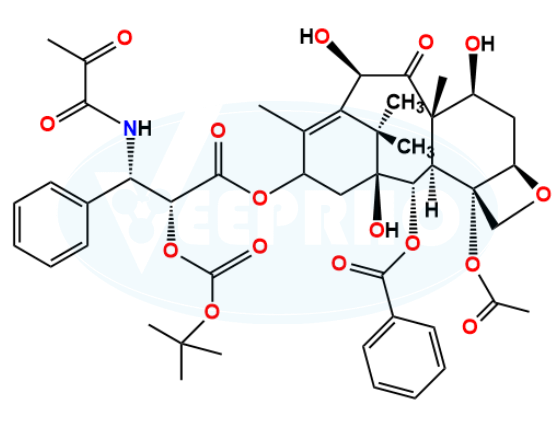
O-BOC-N-Pyruvyl Docetaxel
● In Stock
| Catalogue No.: | VE0027940 |
|---|---|
| CAS No.: | 1021489-55-3 |
| Mol. Formula: | C46H55NO16 |
| Mol. Weight: | 877.93 g/mol |
For laboratory use only: analytical, development and regulatory purposes. Supplied in mg quantities. Not for human or veterinary use.
Additional information on CAS 1021489-55-3
| Parent drug | Docetaxel |
|---|---|
| Product type | Impurity standards |
| IUPAC name | (2aR,4R,4aS,95,115,12S,12aR,12bS)-1,2a,3,4,4a,6,9,10,11,12,12a,12b- Dodecahydro-4, 9,11,12,12b-pentahydroxy-4a,8,13,13-tetramethyl-7,11- methano-5H-cyclodeca[3,4]benz[1,2-b]oxet-5,6-dione 12b-acetate, 12- benzoate, 9-ester with (2R,3S)-2-(tert-butoxycarbonyloxy)-3-(2- oxopropanamido)-3-phenylpropanoic acid |
| SMILES | O=C(C(C)=O)N[C@H]([C@H](C(OC1C[C@]2(O)C(C)(C)C([C@@H](O)C([C@@]3(C)[C@]([C@@]4(OC(C)=O)[C@H](OC4)C[C@@H]3O)([H])[C@@H]2OC(C5=CC=CC=C5)=O)=O)=C1C)=O)OC(OC(C)(C)C)=O)C6=CC=CC=C6 |
| InChI | InChI=1S/C46H55NO16/c1-23-28(59-40(55)34(60-41(56)63-42(4,5)6)32(47-38(53)24(2)48)26-16-12-10-13-17-26)21-46(57)37(61-39(54)27-18-14-11-15-19-27)35-44(9,36(52)33(51)31(23)43(46,7)8)29(50)20-30-45(35,22-58-30)62-25(3)49/h10-19,28-30,32-35,37,50-51,57H,20-22H2,1-9H3,(H,47,53)/t28?,29-,30+,32-,33+,34+,35-,37-,44+,45-,46+/m0/s1 |
| InChIKey | WDUSAUGMDDMKKZ-SJMBUWCFSA-N |
| CHNS Ratio (%) (calculated) | C 62.93 · H 6.31 · N 1.60 · S 0.00 |
| Description | O-BOC-N-Pyruvyl Docetaxel (CAS 1021489-55-3) is a synthetic impurity encountered in docetaxel production characterized by an N-pyruvyl modification with a Boc protecting group that increases mass and polarity relative to the parent molecule. Typically generated through incomplete deprotection or side reactions during synthesis, this impurity shows altered chromatographic retention in reversed-phase HPLC and a diagnostic [M+H]+ ion in LC-MS, enabling sensitive trace-level detection. Control strategies focus on optimizing deprotection and workup conditions, implementing targeted LC-MS/MS assays for identity confirmation, and validating quantitative HPLC-UV methods to support impurity profiling, stability assessment, and specification setting. |
Request a Quote
"*" indicates required fields
Other products related to Docetaxel impurities
| Impurity structure | Name of Impurity | Catalogue No. |
|---|---|---|
| Docetaxel EP Impurity B | VE0011540 | |
| Docetaxel EP Impurity G | VE0011537 | |
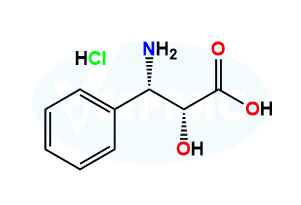 | Docetaxel Related Compound 1 | VE0014428 |
| Docetaxel Related Compound 2 | VE0014429 | |
| Docetaxel Related Compound 3 | VE0014430 | |
| N-Nitroso Docetaxel EP Impurity A | VE0027928 | |
| N-Nitroso Docetaxel EP Impurity B | VE0027930 | |
| N-Nitroso Docetaxel EP Impurity C | VE0027932 | |
| N-Nitroso Docetaxel EP Impurity D | VE0027933 | |
| N-Nitroso Docetaxel EP Impurity G | VE0027938 | |
| 6-Dichloroethxy Carbonyl Docetaxel | VE0011539 | |
| 6-Oxo Docetaxel | VE0022408 |
Show all related products N-Nitroso Docetaxel impurities (6)