- 100% accuracy of data
- 24/7 scientific support
- 0% tolerance in quality of product
Stock Locations
- New Jersey, USA
- Czech Republic, EU
* Stock subject to availability.
Documentation
Includes: HPLC, MASS/LC-MS, 1H NMR, FT-IR, Potency, Structure Elucidation Report (SER), and additional analytical data depending on the product.
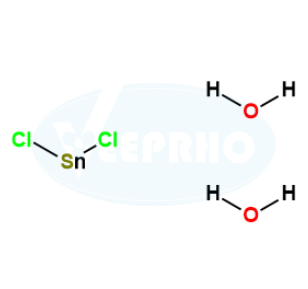
Stannous Chloride Dihydrate / Tindichloride Dihydrate
● Not Available
| Catalogue No.: | VE0026335 |
|---|---|
| CAS No.: | N/A |
| Mol. Formula: | Cl2H4O2Sn |
| Mol. Weight: | 225.65 g/mol |
For laboratory use only: analytical, development and regulatory purposes. Supplied in mg quantities. Not for human or veterinary use.
Additional information on Stannous Chloride Dihydrate / Tindichloride Dihydrate
| IUPAC name | dichlorotin;dihydrate |
|---|---|
| SMILES | [H]O[H].Cl[Sn]Cl.[H]O[H] |
| InChI | InChI=1S/2ClH.2H2O.Sn/h2*1H;2*1H2;/q;;;;+2/p-2 |
| InChIKey | FWPIDFUJEMBDLS-UHFFFAOYSA-L |
| Description | Stannous Chloride Dihydrate impurity profile focuses on oxidative and metallic contaminants that alter reducing power and stability; common issues include partial oxidation to stannic species, variable chloride and free HCl levels, excess moisture beyond dihydrate stoichiometry, and trace metals such as iron, lead, and copper. Organic residues and sulfate or nitrate counterions may arise from production and affect conductivity and corrosion. Analytical control employs ICP-MS or AAS for trace metals, potentiometric redox titration and iodometric assay for valence state and assay, Karl Fischer for water content, and XRD or XPS for phase identification. Tight impurity control is critical for predictable reactivity, shelf life, and corrosion behavior. |
Request a Quote
"*" indicates required fields