
Lapatinib 불순물
세트 견적 요청
- 이 세트 견적 요청
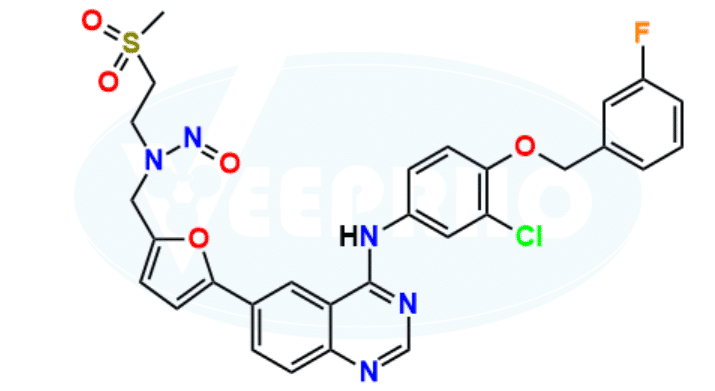
Lapatinib의 니트로사민 불순물 전체
2개 제품2개 제품 보기
- DiNitroso Lapatinib VE0015665
- N-Nitroso Lapatinib VE0013436

19개 중 1–1919 재고 있음
| 구조 | 제품명 |
|---|---|
| Deschloro LapatinibCAS 번호 633370-23-7 · VE0021750 · 재고 있음 | |
| DiNitroso LapatinibVE0015665 · 재고 있음 | |
| Lapatinib 2-Fluoro ImpurityCAS 번호 1393112-45-2 · VE0015754 · 재고 있음 | |
| Lapatinib 4-Fluoro ImpurityCAS 번호 1026818-86-9 · VE0015753 · 재고 있음 | |
| Lapatinib Carboxylic Acid ImpurityCAS 번호 1152131-73-1 · VE0015752 · 재고 있음 | |
| Lapatinib Desmesylethyl ImpurityCAS 번호 697299-82-4 · VE0015763 · 재고 있음 | |
| Lapatinib Desmesylethylamino Hydroxy ImpurityCAS 번호 320337-48-2 · VE0015764 · 재고 있음 | |
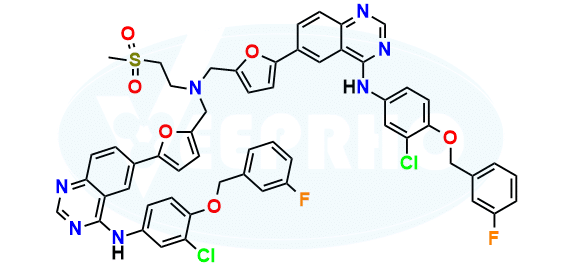 | Lapatinib Dimer ImpurityVE0015757 · 재고 있음 |
| Lapatinib HydroxylamineCAS 번호 1360431-86-2 · VE0015755 · 재고 있음 | |
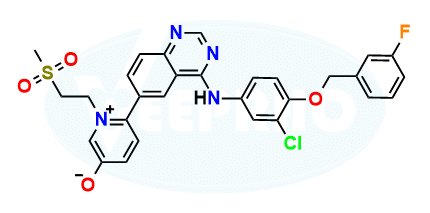 | Lapatinib Impurity 2CAS 번호 1807733-95-4 · VE0015762 · 재고 있음 |
| Lapatinib Impurity 9CAS 번호 231278-84-5 · VE0015751 · 재고 있음 | |
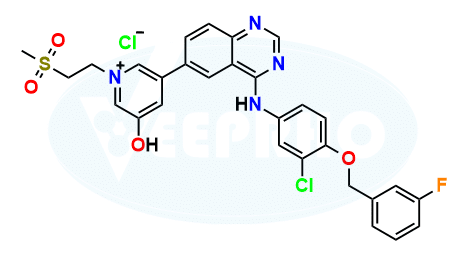 | Lapatinib Impurity 13VE0015759 · 재고 있음 |
| Lapatinib Impurity 15CAS 번호 231278-20-9 · VE0021753 · 재고 있음 | |
| Lapatinib Impurity 18CAS 번호 202197-26-0 · VE0015760 · 재고 있음 | |
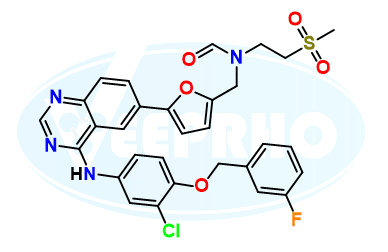 | Lapatinib Impurity 21VE0010931 · 재고 있음 |
| N-Nitroso LapatinibVE0013436 · 재고 있음 | |
| O-De(3-fluorobenzyl) LapatinibCAS 번호 1268997-70-1 · VE0021748 · 재고 있음 | |
 | O-De(3-fluorobenzyl) Lapatinib (Ditosylate Salt)VE0015761 · 재고 있음 |
| SelatinibCAS 번호 1275595-86-2 · VE0010965 · 재고 있음 |
Lapatinib Impurities and Related Compound
Typical quality control specifications for lapatinib active pharmaceutical ingredient target high assay purity and low levels of related substances. Typical assay acceptance is greater than or equal to 98.0 percent of the labeled compound on a dry basis. Known related compounds and degradants include N-desmethyl-lapatinib, lapatinib N-oxide, hydroxylated metabolites, dehalogenated species and tosylate-related counterion residues when the salt form is present. Typical target amounts used in analytical specifications are individual known impurities in the range of 0.01 to 0.5 percent depending on the impurity identity and risk, with common examples being N-desmethyl-lapatinib 0.05 to 0.30 percent and N-oxide 0.02 to 0.20 percent, unspecified individual impurities commonly limited to 0.10 percent or less, and total impurities typically limited to 0.5 to 1.0 percent. Genotoxic impurity thresholds are controlled to very low levels consistent with regulatory guidance, commonly below 0.05 percent or at qualified limits. Analytical control is performed by stability-indicating HPLC with UV and mass spectrometric confirmation, with limits of detection and quantitation set to enable reliable measurement of impurities at or below the specification thresholds.
자주 묻는 질문
What is lapatinib used for?
Lapatinib is used to treat certain advanced solid tumours, most commonly HER2 positive metastatic breast cancer, where it is given orally to inhibit HER2 and EGFR signalling; it is often used in combination with other agents such as capecitabine in patients who have progressed on prior therapies.
What is the difference between trastuzumab and lapatinib?
Trastuzumab is a monoclonal antibody that binds the extracellular domain of HER2 and mediates immune and receptor blockade effects, while lapatinib is a small molecule that inhibits the intracellular tyrosine kinase activity of HER2 and EGFR; their mechanisms, routes of administration, tissue distribution and resistance profiles differ, which is why they can be complementary in some treatment settings.
Is lapatinib a targeted therapy?
Yes, lapatinib is a targeted therapy because it selectively inhibits specific receptor tyrosine kinases, principally HER2 and EGFR, rather than acting as a nonspecific cytotoxic agent.
Is lapatinib an EGFR inhibitor?
Yes, lapatinib inhibits EGFR kinase activity in addition to HER2, so it functions as a dual EGFR and HER2 tyrosine kinase inhibitor.