
Pranlukast 불순물
세트 견적 요청
- 이 세트 견적 요청
Pranlukast의 니트로사민 불순물 전체
4개 제품


7개 중 1–75 재고 있음
| 구조 | 제품명 |
|---|---|
| Ethyl 1-nitroso-1H-tetrazole-5-carboxylateVE0012581 | |
| Pranlukast 8-Amino ImpurityCAS 번호 110683-22-2 · VE0018960 · 재고 있음 | |
| Pranlukast Benzoic Acid ImpurityCAS 번호 30131-16-9 · VE0018961 · 재고 있음 | |
| Pranlukast Chromene Carboxamide ImpurityCAS 번호 136450-10-7 · VE0018958 · 재고 있음 | |
| Pranlukast Chromene Carboxylic Acid ImpurityCAS 번호 211116-98-2 · VE0018957 · 재고 있음 | |
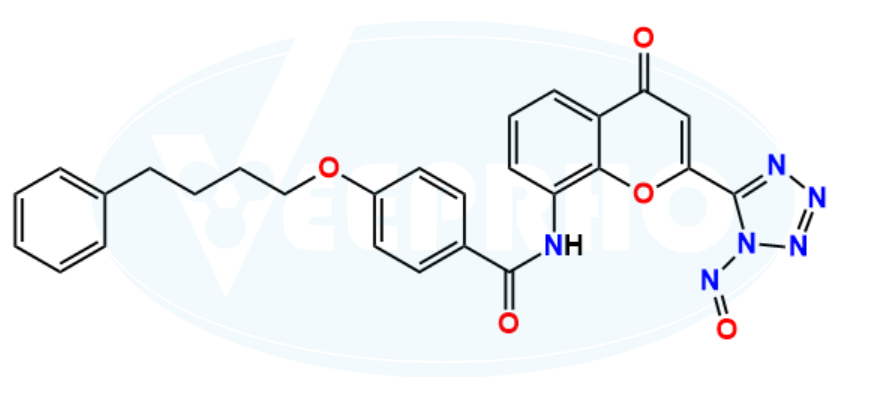
| Pranlukast Nitroso ImpurityVE0012580 | |
| 8-Amino-4-oxo-2-(tetrazol-5-yl)benzopyran HydrochlorideCAS 번호 110683-23-3 · VE0023099 · 재고 있음 |
Pranlukast Related Compound
Impurities in pranlukast originate from its complex synthetic pathway involving condensation reactions, heterocyclic ring formation, and sulfonamide chemistry. Due to its aromatic and heterocyclic moieties, degradation through oxidation or hydrolysis is also a concern. Impurities must comply with ICH Q3A/B guidelines and local pharmacopeial standards (e.g., JP).
Types of Impurities in Pranlukast
Process-Related Impurities • Unreacted starting materials such as quinoline derivatives or benzothiophene sulfonamides • Side-products from coupling reactions or incomplete ring closure • Residual solvents like DMF, toluene, or isopropanol • Over-reaction products from sulfonation or amide formation steps Degradation Impurities • Hydrolysis of amide bonds under humidity or heat • Oxidation of aromatic or sulfur-containing groups • Decomposition of quinoline ring under photolytic or acidic conditions • Formation of nitrated or sulfone derivatives upon exposure to oxidants Elemental Impurities • Trace metals such as iron, copper, or palladium from synthetic catalysts • Regulated as per ICH Q3D for oral drug products Analytical Techniques for Impurity Detection • HPLC – primary technique for assay and related substances profiling • LC-MS/MS – for identification and structure elucidation of trace/unknown impurities • GC – to detect and quantify residual solvents • UV-Vis spectroscopy – to assess photodegradation • ICP-MS – for elemental impurity analysis • Stability testing (ICH Q1A/Q1B) – to determine degradation under stress conditions
자주 묻는 질문
What is Pranlukast used for?
Pranlukast is used for long-term management of asthma, reducing inflammation and bronchial hyperresponsiveness. It may also provide relief in allergic rhinitis.
How does Pranlukast work?
It blocks leukotriene D4 from binding to CysLT1 receptors on airway smooth muscle and immune cells, thus preventing bronchoconstriction and inflammation.
What are the common side effects of Pranlukast?
Headache • Abdominal pain • Diarrhea • Drowsiness • Rare: liver function abnormalities or hypersensitivity reactions
Is Pranlukast a bronchodilator?
No. It is not a bronchodilator but a leukotriene receptor antagonist that works as a controller medication to prevent asthma symptoms.
How should Pranlukast be stored?
Store in a cool, dry place below 25°C, protected from moisture and light. Keep tightly closed in original packaging.