
Tucatinib 불순물
세트 견적 요청
- 이 세트 견적 요청
Tucatinib의 니트로사민 불순물 전체
4개 제품4개 제품 보기
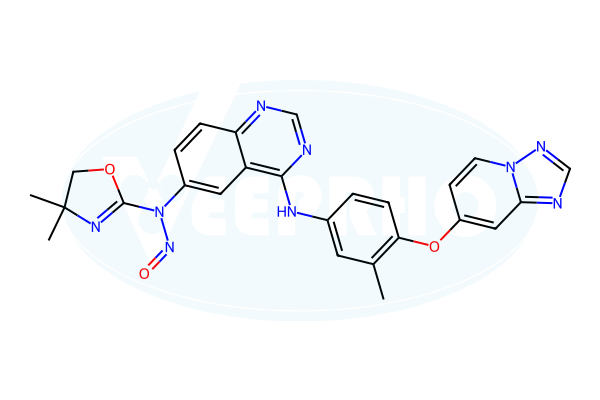
- N-Nitroso Tucatinib Impurity 1 VE0024570
- N-Nitroso Tucatinib Impurity 2 VZA000103
- N-Nitroso Tucatinib Impurity 5 VE0024569
- N,N-Dinitroso Tucatinib VE0024124


10개 중 1–106 재고 있음
| 구조 | 제품명 |
|---|---|
| N-Nitroso Tucatinib Impurity 1VE0024570 | |
| N-Nitroso Tucatinib Impurity 2VZA000103 · 재고 있음 | |
| N-Nitroso Tucatinib Impurity 5VE0024569 | |
| N,N-Dinitroso TucatinibVE0024124 | |
| Tucatinib Carbamate ImpurityVE0022562 | |
| Tucatinib Impurity 3CAS 번호 2307628-67-5 · VE0025240 · 재고 있음 | |
 | Tucatinib Impurity 6VE009458 · 재고 있음 |
| Tucatinib Impurity 7CAS 번호 937266-01-8 · VE009456 · 재고 있음 | |
| Tucatinib Impurity 12CAS 번호 2307628-66-4 · VE0025239 · 재고 있음 | |
| Tucatinib Impurity 14CAS 번호 937263-81-5 · VE0025241 · 재고 있음 |
Tucatinib Related Compound
Impurities in tucatinib primarily arise from its multi-step chemical synthesis, which includes heterocycle formation, amide bond coupling, and selective substitution reactions. Given the complexity and targeted nature of the molecule, impurity profiling is critical, especially for potential genotoxic impurities (PGIs). All impurities are controlled under ICH Q3A/B and, where applicable, ICH M7 guidelines.
Types of Impurities in Tucatinib
Process-Related Impurities • Unreacted starting materials such as substituted quinazoline or benzamide derivatives • Intermediates or side-products from selective halogenation or amination • Residual solvents like DMF, acetonitrile, or dichloromethane • By-products from coupling agents (e.g., HATU, EDC) • Regioisomeric or stereoisomeric impurities Degradation Impurities • Hydrolysis of amide or ether linkages under stress conditions • Oxidation of aromatic rings or methoxy substituents • Photodegradation or rearrangement under light exposure • N-oxide formation at tertiary nitrogen centers Elemental Impurities • Trace metals such as palladium, copper, or iron from catalysts and manufacturing equipment • Must comply with ICH Q3D limits for oral solid dosage forms Analytical Techniques for Impurity Detection
- HPLC – primary method for related substances and assay testing • LC-MS/MS – for identification and structural elucidation of unknown or trace-level impurities • GC – for detection and quantification of residual solvents • ICP-MS – for elemental impurity analysis • Forced degradation studies (ICH Q1A) – to evaluate stability under acidic, basic, thermal, and oxidative conditions • Photostability testing (ICH Q1B) – due to potential sensitivity to light
자주 묻는 질문
What is Tucatinib used for?
Tucatinib is used to treat HER2-positive metastatic breast cancer, including in patients with brain metastases, in combination with trastuzumab and capecitabine.
How does Tucatinib work?
It selectively inhibits HER2 tyrosine kinase, blocking downstream signaling pathways that promote cancer cell growth and survival.
What are the common side effects of Tucatinib?
Diarrhea • Palmar-plantar erythrodysesthesia (hand-foot syndrome) • Elevated liver enzymes • Fatigue • Nausea
Is Tucatinib a targeted therapy?
Yes. Tucatinib is a highly selective HER2-targeted therapy, offering efficacy with reduced EGFR-related toxicities compared to earlier-generation HER2 inhibitors.
How should Tucatinib be stored?
Store at room temperature (20–25°C), in a dry place, protected from moisture and light. Keep tablets in the original container.