
Adenine Impurities
Request a quote for a set
- Request quote for this set
All nitrosamine impurities of Adenine
2 productsSee the 2 products
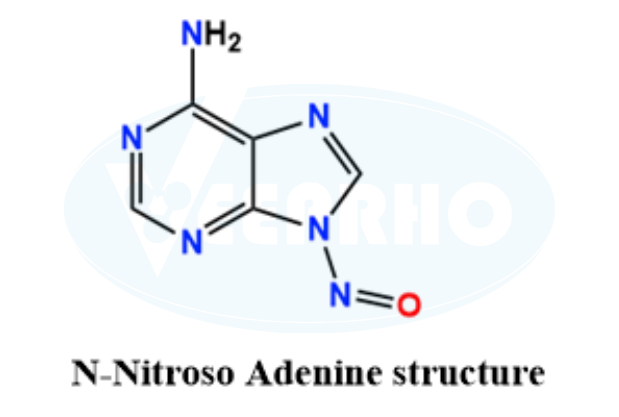
- N-Nitroso Adenine VE007649
CAS 2615274-45-6 - N-Nitroso Adenine: Synthesis Attempts and Failure Report VE0025793
CAS 2615274-45-6
- N-Nitroso Adenine VE007649

1–1 of 1 results
| Structure | Product Name |
|---|---|
| N-Nitroso AdenineCAS No. 2615274-45-6 · VE007649 |
Adenine and Related Compound
Typical quality specifications depend on intended use, with biochemical grade material commonly specified at assay greater than or equal to 98.0% by HPLC and molecular biology or pharmaceutical grades specified at 99.0 to 99.9% assay. Typical limits for total organic impurities range from 0.5 to 2.0% depending on grade, with individual related compounds often controlled to 0.1 to 0.5% for high purity material. Common related impurities monitored by HPLC or LCMS include hypoxanthine, guanine, xanthine, inosine and low-level purine analogs such as 2,6-diaminopurine; oxidative degradation products such as 8-oxoadenine are monitored at trace levels. Typical inorganic and physical limits include water content less than or equal to 0.5% by Karl Fischer for dried material, heavy metals controlled to single digit ppm levels (for example less than or equal to 10 ppm) and residue on ignition or ash specified per grade. Exact impurity profiles and acceptance criteria should be taken from the certificate of analysis for the supplied batch.
FAQ
What is adenine and its function?
Adenine is a basic purine nucleobase that forms part of nucleotides and nucleic acids; its primary functions are to pair with thymine in DNA or uracil in RNA to encode genetic information, to serve as the adenine moiety in energy carriers such as ATP, and to act in cofactors and signaling molecules including NAD, FAD and cyclic AMP.
Are adenine and adenosine the same?
No, they are not the same. Adenine is the free nucleobase, while adenosine is the nucleoside formed when adenine is covalently linked to a ribose sugar. Addition of phosphate groups to adenosine yields nucleotides such as AMP, ADP and ATP.
Is adenine A vitamin?
No, adenine is not a vitamin. It is a purine base synthesized de novo and via salvage pathways in cells and is a structural component of nucleotides and nucleic acids rather than an essential dietary vitamin.