
Cangrelor Impurities
Request a quote for a set
- Request quote for this set
All nitrosamine impurities of Cangrelor
2 productsSee the 2 products


1–11 of 11 results8 in stock
| Structure | Product Name |
|---|---|
| Cangrelor 6-Amino Triol ImpurityCAS No. 163706-51-2 · VE008675 · In stock | |
| Cangrelor DimerCAS No. 2353388-08-4 · VE0018050 · In stock | |
| Cangrelor Impurity 4CAS No. 1830294-26-2 · VE0013190 · In stock | |
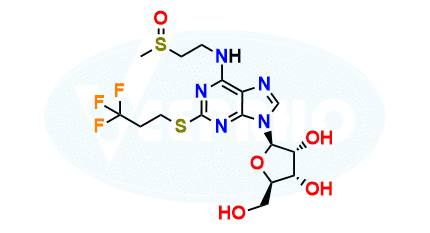 | Cangrelor Impurity 7 (Mixture of Diastereomers)VE0013191 · In stock |
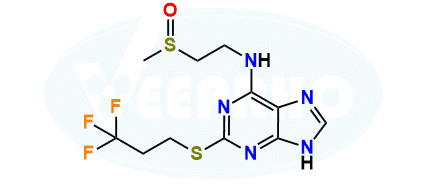 | Cangrelor Impurity 9VE0013192 · In stock |
| Cangrelor Phosphate ImpurityCAS No. 847460-53-1 · VE008672 | |
| Cangrelor Sulfoxide (Sodium Salt )VE0021850 | |
| Des Ribose Cangrelor ImpurityCAS No. 1830294-25-1 · VE008670 · In stock | |
| N-[2-(methylthio)ethyl]-2-[(3,3,3-trifluoropropyl)thio]-5’-adenylic Acid (9CI)CAS No. 163706-58-9 · VE008673 · In stock | |
| N-Nitroso CangrelorVE0014154 | |
| 2-ThioadenosineCAS No. 43157-50-2 · VE008674 · In stock |
Cangrelor Impurities and Related Compound
Typical API analytical controls include assay by validated HPLC and limits for related substances and degradation products consistent with ICH Q3A/Q3B principles; commonly applied example limits are assay acceptance around 95.0 to 105.0 percent of label claim, individual identified related compounds 0.05 to 0.2 percent, unspecified individual impurities not greater than 0.05 to 0.1 percent, and total impurities generally controlled to 0.5 to 1.5 percent depending on the manufacturer specification and identification status. Relevant related compounds encountered during synthesis and stability testing include dephosphorylated and partially dephosphorylated analogs, hydrolysis products of the phosphate moieties, minor positional or stereoisomers, oxidative degradants, and residual synthetic intermediates; residual solvents and inorganic counterions are controlled to pharmacopeial limits and sterile injectable acceptance criteria such as endotoxin and bioburden limits apply for finished drug product.
FAQ
What is cangrelor used for?
Cangrelor is used as an intravenous antiplatelet agent during percutaneous coronary intervention to provide immediate platelet inhibition and reduce periprocedural thrombotic events when rapid on/off control of platelet function is required.
Is cangrelor a P2Y12 inhibitor?
Yes, cangrelor is a P2Y12 receptor antagonist that competitively inhibits ADP-mediated platelet activation by binding to the P2Y12 receptor.
Is cangrelor reversible?
Yes, cangrelor produces reversible inhibition of the P2Y12 receptor; its short plasma half-life and rapid metabolism allow platelet function to recover relatively quickly after stopping the infusion.
When to stop cangrelor before surgery?
Because cangrelor has a very short half-life and platelet function typically begins to recover within 30 to 60 minutes after stopping the infusion, discontinuation a short time prior to surgery is often possible; timing should be individualized based on bleeding risk, surgical urgency, and institutional protocols, and consultation with the treating physician or surgical team is recommended.