
Encorafenib Impurities
Request a quote for a set
- Request quote for this set
All nitrosamine impurities of Encorafenib
2 productsSee the 2 products
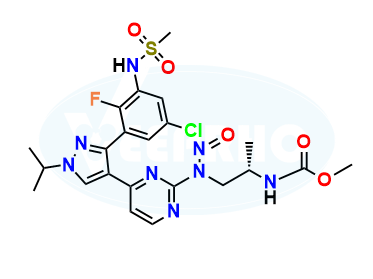
1–9 of 9 results6 in stock
| Structure | Product Name |
|---|---|
| Encorafenib Amino Carbamate ImpurityCAS No. 1269440-78-9 · VE0026121 · In stock | |
| Encorafenib Descarbamate ImpurityCAS No. 3047752-81-5 · VE0027867 | |
| Encorafenib Disulfonamide ImpurityCAS No. 1269440-99-4 · VE0027868 · In stock | |
| Encorafenib Impurity 2CAS No. 1269440-54-1 · VE0027869 · In stock | |
| Encorafenib Impurity 4CAS No. 1269440-58-5 · VE0027880 · In stock | |
| Encorafenib R-IsomerCAS No. 1269440-29-0 · VE0026120 · In stock | |
| Encorafenib Refrence standardCAS No. 1269440-17-6 · VE0026051 | |
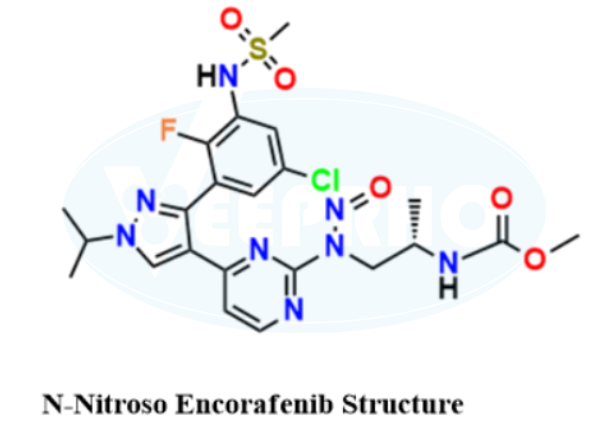
| N-Nitroso EncorafenibVE0024018 | |
| 1-(3-Iodo-1-isopropyl-1H-pyrazol-4-yl)ethan-1-oneCAS No. 1269440-49-4 · VE0027881 · In stock |
Encorafenib and Related Compound
Encorafenib active pharmaceutical ingredient is controlled using validated chromatographic and mass spectrometric methods to quantify related substances and degradation products. Typical quality acceptance criteria applied in API specifications include individual identified related compounds limited to 0.20 percent or less by area, individual unspecified impurities limited to 0.10 percent or less by area, and total impurities controlled to 1.0 percent or less by area. Specified known impurities and degradants are assigned structural identification and tighter limits as required. Residual solvents and elemental impurities are managed according to ICH guidelines, and water content is controlled to ensure stability. These limits are representative of common regulatory and pharmacopeial expectations and are implemented alongside stability-indicating assays and forced-degradation studies.
FAQ
What is the drug encorafenib used for?
Encorafenib is used to treat cancers driven by activating BRAF mutations, most notably BRAF V600-mutant melanoma, and is often administered as part of a combination therapy to improve response and delay resistance.
Is encorafenib a targeted therapy?
Yes. Encorafenib is a targeted therapy that selectively inhibits mutant BRAF kinase activity, aiming at a defined molecular driver of tumor growth rather than broadly cytotoxic mechanisms.
What is the mechanism of action of encorafenib?
Encorafenib binds to the ATP pocket of mutant BRAF kinases, inhibiting their catalytic activity, which reduces downstream MEK and ERK phosphorylation in the MAPK pathway, leading to decreased tumor cell proliferation and increased apoptosis; combination strategies are used to mitigate compensatory pathway reactivation.
Does encorafenib cause hair loss?
Hair thinning or hair loss can occur with encorafenib in some patients, along with other dermatologic effects; incidence and severity vary, so patients should review prescribing information and consult their oncology team for management options.