
Pranlukast Impurities
Request a quote for a set
- Request quote for this set
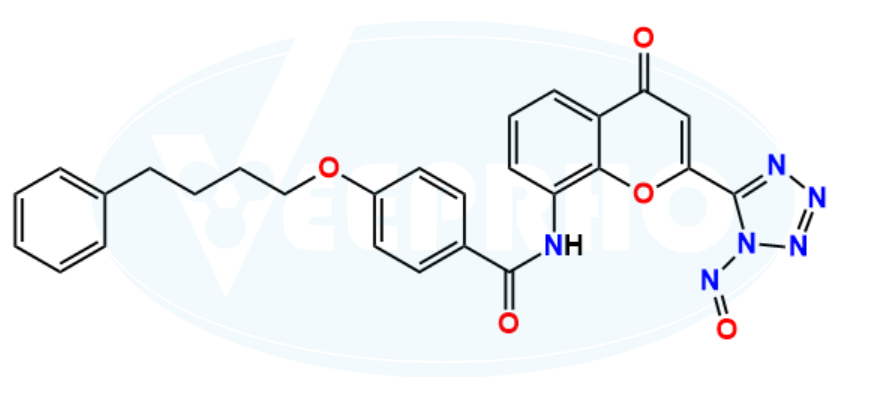
All nitrosamine impurities of Pranlukast
4 products


1–7 of 7 results5 in stock
| Structure | Product Name |
|---|---|
| Ethyl 1-nitroso-1H-tetrazole-5-carboxylateVE0012581 | |
| Pranlukast 8-Amino ImpurityCAS No. 110683-22-2 · VE0018960 · In stock | |
| Pranlukast Benzoic Acid ImpurityCAS No. 30131-16-9 · VE0018961 · In stock | |
| Pranlukast Chromene Carboxamide ImpurityCAS No. 136450-10-7 · VE0018958 · In stock | |
| Pranlukast Chromene Carboxylic Acid ImpurityCAS No. 211116-98-2 · VE0018957 · In stock | |
| Pranlukast Nitroso ImpurityVE0012580 | |
| 8-Amino-4-oxo-2-(tetrazol-5-yl)benzopyran HydrochlorideCAS No. 110683-23-3 · VE0023099 · In stock |
Pranlukast Related Compound
Impurities in pranlukast originate from its complex synthetic pathway involving condensation reactions, heterocyclic ring formation, and sulfonamide chemistry. Due to its aromatic and heterocyclic moieties, degradation through oxidation or hydrolysis is also a concern. Impurities must comply with ICH Q3A/B guidelines and local pharmacopeial standards (e.g., JP).
Types of Impurities in Pranlukast
Process-Related Impurities • Unreacted starting materials such as quinoline derivatives or benzothiophene sulfonamides • Side-products from coupling reactions or incomplete ring closure • Residual solvents like DMF, toluene, or isopropanol • Over-reaction products from sulfonation or amide formation steps Degradation Impurities • Hydrolysis of amide bonds under humidity or heat • Oxidation of aromatic or sulfur-containing groups • Decomposition of quinoline ring under photolytic or acidic conditions • Formation of nitrated or sulfone derivatives upon exposure to oxidants Elemental Impurities • Trace metals such as iron, copper, or palladium from synthetic catalysts • Regulated as per ICH Q3D for oral drug products Analytical Techniques for Impurity Detection • HPLC – primary technique for assay and related substances profiling • LC-MS/MS – for identification and structure elucidation of trace/unknown impurities • GC – to detect and quantify residual solvents • UV-Vis spectroscopy – to assess photodegradation • ICP-MS – for elemental impurity analysis • Stability testing (ICH Q1A/Q1B) – to determine degradation under stress conditions
FAQ
What is Pranlukast used for?
Pranlukast is used for long-term management of asthma, reducing inflammation and bronchial hyperresponsiveness. It may also provide relief in allergic rhinitis.
How does Pranlukast work?
It blocks leukotriene D4 from binding to CysLT1 receptors on airway smooth muscle and immune cells, thus preventing bronchoconstriction and inflammation.
What are the common side effects of Pranlukast?
Headache • Abdominal pain • Diarrhea • Drowsiness • Rare: liver function abnormalities or hypersensitivity reactions
Is Pranlukast a bronchodilator?
No. It is not a bronchodilator but a leukotriene receptor antagonist that works as a controller medication to prevent asthma symptoms.
How should Pranlukast be stored?
Store in a cool, dry place below 25°C, protected from moisture and light. Keep tightly closed in original packaging.