
Impurezas de Afatinib
Solicitar cotação de um conjunto
- Solicitar cotação para este conjunto
Todas as impurezas de nitrosaminas de Afatinib
2 produtosVer os 2 produtos
- N-Nitroso Afatinib VE0020299
- N-Nitroso N-Desmethyl Afatinib VE0020300


1–32 de 32 resultados18 em estoque
| Estrutura | Nome do produto |
|---|---|
 | Afatinib Amino Pyrrolidinone ImpurityVL5510060 |
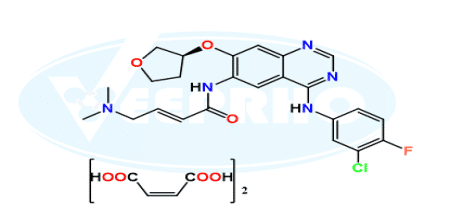 | Afatinib DimaleateNº CAS 850140-73-7 · VL5510061 · Em estoque |
| Afatinib Impurity 6Nº CAS 2413212-07-2 · VL5510018 | |
| Afatinib Impurity 8Nº CAS 2413212-09-4 · VE0012027 · Em estoque | |
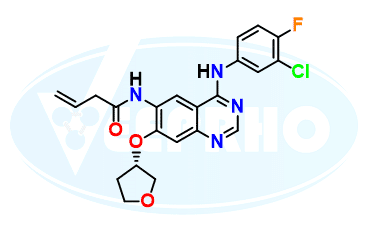 | Afatinib Impurity 11Nº CAS 2413212-17-4 · VE0012028 · Em estoque |
| Afatinib Impurity 12Nº CAS 2121530-37-6 · VE0012029 · Em estoque | |
 | Afatinib Impurity 14VE0012031 · Em estoque |
 | Afatinib Impurity 15VE0012032 · Em estoque |
| Afatinib Impurity 16Nº CAS 2223677-60-7 · VE0012038 · Em estoque | |
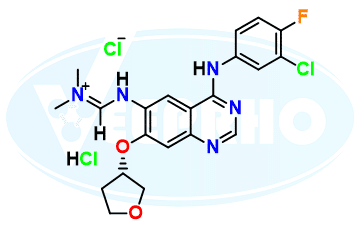 | Afatinib Impurity 17 HClVE0012039 · Em estoque |
| Afatinib Impurity 18Nº CAS 2413212-25-4 · VE0012040 · Em estoque | |
| Afatinib Impurity 21Nº CAS 2044709-72-8 · VE0012041 · Em estoque | |
| Afatinib Impurity 46Nº CAS 2223677-58-3 · VE0012042 · Em estoque | |
| Afatinib Impurity 50Nº CAS 2323570-72-3 · VE0012043 · Em estoque | |
| Afatinib Impurity 53Nº CAS 402855-07-6 · VE0012025 · Em estoque | |
| Afatinib Impurity 55Nº CAS 2223677-62-9 · VE0012026 · Em estoque | |
| Afatinib Impurity ANº CAS 314771-88-5 · VL5510004 | |
| Afatinib Impurity BNº CAS 314771-76-1 · VL5510005 | |
| Afatinib Impurity CNº CAS 945553-91-3 · VL5510006 | |
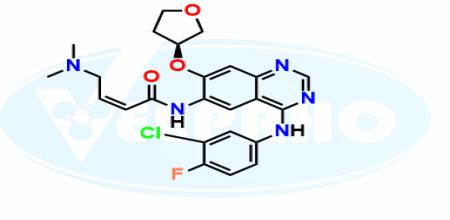 | Afatinib Impurity DNº CAS 1680184-59-1 · VL5510007 · Em estoque |
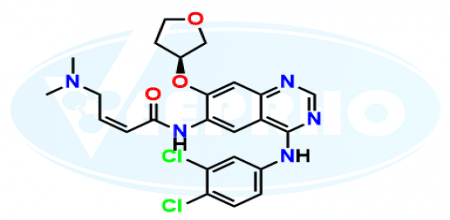 | Afatinib Impurity EVL5510008 |
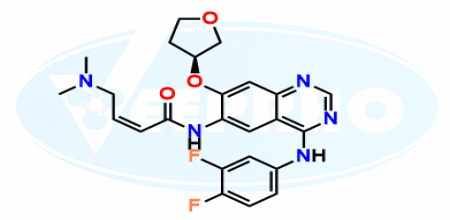 | Afatinib Impurity FVL5510009 · Em estoque |
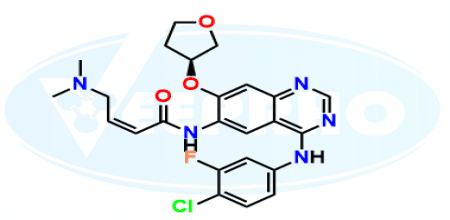 | Afatinib Impurity GVL5510010 |
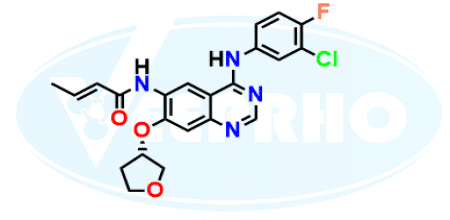 | Afatinib Impurity HVL5510011 |
 | Afatinib Impurity IVL5510012 |
| Afatinib Impurity JNº CAS 1456696-14-2 · VL5510013 | |
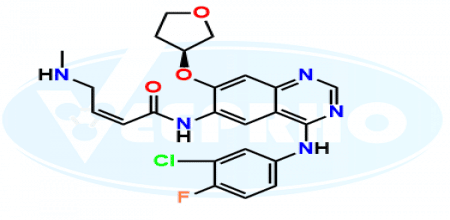 | Afatinib Impurity KVL5510024 |
| Afatinib impurity VNº CAS 2223677-61-8 · VE009821 · Em estoque | |
 | Afatinib Maleic Acid AdductVL5510057 |
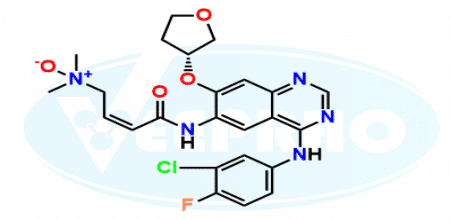 | Afatinib N-Oxide ImpurityVL5510023 |
| N-Nitroso AfatinibVE0020299 | |
| N-Nitroso N-Desmethyl AfatinibVE0020300 · Em estoque |
Afatinib Related Compound
Afatinib impurities can result from synthesis, formulation processes, or degradation, and must be controlled under ICH and regulatory guidelines to ensure drug safety, purity, and efficacy.
Types of Impurities in Afatinib
Process-Related Impurities
- Unreacted intermediates in the quinazoline or aniline pathways
- Residual solvents such as methanol, acetonitrile, or DMF
- Isomeric by-products or excess reagents from coupling reactions
Degradation Impurities
- Oxidative degradation products under air or light
- Hydrolysis products in high humidity or aqueous environments
- Thermal degradation from excessive heat during storage
Elemental Impurities
- Trace levels of heavy metals (e.g., arsenic, cadmium, lead, mercury) from catalysts or manufacturing equipment
Analytical Techniques for Impurity Detection
- High-Performance Liquid Chromatography (HPLC)
- Mass Spectrometry (MS)
- Gas Chromatography (GC)
- Fourier-Transform Infrared Spectroscopy (FT-IR)
- Nuclear Magnetic Resonance (NMR)
Perguntas frequentes
Is Afatinib a chemotherapy drug?
No , Afatinib is not a traditional chemotherapy drug . It is a targeted therapy , specifically a tyrosine kinase inhibitor , designed to block EGFR and related pathways that drive cancer cell growth. Unlike chemotherapy, which kills both cancerous and healthy dividing cells, Afatinib selectively targets cancer cells with EGFR mutations .
Can Afatinib cure cancer?
Afatinib does not cure cancer , but it can significantly slow down or control its growth , particularly in EGFR-positive non-small cell lung cancer . It helps extend progression-free survival and improve quality of life , especially when used in early treatment lines. Cancer may eventually develop resistance , at which point alternative therapies may be required.
What is the mechanism of action of Afatinib?
Afatinib irreversibly binds to the ErbB family of receptors , including EGFR (ErbB1) , HER2 (ErbB2) , and ErbB4 , inhibiting tyrosine kinase activity . This blocks downstream signaling pathways responsible for: Cell proliferation Survival Angiogenesis By blocking these pathways, Afatinib helps prevent tumor growth and spread .
What is the life expectancy of someone on Afatinib?
Life expectancy depends on several factors, including: Type and stage of cancer Specific EGFR mutation present Overall health and response to therapy In clinical trials, median progression-free survival was around 11–13 months , and overall survival can extend to 2 years or more in some patients. However, individual outcomes vary widely, and treatment plans are customized by oncologists .