
Impurezas de Prilocaine
Solicitar cotação de um conjunto
- Solicitar cotação para este conjunto
Todas as impurezas EP de Prilocaine
8 produtosVer os 8 produtos
- Prilocaine EP Impurity A VE0018383
CAS 19281-31-3 - Prilocaine EP Impurity B VL6590004
CAS 95-53-4 - Prilocaine EP Impurity C (HCl Salt) VE0018001
CAS 35891-75-9 - Prilocaine EP Impurity D (HCl Salt) VE0018164
CAS 878791-35-6 - Prilocaine EP Impurity E VL3920001
CAS 744961-76-0 - Prilocaine EP Impurity E (HCl Salt) VE0025672
CAS 35891-99-7 - Prilocaine EP Impurity F (HCl) VE0017683
CAS 13327-14-5 - Prilocaine EP Impurity G (HCl Salt) VE0019515
CAS 1049712-77-7
- Prilocaine EP Impurity A VE0018383
- Solicitar cotação para este conjunto
Todas as impurezas USP de Prilocaine
4 produtosVer os 4 produtos
- Prilocaine EP Impurity B VL6590004
CAS 95-53-4 - Prilocaine EP Impurity E VL3920001
CAS 744961-76-0 - Prilocaine EP Impurity E (HCl Salt) VE0025672
CAS 35891-99-7 - Prilocaine Related Compound A VE0010317
CAS 636-21-5
- Prilocaine EP Impurity B VL6590004
- Solicitar cotação para este conjunto
Todas as impurezas de nitrosaminas de Prilocaine
7 produtosVer os 7 produtos
- N-Nitroso Prilocaine VE0018364
CAS 211490-46-9 - N-Nitroso Prilocaine EP Impurity A VE0017286
- N-Nitroso Prilocaine EP Impurity C VE0017288
- N-Nitroso Prilocaine EP Impurity D VE0017289
- N-Nitroso Prilocaine EP Impurity E VE0017290
- N-Nitroso Prilocaine EP Impurity F VE0017291
- N-Nitroso Prilocaine EP Impurity G VE0017292
- N-Nitroso Prilocaine VE0018364


1–18 de 18 resultados18 em estoque
| Estrutura | Nome do produto |
|---|---|
| N-Nitroso PrilocaineNº CAS 211490-46-9 · VE0018364 · Em estoque | |
| N-Nitroso Prilocaine EP Impurity AVE0017286 · Em estoque | |
| N-Nitroso Prilocaine EP Impurity CVE0017288 · Em estoque | |
| N-Nitroso Prilocaine EP Impurity DVE0017289 · Em estoque | |
| N-Nitroso Prilocaine EP Impurity EVE0017290 · Em estoque | |
| N-Nitroso Prilocaine EP Impurity FVE0017291 · Em estoque | |
| N-Nitroso Prilocaine EP Impurity GVE0017292 · Em estoque | |
| Prilocaine EP Impurity ANº CAS 19281-31-3 · VE0018383 · Em estoque | |
| Prilocaine EP Impurity BNº CAS 95-53-4 · VL6590004 · Em estoque | |
| Prilocaine EP Impurity C (HCl Salt)Nº CAS 35891-75-9 · VE0018001 · Em estoque | |
| Prilocaine EP Impurity D (HCl Salt)Nº CAS 878791-35-6 · VE0018164 · Em estoque | |
| Prilocaine EP Impurity ENº CAS 744961-76-0 · VL3920001 · Em estoque | |
| Prilocaine EP Impurity E (HCl Salt)Nº CAS 35891-99-7 · VE0025672 · Em estoque | |
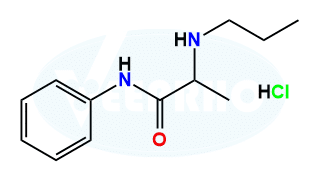 | Prilocaine EP Impurity F (HCl)Nº CAS 13327-14-5 · VE0017683 · Em estoque |
| Prilocaine EP Impurity G (HCl Salt)Nº CAS 1049712-77-7 · VE0019515 · Em estoque | |
| Prilocaine Impurity 2Nº CAS 2509057-86-5 · VE0017898 · Em estoque | |
 | Prilocaine Impurity 10VE0019513 · Em estoque |
| Prilocaine Related Compound ANº CAS 636-21-5 · VE0010317 · Em estoque |
Prilocaine Impurities and Related Compound
Typical quality control for prilocaine active pharmaceutical ingredient monitors related substances including N dealkylation products, hydrolysis products, the aromatic amine o toluidine, despropyl derivatives and process related impurities from synthesis such as unreacted anilines and O alkylation by products. Typical API and finished product specifications used in manufacturing and pharmacopeial monographs control individual related compounds generally at or below the 0.1 to 0.5 percent range by weight and total impurities below approximately 1.0 percent by weight, with particularly toxic species such as o toluidine often limited to low parts per million levels for safety, commonly specified at or below 0.05 percent by weight depending on regional regulatory requirements. Analytical methods for release and stability include HPLC with UV or MS detection and confirmatory GC MS for volatile or low level aromatic amines, with residual solvents and heavy metal limits applied per standard guidance.
Perguntas frequentes
What is the use of prilocaine?
Prilocaine is used to produce local anesthesia for minor surgical, dental and dermatologic procedures. Injectable solutions are commonly used for local infiltration and nerve blocks in dentistry and surgery, while topical mixtures with lidocaine are used to numb skin prior to needle insertion or superficial procedures.
What is the difference between lidocaine and prilocaine?
Both are amino amide local anesthetics that block voltage gated sodium channels, but they differ in potency, onset, metabolism and side effect profile. Prilocaine tends to have slightly lower systemic toxicity at equivalent doses and a similar to slightly faster onset, while lidocaine is more widely used and has a broader range of formulations. Prilocaine is metabolized to o toluidine which can induce methemoglobinemia at high doses, a risk less associated with lidocaine.
How is prilocaine metabolized?
Prilocaine undergoes hepatic and plasma amidase mediated hydrolysis and N dealkylation to form several metabolites; a principal metabolite is o toluidine, an aromatic amine that can oxidize hemoglobin to methemoglobin. Metabolism is rapid, contributing to a relatively short systemic half life; renal excretion clears polar metabolites.
How long does the prilocaine effect last?
Duration depends on route, concentration, dose and presence of vasoconstrictor. Typical infiltration or peripheral block durations are in the short to intermediate range, often from about 30 minutes up to 2 hours for soft tissue, with pulpal anesthesia in dental applications commonly shorter. Addition of a vasoconstrictor will prolong local effect by reducing systemic absorption.