
- 100 % Datengenauigkeit
- Wissenschaftlicher Support rund um die Uhr
- 0 % Toleranz bei der Produktqualität
Lagerstandorte
- New Jersey, USA
- Tschechien, EU
* Bestand vorbehaltlich Verfügbarkeit.
Dokumentation
Enthält: HPLC, MASS/LC-MS, 1H-NMR, FT-IR, Gehalt, Structure Elucidation Report (SER) sowie zusätzliche analytische Daten je nach Produkt.
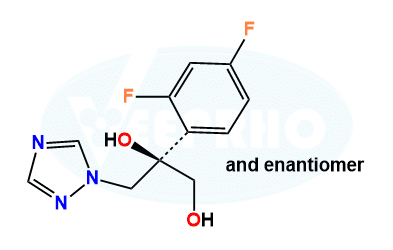
118689-07-9
Fluconazole EP Impurity F
● In Stock
| Katalog-Nr.: | VE0016273 |
|---|---|
| CAS-Nr.: | 118689-07-9 |
| Summenformel: | C11H11F2N3O2 |
| Molare Masse: | 255.23 g/mol |
For laboratory use only: analytical, development and regulatory purposes. Supplied in mg quantities. Not for human or veterinary use.
Angebot für ein Set anfordern
- Angebot für dieses Set anfragen
Alle EP-Verunreinigungen von Fluconazole
10 ProdukteDie 10 Produkte ansehen
- Fluconazole EP Impurity A VL60005
CAS 89429-59-4 - Fluconazole EP Impurity B VL60001
CAS 871550-15-1 - Fluconazole EP Impurity C VL60003
CAS 514222-44-7 - Fluconazole EP Impurity E VL60008
CAS 86404-63-9 - Fluconazole EP Impurity F VE0016273
CAS 118689-07-9 - Fluconazole EP Impurity G VE0013448
CAS 86386-76-7 - Fluconazole EP Impurity G (Mesylate) VE0016259
CAS 86386-77-8 - Fluconazole EP Impurity H VE0016257
CAS 150194-52-8 - Fluconazole EP Impurity I VL60004
CAS 150168-54-0 - Fluconazole Related Compound B VL60002
CAS 81886-51-3
- Fluconazole EP Impurity A VL60005
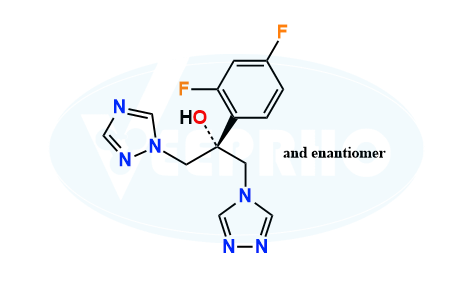


Zusätzliche Informationen zu CAS 118689-07-9
| Wirkstoff | Fluconazole |
|---|---|
| Produkttyp | Verunreinigungsstandards |
| IUPAC-Name | (2RS)-2-(2,4-difluorophenyl)-3-(1H-1,2,4-triazol-1-yl)propane-1,2-diol |
| Name im EP | Fluconazole EP Impurity F |
| SMILES | OCC(O)(Cn1cncn1)c1ccc(F)cc1F |
| InChIKey | BZYVJTMKMDGJRN-UHFFFAOYSA-N |
| CHNS-Verhältnis (%) (berechnet) | C 51.77 · H 4.34 · N 16.46 · S 0.00 |
| Referenzen | - |
| Beschreibung | Fluconazol EP Verunreinigung F, auch als Fluconazol-Diol-Verunreinigung bezeichnet, ist ein definierter prozess- und/oder abbauassoziierter Analogon des Triazol-Antimykotikums Fluconazol. CAS 118689-07-9 entspricht C11H11F2N3O2 bei einer Molekülmasse von 255,23 g/mol. Strukturell handelt es sich um ein hydroxylierter Oxidationszustand der 2,4-Difluorphenyl-substituierten Seitenkette, der typischerweise aus Variationen des Synthesewegs oder oxidativer Biotransformation resultiert. Die erhöhte Polarität und die enge strukturelle Verwandtschaft zum Wirkstoff erschweren die chromatographische Trennung. Der sensitive Nachweis erfordert üblicherweise LC-MS/MS, hochauflösende LC-MS sowie HPLC-Methoden zur Verunreinigungsprofilierung, mit Relevanz im Rahmen pharmakopöischer Spezifikationen und allgemeiner ICH-Impurity-Bewertung. |
Angebot anfordern
"*" kennzeichnet Pflichtfelder
Weitere Produkte zu Fluconazole Verunreinigungen
| Struktur der Verunreinigung | Name der Verunreinigung | Katalog-Nr. |
|---|---|---|
| Fluconazole EP Impurity A | VL60005 | |
| Fluconazole EP Impurity B | VL60001 | |
| Fluconazole EP Impurity C | VL60003 | |
| Fluconazole EP Impurity E | VL60008 | |
| Fluconazole EP Impurity G | VE0013448 | |
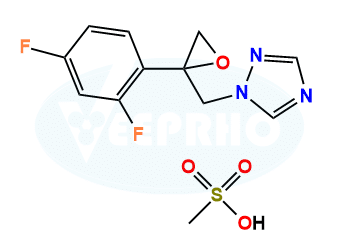 | Fluconazole EP Impurity G (Mesylate) | VE0016259 |
| Fluconazole EP Impurity H | VE0016257 | |
| Fluconazole EP Impurity I | VL60004 | |
| Fluconazole Related Compound B | VL60002 | |
| 4-Amino-1,2,4-triazole | VE0022421 | |
| Fluconazole Impurity 1 | VE0022362 | |
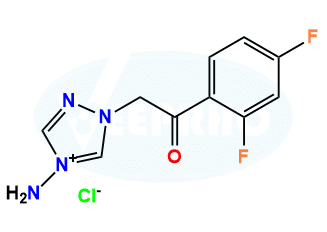 | Fluconazole Impurity 5 (Chloride) | VE0016277 |