
- 100 % Datengenauigkeit
- Wissenschaftlicher Support rund um die Uhr
- 0 % Toleranz bei der Produktqualität
Lagerstandorte
- New Jersey, USA
- Tschechien, EU
* Bestand vorbehaltlich Verfügbarkeit.
Dokumentation
Enthält: HPLC, MASS/LC-MS, 1H-NMR, FT-IR, Gehalt, Structure Elucidation Report (SER) sowie zusätzliche analytische Daten je nach Produkt.
43197-33-7
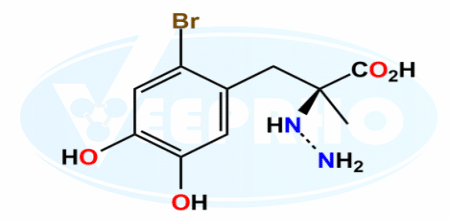
Carbidopa EP Impurity J
● In Stock
| Katalog-Nr.: | VE006053 |
|---|---|
| CAS-Nr.: | 43197-33-7 |
| Summenformel: | C10H13BrN2O4 |
| Molare Masse: | 305.13 g/mol |
For laboratory use only: analytical, development and regulatory purposes. Supplied in mg quantities. Not for human or veterinary use.
Angebot für ein Set anfordern
- Angebot für dieses Set anfragen
Alle EP-Verunreinigungen von Carbidopa
10 ProdukteDie 10 Produkte ansehen
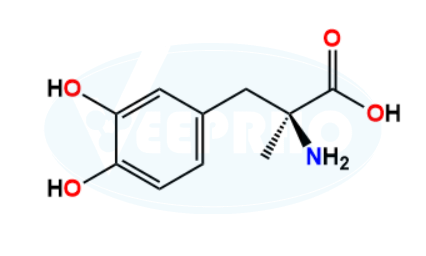
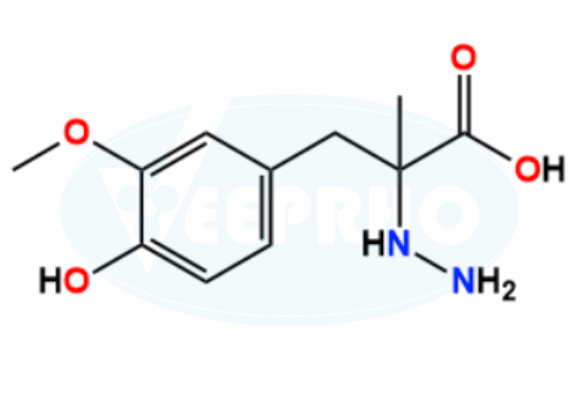
- Carbidopa EP Impurity A VL420005
CAS 555-30-6 - Carbidopa EP Impurity B VL420003
CAS 18181-08-3 - Carbidopa EP Impurity C VL420010
CAS 85933-19-3 - Carbidopa EP Impurity C (S)-Isomer VE0013212
CAS 84488-77-7 - Carbidopa EP Impurity E VL420006
CAS 52514-63-3 - Carbidopa EP Impurity F(Free Base) VL420007
CAS 91908-71-3 - Carbidopa EP Impurity H VL420013
CAS 1361017-74-4 - Carbidopa EP Impurity I VE006052
CAS 1246819-09-9 - Carbidopa EP Impurity J VE006053
CAS 43197-33-7 - N-Cyclohexylidene Carbidopa Methyl Ester VL420004
CAS 934371-48-9
- Carbidopa EP Impurity A VL420005

Zusätzliche Informationen zu CAS 43197-33-7
| Wirkstoff | Carbidopa |
|---|---|
| Produkttyp | Verunreinigungsstandards |
| IUPAC-Name | (2S)-3-(2-Bromo-4,5-dihydroxyphenyl)-2-hydrazino-2-methylpropanoic acid |
| Name im EP | Carbidopa EP Impurity J |
| SMILES | C[C@@](Cc1cc(O)c(O)cc1Br)(NN)C(=O)O |
| InChIKey | ZIBONFZRHFUWIX-JTQLQIEISA-N |
| CHNS-Verhältnis (%) (berechnet) | C 39.36 · H 4.29 · N 9.18 · S 0.00 |
| Referenzen | - |
| Beschreibung | Carbidopa EP Impurity J, als 2-Brom-(S)-Carbidopa bezeichnet, ist ein halogeniertes Strukturanalogon des Dopa-Decarboxylase-Hemmers Carbidopa mit Bromsubstitution am aromatischen Ringsystem. CAS 43197-33-7; Summenformel C10H13BrN2O4; Molekulargewicht 305,13 g/mol. Die Verunreinigung kann als synthetischer Nebenbestandteil bei elektrophiler Bromierung oder durch Halogenaustausch in Vorstufen entstehen und ist nicht typischerweise als einfache Hydrolysefolge zu bewerten. Aufgrund der engen strukturellen Verwandtschaft zum Wirkstoff erfolgt die Bestimmung üblicherweise mittels chromatographischer Verfahren in Kombination mit LC-MS/MS oder hochauflösender Massenspektrometrie zur Identitätsbestätigung und Gehaltsbestimmung. |
Angebot anfordern
"*" kennzeichnet Pflichtfelder