
- 100 % Datengenauigkeit
- Wissenschaftlicher Support rund um die Uhr
- 0 % Toleranz bei der Produktqualität
Lagerstandorte
- New Jersey, USA
- Tschechien, EU
* Bestand vorbehaltlich Verfügbarkeit.
Dokumentation
Enthält: HPLC, MASS/LC-MS, 1H-NMR, FT-IR, Gehalt, Structure Elucidation Report (SER) sowie zusätzliche analytische Daten je nach Produkt.
910297-52-8
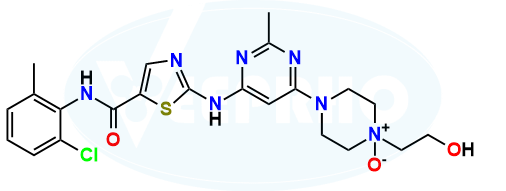
Dasatinib N-Oxide
● In Stock
| Katalog-Nr.: | VL4870001 |
|---|---|
| CAS-Nr.: | 910297-52-8 |
| Summenformel: | C22H26ClN7O3S |
| Molare Masse: | 504.00 g/mol |
For laboratory use only: analytical, development and regulatory purposes. Supplied in mg quantities. Not for human or veterinary use.
Angebot für ein Set anfordern
- Angebot für dieses Set anfragen
Alle USP-Verunreinigungen von Dasatinib
2 ProdukteDie 2 Produkte ansehen
- Dasatinib Dehydroxy Ethyl Impurity VE009762
CAS 910297-51-7 - Dasatinib N-Oxide VL4870001
CAS 910297-52-8
- Dasatinib Dehydroxy Ethyl Impurity VE009762

Zusätzliche Informationen zu CAS 910297-52-8
| Wirkstoff | Dasatinib |
|---|---|
| Produkttyp | Verunreinigungsstandards |
| IUPAC-Name | 4-(6-((5-((2-chloro-6-methylphenyl)carbamoyl)thiazol-2-yl)amino)-2-methylpyrimidin-4-yl)-1-(2-hydroxyethyl)piperazine 1-oxide |
| Name in der USP | Dasatinib Related Compound A |
| SMILES | Cc1nc(Nc2ncc(C(=O)Nc3c(C)cccc3Cl)s2)cc(N2CC[N+]([O-])(CCO)CC2)n1 |
| InChIKey | UEFNEEZCTQCRAW-UHFFFAOYSA-N |
| CHNS-Verhältnis (%) (berechnet) | C 52.43 · H 5.20 · N 19.45 · S 6.36 |
| Referenzen | Christopher | Lisa J. | et al. “Metabolism and Disposition of Dasatinib after Oral Administration to Humans.†Drug Metabolism and Disposition | vol. 36 | no. 7 | Apr. 2008 | pp. 1357–64 | https://doi.org/10.1124/dmd.107.018267.?McCormack | Paul L. | and Susan J. Keam. “Dasatinib.†Drugs | vol. 71 | no. 13 | Sept. 2011 | pp. 1771–95 | https://doi.org/10.2165/11207580-000000000-00000. |
| Beschreibung | Dasatinib-N-oxid, auch als Dasatinib Related Compound A bezeichnet, ist eine oxidierte prozess- und abbauassoziierte Verunreinigung des Tyrosinkinase-Inhibitors Dasatinib (CAS 910297-52-8). Mit der Summenformel C22H26ClN7O3S und einer Molekülmasse von 504,00 g/mol entspricht es einer Sauerstoffinsertion am Stickstoffzentrum, die typischerweise unter oxidativem Stress während Synthese, Lagerung oder Formulierungsprozess entsteht. Die Bestimmung erfolgt üblicherweise mittels LC-MS/MS und LC-UV, mit bestätigender Charakterisierung durch HRMS und bei Bedarf NMR. Obwohl kein Nitrosamin, ist der Stoff für das Verunreinigungsprofil und stabilitätsindikative Verfahren nach ICH Q3A/Q3B relevant. |
Angebot anfordern
"*" kennzeichnet Pflichtfelder
Weitere Produkte zu Dasatinib Verunreinigungen
| Struktur der Verunreinigung | Name der Verunreinigung | Katalog-Nr. |
|---|---|---|
| 2-[4-(6-Chloro-2-methylpyrimidin-4-yl)piperazin-1-yl]ethanol | VE0022857 | |
| 2-Deschloro-2-Hydroxy Dasatinib | VE0014218 | |
| Dasatinib Carboxylic Acid | VE0014221 | |
| Dasatinib Dehydroxy Ethyl Impurity | VE009762 | |
| Dasatinib Dimer Impurity | VE0014217 | |
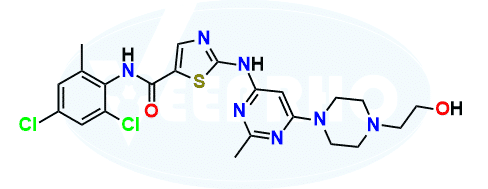 | Dasatinib Impurity 1 | VE0014226 |
| Dasatinib Impurity 2 | VE0014227 | |
| Dasatinib Impurity 3 | VE0014229 | |
| Dasatinib Impurity 5 | VE0014207 | |
| Dasatinib Impurity 6 | VE0014209 | |
| Dasatinib Impurity 7 | VE0014210 | |
| Dasatinib Impurity 13 | VE0014219 |