

- 100 % Datengenauigkeit
- Wissenschaftlicher Support rund um die Uhr
- 0 % Toleranz bei der Produktqualität
Lagerstandorte
- New Jersey, USA
- Tschechien, EUAuf Lager
* Bestand vorbehaltlich Verfügbarkeit.
Dokumentation
Enthält: HPLC, MASS/LC-MS, 1H-NMR, FT-IR, Gehalt, Structure Elucidation Report (SER) sowie zusätzliche analytische Daten je nach Produkt.
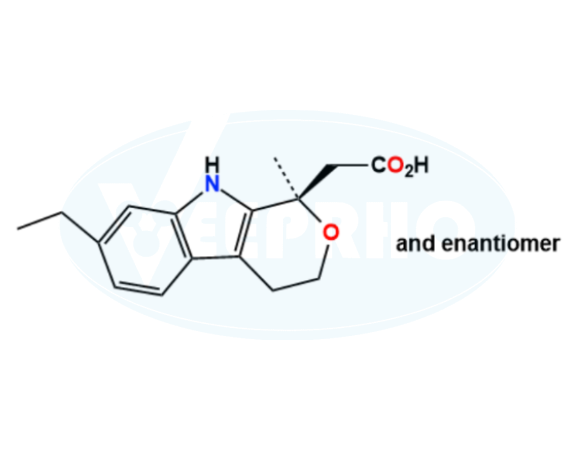
115066-03-0
Etodolac EP Impurity J
● Auf Lager
| Katalog-Nr.: | VL2000010 |
|---|---|
| CAS-Nr.: | 115066-03-0 |
| Summenformel: | C16H21NO |
| Molare Masse: | 243.34 g/mol |
For laboratory use only: analytical, development and regulatory purposes. Supplied in mg quantities. Not for human or veterinary use.
Angebot für ein Set anfordern
- Angebot für dieses Set anfragen
Alle EP-Verunreinigungen von Etodolac
11 ProdukteDie 11 Produkte ansehen
- Etodolac EP Impurity A VL2000007
CAS 41339-67-7 - Etodolac EP Impurity B VL2000005
CAS 41340-19-6 - Etodolac EP Impurity C (Free Base) VL2000008
CAS 109518-50-5 - Etodolac EP Impurity D VL2000001
CAS 57917-63-2 - Etodolac EP Impurity E VL2000002
CAS 57817-27-3 - Etodolac EP Impurity F VL2000003
CAS 849630-65-5 - Etodolac EP Impurity G VL2000004
CAS 57816-83-8 - Etodolac EP Impurity H VL2000009
CAS 41340-36-7 - Etodolac EP Impurity I VE009267
- Etodolac EP Impurity J VL2000010
CAS 115066-03-0 - Etodolac EP Impurity K VL2000011
CAS 122188-02-7
- Etodolac EP Impurity A VL2000007

Zusätzliche Informationen zu CAS 115066-03-0
| Wirkstoff | Etodolac |
|---|---|
| Produkttyp | Verunreinigungsstandards |
| IUPAC-Name | 1,8-Diethyl-1,3,4,9-tetrahydro-1-methyl-pyrano[3,4-b]indole |
| Name im EP | Etodolac EP Impurity J |
| SMILES | CCc1cccc2c3c([nH]c12)C(C)(CC)OCC3 |
| InChIKey | IYMCQNNWNNRAQH-UHFFFAOYSA-N |
| CHNS-Verhältnis (%) (berechnet) | C 78.97 · H 8.70 · N 5.76 · S 0.00 |
| Referenzen | - |
| Beschreibung | Etodolac EP Impurity J, auch als decarboxyliertes Etodolac bezeichnet, CAS 115066-03-0, ist eine verwandte Substanz, die durch decarboxylative Degradation des Pyranocarbonsäure-Gerüsts von Etodolac entsteht. Diese neutrale heteroaromatische Verunreinigung besitzt die Summenformel C16H21NO und eine molare Masse von 243,34 g/mol. Ihre Bildung ist typischerweise mit thermischer Belastung, sauren oder lang gelagerten Bedingungen sowie prozessbedingter Umwandlung des Wirkstoffs verknüpft. Aufgrund der geringen Gehalte ist zur Identifizierung und Quantifizierung meist LC-MS/MS, LC-HRMS und orthogonale HPLC mit UV-Detektion erforderlich. Die Substanz gilt nicht als klassisch genotoxisch, ihre Kontrolle unterstützt jedoch die monographische Spezifikation und die stabilitätsindizierende Bewertung. |
Angebot anfordern
"*" kennzeichnet Pflichtfelder
Weitere Produkte zu Etodolac Verunreinigungen
| Struktur der Verunreinigung | Name der Verunreinigung | Katalog-Nr. |
|---|---|---|
 | Etodolac EP Impurity A | VL2000007 |
| Etodolac EP Impurity B | VL2000005 | |
| Etodolac EP Impurity C (Free Base) | VL2000008 | |
| Etodolac EP Impurity D | VL2000001 | |
| Etodolac EP Impurity E | VL2000002 | |
| Etodolac EP Impurity F | VL2000003 | |
| Etodolac EP Impurity G | VL2000004 | |
 | Etodolac EP Impurity H | VL2000009 |
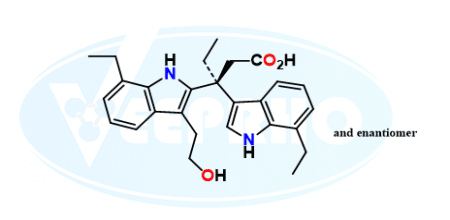 | Etodolac EP Impurity I | VE009267 |
| Etodolac EP Impurity K | VL2000011 | |
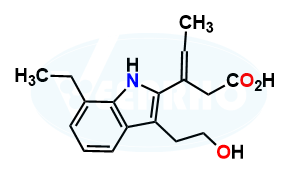 | Etodolac EP Impurity L (Free Base) | VE0025644 |
| 1-(1,8-diethyl-9-nitroso-1,3,4,9-tetrahydropyrano[3,4-b]indol-1-yl)propan-2-one | VE0023845 |
Alle verwandten Produkte zeigen N-Nitroso-Etodolac-Verunreinigungen (4)