
- 100 % Datengenauigkeit
- Wissenschaftlicher Support rund um die Uhr
- 0 % Toleranz bei der Produktqualität
Lagerstandorte
- New Jersey, USA
- Tschechien, EU
* Bestand vorbehaltlich Verfügbarkeit.
Dokumentation
Enthält: HPLC, MASS/LC-MS, 1H-NMR, FT-IR, Gehalt, Structure Elucidation Report (SER) sowie zusätzliche analytische Daten je nach Produkt.
1320360-87-9
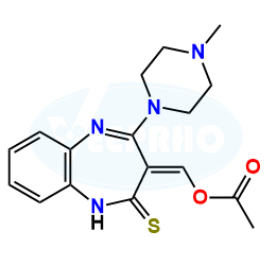
Olanzapine Acetyl Open Ring Analog
● Under Development
| Katalog-Nr.: | VE008122 |
|---|---|
| CAS-Nr.: | 1320360-87-9 |
| Summenformel: | C17H20N4O2S |
| Molare Masse: | 344.43 g/mol |
For laboratory use only: analytical, development and regulatory purposes. Supplied in mg quantities. Not for human or veterinary use.
Zusätzliche Informationen zu CAS 1320360-87-9
| Wirkstoff | Olanzapine |
|---|---|
| Produkttyp | Verunreinigungsstandards |
| IUPAC-Name | (Z)-(4-(4-methylpiperazin-1-yl)-2-thioxo-1H-benzo[b][1,4]diazepin-3(2H)-ylidene)methyl acetate |
| SMILES | CC(=O)O/C=C1\C(=S)Nc2ccccc2N=C1N1CCN(C)CC1 |
| InChIKey | KMCOFWWWTNQXFV-QBFSEMIESA-N |
| CHNS-Verhältnis (%) (berechnet) | C 59.28 · H 5.85 · N 16.27 · S 9.31 |
| Referenzen | Rao | P. Sreenivasa | et al. “Identification of Oxidative Degradation Impurities of Olanzapine Drug Substance as Well as Drug Product.†Journal of Pharmaceutical and Biomedical Analysis | vol. 56 | no. 2 | Sept. 2011 | pp. 413–18 | https://doi.org/10.1016/j.jpba.2011.05.003.? |
| Beschreibung | Olanzapin Acetyl Open Ring Analog, auch als Olanzapin Acetoxymethylidene bezeichnet, ist eine prozess- und abbauassoziierte Verunreinigung des Thienobenzodiazepin-Gerüsts von Olanzapin. Die CAS-Nummer 1320360-87-9 entspricht C17H20N4O2S bei einem Molekulargewicht von 344,43 g/mol. Die geöffnete, acetylierte Struktur weist auf eine oxidative oder hydrolytische Umwandlung des Ausgangsheterocyclus während Synthese, Lagerung oder Stressbedingungen hin und zeigt ein anderes Konformations- und Chromatographieprofil als Olanzapin. Die Bestimmung erfordert typischerweise LC-MS/MS oder hochauflösende LC-MS, ergänzt durch HPLC-UV für Profilierung und Verunreinigungszuordnung. Regulatorisch stehen Qualifizierung, Response-Faktoren und eine mögliche genotoxische Relevanz im Fokus. |
Angebot anfordern
"*" kennzeichnet Pflichtfelder
Weitere Produkte zu Olanzapine Verunreinigungen
| Struktur der Verunreinigung | Name der Verunreinigung | Katalog-Nr. |
|---|---|---|
| N-Nitroso Olanzapine EP Impurity B | VE0024726 | |
| N-Nitroso Olanzapine EP Impurity C | VE0024745 | |
| N-Nitroso Olanzapine EP Impurity D | VE0024727 | |
| Olanzapine EP Impurity A | VL109001 | |
| Olanzapine EP Impurity B | VL109002 | |
| Olanzapine EP Impurity C (Chloride) | VL109003 | |
| Olanzapine EP Impurity C (Free Base) | VE0028926 | |
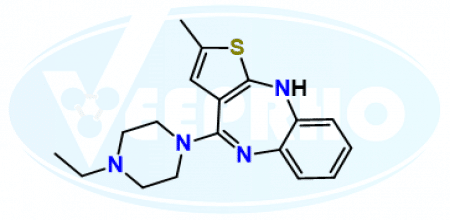 | Olanzapine Related Compound 03 | VL109004 |
| Olanzapine Related Compound 07 | VL109005 | |
 | Olanzapine Related Compound 08 | VL109006 |
| Olanzapine Related Compound C | VL109009 | |
| 2-Hydroxymethyl Olanzapine | VE0018343 |
Alle verwandten Produkte zeigen N-Nitroso-Olanzapine-Verunreinigungen (7)