
- 100 % Datengenauigkeit
- Wissenschaftlicher Support rund um die Uhr
- 0 % Toleranz bei der Produktqualität
Lagerstandorte
- New Jersey, USA
- Tschechien, EUAuf Lager
* Bestand vorbehaltlich Verfügbarkeit.
Dokumentation
Enthält: HPLC, MASS/LC-MS, 1H-NMR, FT-IR, Gehalt, Structure Elucidation Report (SER) sowie zusätzliche analytische Daten je nach Produkt.
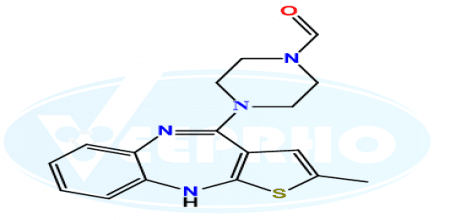
639460-79-0
Olanzapine F-PIN Impurity
● Auf Lager
| Katalog-Nr.: | VL109011 |
|---|---|
| CAS-Nr.: | 639460-79-0 |
| Summenformel: | C₁₇H₁₈N₄OS |
| Molare Masse: | 326.42 |
For laboratory use only: analytical, development and regulatory purposes. Supplied in mg quantities. Not for human or veterinary use.
Zusätzliche Informationen zu CAS 639460-79-0
| Wirkstoff | Olanzapine |
|---|---|
| Produkttyp | Verunreinigungsstandards |
| IUPAC-Name | 4-(2-Methyl-10H-thieno[2,3-b][1,5]benzodiazepin-4-yl)-1-piperazinecarboxaldehyde |
| SMILES | Cc1cc2c(s1)Nc1ccccc1N=C2N1CCN(C=O)CC1 |
| InChIKey | SFWJCBPXQCTXTO-UHFFFAOYSA-N |
| CHNS-Verhältnis (%) (berechnet) | C 62.55 · H 5.56 · N 17.16 · S 9.82 |
| Referenzen | Tumpa, Anja, et al. “Quality by Design in the Development of Hydrophilic Interaction Liquid Chromatography Method with Gradient Elution for the Analysis of Olanzapine.†Journal of Pharmaceutical and Biomedical Analysis, vol. 134, Feb. 2017, pp. 18–26, https://doi.org/10.1016/j.jpba.2016.11.010. ‌Tohen, Mauricio, et al. “Efficacy of Olanzapine in the Treatment of Bipolar Mania with Mixed Features Defined by DSM-5.†Journal of Affective Disorders, vol. 168, Oct. 2014, pp. 136–41, https://doi.org/10.1016/j.jad.2014.06.039. ‌ |
| Beschreibung | Olanzapin F-PIN-Impurität, auch als N-Demethyl-N-formylo lanzapin bezeichnet, ist eine verfahrensbedingte verwandte Substanz des Thienobenzodiazepin-Antipsychotika-Gerüsts und kein Nitrosamin. Die CAS-Nummer 639460-79-0 gehört zur Summenformel C17H18N4OS mit einer Molekülmasse von 326,42. Die Struktur spiegelt eine N-Demethylierung mit anschließender N-Formylierung am Piperazin-Stickstoff wider, vereinbar mit Synthesenebenproduktbildung oder oxidativ-formylierender Degradation unter Stressbedingungen. Die regulatorische Beurteilung stützt sich typischerweise auf das Verunreinigungsprofil gemäß ICH Q3A/Q3B, wobei LC-MS/MS und hochauflösende LC-MS für den Spurenbefund sowie LC-UV- oder HPLC-Verfahren für die quantitative Bestimmung verwendet werden. |
Angebot anfordern
"*" kennzeichnet Pflichtfelder
Weitere Produkte zu Olanzapine Verunreinigungen
| Struktur der Verunreinigung | Name der Verunreinigung | Katalog-Nr. |
|---|---|---|
| N-Nitroso Olanzapine EP Impurity B | VE0024726 | |
| N-Nitroso Olanzapine EP Impurity C | VE0024745 | |
| N-Nitroso Olanzapine EP Impurity D | VE0024727 | |
| Olanzapine EP Impurity A | VL109001 | |
| Olanzapine EP Impurity B | VL109002 | |
| Olanzapine EP Impurity C (Chloride) | VL109003 | |
| Olanzapine EP Impurity C (Free Base) | VE0028926 | |
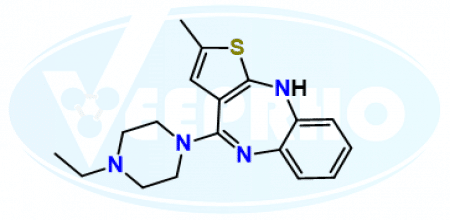 | Olanzapine Related Compound 03 | VL109004 |
| Olanzapine Related Compound 07 | VL109005 | |
 | Olanzapine Related Compound 08 | VL109006 |
| Olanzapine Related Compound C | VL109009 | |
| 2-Hydroxymethyl Olanzapine | VE0018343 |
Alle verwandten Produkte zeigen N-Nitroso-Olanzapine-Verunreinigungen (7)